About the NMO
NMO name | Rwanda Fraternity Against Hemophilia (RFH) |
Location | Kigali, Rwanda |
Founding date | 2014 |
PWBDs served | 146 |
Website |
Background
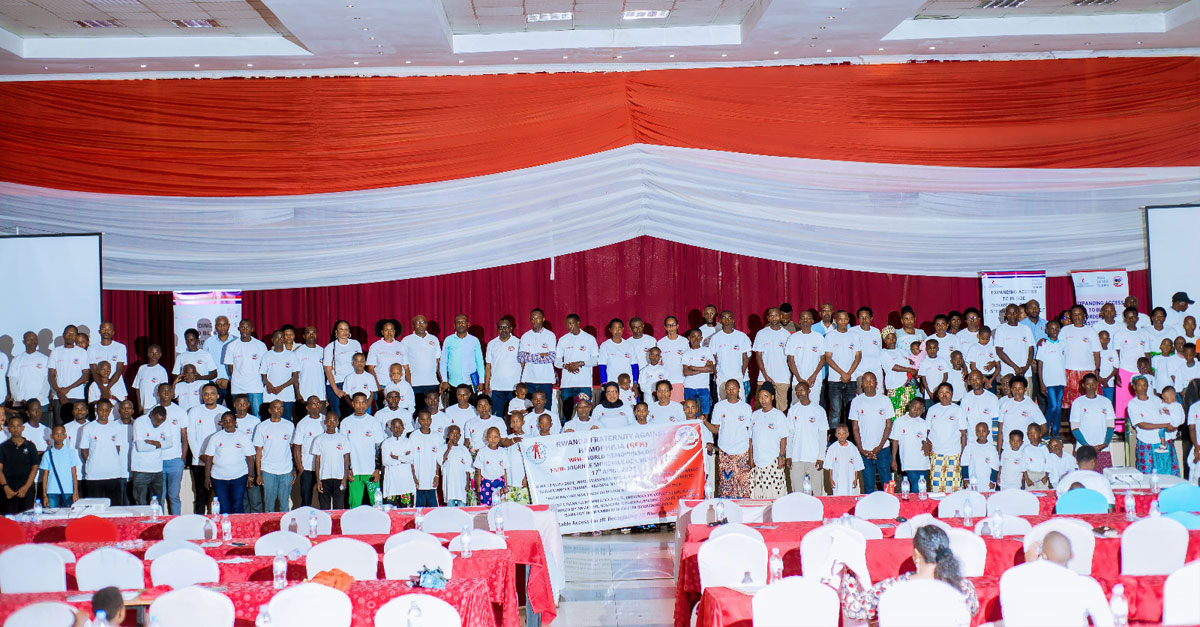
The Rwanda Fraternity Against Hemophilia (RFH) was founded in 2014 and currently has 264 members. Rwanda has been supported through several key WFH programs and initiatives in recent years, including the WFH Twinning Program, which supported a four-year partnership between the RFH and the Pays de la Loire regional chapter of Association française des hémophiles (AFH), the NMO in France; and a two-year collaboration between the Centre Hospitalier Universitaire de Kigali (CHUK) and the Centre de Traitement de l’Hémophilie du CHU de Nantes in France, to strengthen diagnosis and multidisciplinary care. The WFH Cornerstone Initiative was also successfully completed in Rwanda. Rwanda is also receiving support from the WFH Humanitarian Aid Program with over 13 million IUs of clotting factor concentrates donated since 2015.
Q&A with the NMO
What is the mission of your NMO?
The mission of the Rwanda Fraternity Against Hemophilia (RFH) is to improve the health and well-being of people living with hemophilia by strengthening healthcare capacity and collaborating with national and international partners to ensure sustainable access to treatment.
What services do you offer to your community?
We offer therapeutic education and awareness activities designed to improve understanding of hemophilia and inherited bleeding disorders among PWBDs and their families. These initiatives are part of broader efforts to strengthen community awareness and encourage earlier diagnosis and better management of bleeding disorders in Rwanda.
What are the challenges your NMO faces?
The RFH continues to face several important challenges, including low public awareness, the absence of a dedicated national policy on bleeding disorders, limited diagnostic capacity, and a shortage of physicians specializing in hemophilia. Delays in diagnosis also remain a significant issue. To address these gaps, the organization has carried out awareness activities in hospitals and communities, while also advocating with the Ministry of Health to improve early diagnosis and expand access to diagnostic equipment.
Why did your NMO join the WFH, and how has your experience been?
Since joining the WFH in 2019, we have benefited from treatment donations through the WFH Humanitarian Aid Program, and partnerships with other NMOs. WFH support in Rwanda has helped strengthen community awareness efforts, improve visibility nationally and internationally, and increase access to treatment products for patients with hemophilia.
Which WFH program has been the most impactful for your community?
Treatment products donated by the WFH Humanitarian Aid Program have had a huge impact on our community. Also, different WFH funding and awareness opportunities have made a big difference for us in Rwanda. Therefore, WFH supported us in strengthening organizational capacities and in training of the board members.These programs have contributed to improving treatment access and reducing complications among PWBDs.
How has your NMO changed improved care for PWBDs in your country?
Hemophilia is now recognized nationally as a non-communicable disease, and treatment availability has improved significantly in recent years. We have also helped establish a national patient registry and treatment guidelines, strengthening care systems for PWBDs across the country.
Have you been successful advocating with the government?
We have begun advocacy efforts with national authorities to encourage the development of policies to increase diagnosis, treatment and social protection for people with bleeding disorders. While some progress has been made, we need to continue our advocacy efforts to fully demonstrate to the government the importance of dedicated national policies for inherited bleeding disorders.
What was your main highlight/achievement of the last year?
One of the organization’s major accomplishments was the creation of a second hemophilia treatment centre (HTC) in southern Rwanda. The project was made possible through collaboration between international partners, our NMO, the host hospital, and the Ministry of Health via the Rwanda Biomedical Centre.
Would you like to highlight any of your team members?
Yes! Here is the story of James Ndahayo:
For more than thirty years, I lived with unexplained bleeding, severe pain, and frequent swelling without understanding the underlying cause. Growing up in Kigali, Rwanda, I often faced misunderstanding and stigma, as many people believed I was weak or cursed because I bruised easily and experienced prolonged bleeding episodes that sometimes left me unable to walk. As a husband and father of one son and two daughters, living without a diagnosis was both emotionally and physically challenging for me and my family.
My life changed significantly when I was finally diagnosed with hemophilia B at the age of thirty after receiving medical care at Kigali University Teaching Hospital. Through the support of the RFH and the WFH, I gained access to proper treatment. This support transformed my life by helping me manage bleeding episodes effectively.
I successfully completed my university studies in Computer Science and Systems, a journey that was difficult but achievable with determination and perseverance. Today, I work in a public institution as a System Administrator and IT professional, continuing to build a stable and productive life.
My experience demonstrates that with proper diagnosis, treatment, and community support, it is possible to overcome challenges and live a meaningful and hopeful life.
How do you envision the future of the bleeding disorder community in your country and globally?
The Rwanda Fraternity Against Hemophilia (RFH) envisions a future where people living with inherited bleeding disorders everywhere have easy and effective access to treatment and care.
Find out more about other NMOs
To read about the way the WFH and NMOs collaborate to make a difference in local bleeding disorders communities, please read “National member organizations: the heartbeat of the WFH” here.
To read more stories in this series, please click on one of the links below.
NMO | Country | Article |
Federação Brasileira de Hemofilia | Brazil | |
Asociación Costarricense de Hemofilia | Costa Rica | |
Fundación Apoyo al Hemofílico | Dominican Republic | |
The Haemophilia Society (THS) | U.K. | |
National Hemophilia Network of Japan | Japan | |
Kenya Haemophilia Association (KHA) | Kenya | |
Kyrgyz Hemophilia Society Community of Handicapped-Hemophiliacs of the Republic of Kyrgyzstan | Kyrgyzstan | |
Libyan Association for Hemophilia | Libya | |
Hemophilia Society of Malaysia | Malaysia | |
Haemophilia Association of Mauritius | Mauritius | |
Federación de Hemofilia de la República Mexicana | Mexico | |
Haemophilia Foundation of Nigeria (HFN) | Nigeria | |
Syrian Hemophilia Society | Syria | |
Haemophilia Society of Tanzania (HST) | Tanzania | |
Association Tunisienne de L’Hemophilie (ATH) | Tunisia | |
Haemophilia Foundation of Zambia (HFZ) | Zambia |