About the NMO
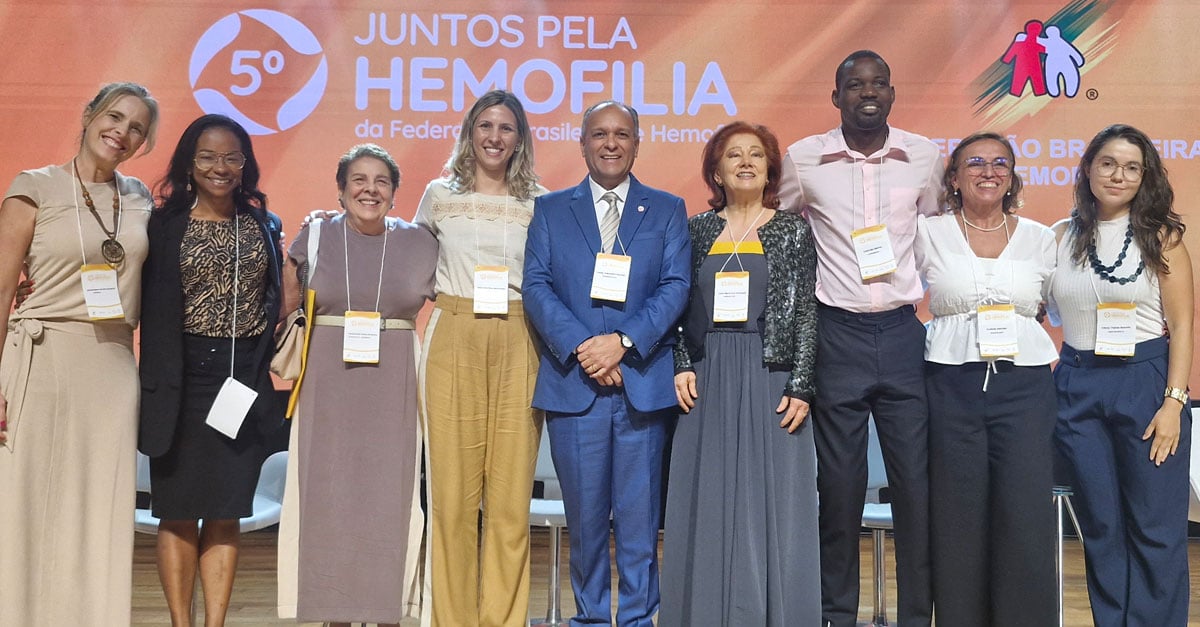
| NMO name | Federação Brasileira de Hemofilia |
| Location | Caxias do Sul, Brazil |
| Founding date | 1976 |
| PWBDs served | 32,556 |
| Website | hemofiliabrasil.org.br |
Q&A with the NMO
The following answers from the NMO have been edited for clarity.
What are your vision and mission?
Our mission is to advocate for the treatment of—and the improvement in the quality of life for—all people with hemophilia, von Willebrand and other inherited bleeding disorders in Brazil.
What services do you offer to your community?
We support our community with diagnosis, registering patients and the use of treatment products. We do this in 27 states, including in the interior of the country.
What are the challenges your NMO faces?
Our main challenges are improving policies with the Ministry of Health, ensuring our budget sustainability, and providing education for health professionals, state associations, patients, families, and the community. We’re trying to overcome these challenges by bringing the concerns of patients to decision makers as much as possible. We’re also working very closely with hemophilia treatment centres (HTCs) to hear their concerns and try to once again bring those concerns to governments.
Why did your NMO join the WFH?
Our founder recognized the need for a central point of reference to develop new leaders and guide efforts toward achieving safe and effective treatments. He saw the WFH as a way for us to achieve that goal. The WFH has been a great support for us, providing education, serving as a model for developing Brazil’s national policy for bleeding disorders care, and contributing to the education and training of healthcare professionals (HCPs).
How would you describe your experience collaborating with the WFH?
It has been a very rewarding experience. The WFH has played a fundamental role in giving us better visibility in society as a whole and with the government. This has helped us achieve adequate and personalized treatment for many PWBDs in Brazil. We see the WFH as our benchmark for the development of programs, educational materials, and treatment guides.
Which WFH programs have been the most impactful for your community?
For us, the WFH Path to Access to Care and Treatment (PACT) Program has been invaluable. It has helped us improve outreach and diagnosis and increase access to sustainable care for PWBDs in Brazil.
What was your main achievement in the last year?
We made significant progress last year, including securing a budget increase from 1.5 to 1.6 billion reals and ensuring the inclusion of non-factor replacement therapy for patients with inhibitors. This was done through collaboration with the Ministry of Health and the senate budget committee.
Our lessons learned over the last year include working hard to convince the government of the benefits of prophylactic care and encouraging community participation in public consultations to support the approval of new therapies and guidelines.
What progress have you made over the years?
From 2009 to 2024, we accomplished a lot. In 2009, a Federal Court report highlighted the need for prophylaxis to prevent sequelae, leading to sufficient budget allocation for treatments. Primary prophylaxis for children began in 2011, followed by secondary prophylaxis and immunotolerance in 2012, along with recombinant factor VIII technology transfer and increased home treatment. Improvements continued with safer medical tools in 2017, the inclusion of non-factor replacement therapy for refractory cases and long-acting factor VIII in 2019, and extended home dose supplies during the 2020 pandemic. By 2024, non-factor replacement therapy became available for all hemophilia A patients with inhibitors.
What advice can you give other NMOs?
You must understand your country’s healthcare system and familiarize yourself with the political landscape—and especially the government’s. Identifying the root causes of issues and pinpointing the most critical problems is key. Be sure to build alliances across all government and healthcare sectors. Be open to collaborating in the development of public health policies. And, of course, always be diplomatic when you work with people anywhere.
Find out more
To read about the way the WFH and NMOs collaborate to make a difference in local bleeding disorders communities, please read “National member organizations: the heartbeat of the WFH” here.
To read more stories in this series, please click on one of the links below.
| NMO | Article |
| Federación de Hemofilia de la República Mexicana (Mexico) | Click here |
| Asociación Costarricense de Hemofilia (Costa Rica) | Click here |
| Haemophilia Association of Mauritius | Click here |
| Syrian Hemophilia Society | Click here |
| National Hemophilia Network of Japan | Click here |
| Hemophilia Society of Malaysia (HSM) | Click here |
| Tunisian NMO, the Association Tunisienne de L’Hemophilie (ATH). | Click here |
| Kyrgyz Hemophilia Society Community of Handicapped-Hemophiliacs of the Republic of Kyrgyzstan | Click here |
| Libyan Association for Hemophilia | Click here |
* Disclaimer: This is an external website, and its content has not been developed nor endorsed by the WFH.