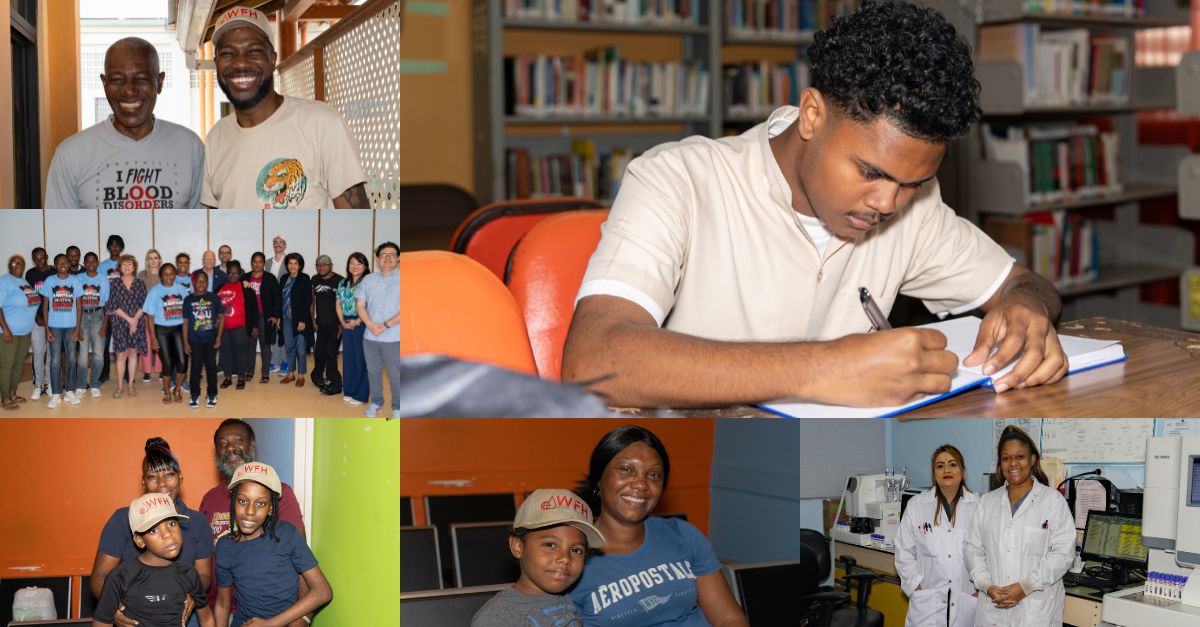
Before receiving donated treatment product for home infusion donated by the WFH Humanitarian Aid Program, Nikolai’s early years were marked by frequent bleeding episodes and repeated hospital visits—often late at night. His mother describes the strain: “So with Nikolai, he [was always] in the hospital. Three times, four times a week. And most of his bleeds were at night. So mostly 11 p.m., 12:00 a.m. we [were] leaving here and having to go to the hospital to get factor.” These disruptions also affected his education and daily life. “I was able to continue school, but it was very hard… I missed a lot of the sessions,” Nikolai says.
Access to consistent treatment has since transformed his quality of life. “Since I [started getting] treatment at home… it has made a major improvement in my life. Because I used to have to go to the hospital every single day… It has overall helped me to further reduce the amount of bleeds in my body.”
[Hemophilia is] no longer life sentence. And the future is bright.
—Adena, the mother of Nikolai, a young man with hemophilia B
The WFH has provided support to Trinidad and Tobago through programs designed to help the country provide sustainable care to its inherited bleeding disorders community. Currently, there is a Hemophilia Organization Twinning (HOT) between the Society for Inherited and Severe Blood Disorders of Trinidad and Tobago and the Canadian Hemophilia Society (CHS), and a Hemophilia Treatment Centre (HTC) Twinning between the Eric Williams Medical Sciences Complex in Trinidad and Tobago and the Hospital for Sick Children (SickKids) in Toronto, Canada. Additionally, the WFH Humanitarian Aid Program has played a pivotal role in the country, by offering training support and donated treatment products. The results have been life-changing: people with bleeding disorders now have a chance of a near-normal life, without the threat of acute bleeds.
Consultant hematologist Shivir Moosai, MD, notes that organizations like the WFH play a critical role in overcoming barriers to access, helping ensure patients receive the treatments they need. Having recently returned to Trinidad after practising in the United Kingdom, he highlights both the challenges and strengths of the local healthcare system. “Now some of the differences in Trinidad compared to the U.K. is we may not have every test available or every treatment available [here],” he explains.
The contrast in the level of care before and after access to support is especially evident in the experience of Mikhail, Nikolai’s younger brother, who benefited from earlier diagnosis. Unlike Nikolai, Mikhail was able to receive factor therapy at home from the start, allowing him to live a far more active and unrestricted childhood. He can play sports, run freely, and participate in everyday activities without the same fear of an acute bleed.
For the inherited bleeding disorders community in Trinidad and Tobago, the experiences of Nikolai and Mikhail reflect the progress made in care—demonstrating how early diagnosis and consistent treatment can give children with hemophilia the opportunity to live more normal, independent lives.
The WFH Humanitarian Aid Program has donated over 8.3 million IUs of factor to Trinidad and Tobago since 2015. Almost 1.4 million IUs of factor were donated in 2025 alone. To find out more about the Program, please click here.
About the WFH Humanitarian Aid Program
The WFH Humanitarian Aid Program improves the lack of access to care and treatment by providing much-needed support for people with inherited bleeding disorders in developing countries. By providing patients with a more predictable and sustainable flow of humanitarian aid donations, the WFH Humanitarian Aid Program makes it possible for patients to receive consistent and reliable access to treatment and care. None of this would be possible without the generous support of Sanofi and Sobi, our Founding Visionary Contributors; Bayer, CSL Behring and Roche, our Visionary Contributors; Grifols, our Leadership Contributor; and Takeda, our Contributor. To learn more about the WFH Humanitarian Aid Program, visit www.treatmentforall.org.