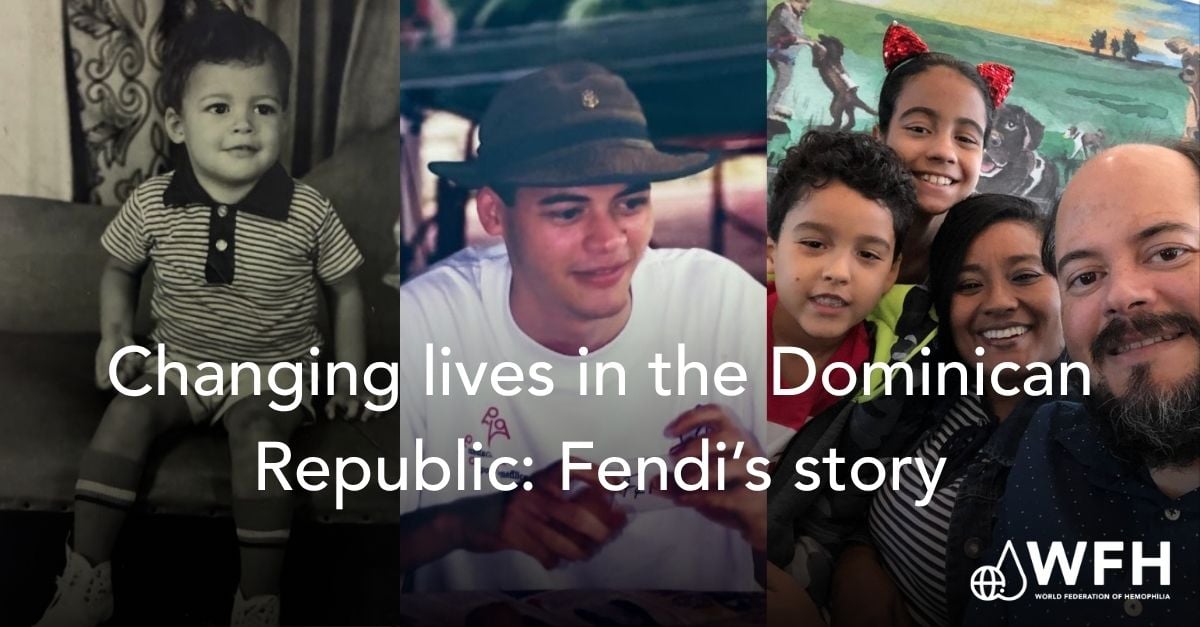
Changing lives in the Dominican Republic: Fendi’s story

Changing lives in the Dominican Republic: Fendi’s story

Fendi Valdez was only three months old when his family first noticed something was wrong: a large hematoma appeared on his body. At the time, few healthcare professionals in the Dominican Republic knew about hemophilia, making diagnosis difficult. Even when the right diagnosis was made, treatment remained largely unavailable. Factor concentrate was expensive and difficult to obtain. To make treatment last longer, Fendi sometimes used less than the recommended dose. As a result of his limited care, he experienced frequent bleeding episodes, missed school, spent time in hospital, and developed severe damage in both knees. It wasn’t until Fendi began receiving donated factor provided by the World Federation of Hemophilia (WFH) Humanitarian Aid Program that he found hope for a better life.

Also available in: Français Español

Through the WFH Humanitarian Aid Program, people with bleeding disorders in emerging countries gain access to life changing treatment, while healthcare professionals receive the training and support they need to strengthen care. In the Dominican Republic, access to treatment and comprehensive care has improved significantly over the last several years, giving more people with bleeding disorders the opportunity to live healthier, more active lives.

From crutches to daily walks

For Fendi, the impact of access to proper care was life changing. Thanks to donated treatment products, he was able to undergo total knee replacement surgery in both joints. “My life changed completely,” he says. “Now I can go to work, go to the beach, go to the park, go to the cinema, and spend time with my family.”  Today, he enjoys cooking, swimming, and spending time outdoors—activities that were once difficult or impossible for him to do because of pain and reduced mobility.

Giving back to the community

In 2000, Fendi attended a WFH workshop in Costa Rica. For the first time, he met people with bleeding disorders from other countries who had access to regular treatment and specialized care. The experience changed his perspective. “I saw that people with hemophilia in other countries had a better life. And I thought, maybe in the Dominican Republic we can get treatment for everyone too.”  The workshop marked the beginning of Fendi’s long relationship with WFH, and strengthened his commitment to improving care for others living with bleeding disorders.

The [WFH Humanitarian Aid Program] saved my life. And it has saved the lives of many other people in our country.

— Fendi Valdez, President of the Fundación Apoyo al Hemofílico (FAHEM)

Today, Fendi serves as President of the Fundación Apoyo al Hemofílico (FAHEM), the WFH NMO in the Dominican Republic. He works with healthcare professionals, government stakeholders, and the WFH to improve diagnosis, expand access to treatment, and strengthen care nationwide. Fendi has witnessed firsthand how humanitarian aid changes lives. Through WFH programs and partnerships, more patients have gained access to treatment, healthcare professionals have received specialized training, and families have access to more support than ever before. For Fendi, humanitarian aid is more than treatment—it is a bridge to a stronger future: “If I do not have treatment in my refrigerator, my whole family notices. When it is there, we all feel more comfortable.”

 Through the generosity of our donors and sponsors, the WFH is not just providing medication to people with bleeding disorders, it’s building care infrastructure, training healthcare professionals, and empowering communities. Fendi’s story is a powerful reminder that your generosity and compassion changes lives. Your donations ensure that the WFH can continue this critical work across the globe. To give today and help more families access life-changing care, click here.


We’ve accomplished a lot this year, we need your help to continue strong.

Would you like to read more about similar articles?

Disclaimer

The information on the WFH website is provided for general information purposes only. The WFH does not engage in the practice of medicine and under no circumstances recommends particular treatment for specific individuals. For diagnosis or consultation on a specific medical problem, the WFH recommends that you contact your physician or local treatment centre. Before administering any products, the WFH urges patients to check dosages with a physician or hemophilia centre staff, and to consult the pharmaceutical company’s printed instructions.

While every effort has been made to ensure the accuracy of the information on this site, the WFH does not guarantee the information is accurate, and is not responsible in any way whatsoever for damages arising out of the use of this website or any of the information contained herein.

Messages posted to WFH discussion forums, Facebook, Twitter, and other social media platforms do not represent the opinions of the World Federation of Hemophilia, its staff, or Board of Directors. The author of a message is solely responsibility for its content. Information posted on WFH social networks and platforms should never be a substitute for individualized professional medical advice, even when the author has medical qualifications or is considered an authority. Information posted to a discussion group should not be used to diagnose or treat a specific health problem without consulting a qualified healthcare professional. The WFH recommends that you contact your physician or local treatment centre if you have any individual questions or concerns.

References and links to other websites or references to other organizations, products, services, or publications do not constitute endorsement or approval by the WFH. The WFH is not responsible and assumes no liability for the content of any linked websites.

Fraud Alert

Unauthorized solicitations – Warning

The WFH has been made aware of various correspondences—circulated via e-mail and telephone—coming from individuals impersonating WFH staff or falsely stating that they are associated with the WFH. These correspondences, which may seek to obtain money using the name of someone affiliated with the WFH, are fraudulent and come from outside of our organization.

If you receive a suspicious solicitation, exercise extreme caution. In the case of an email, look at the email address to see if it looks suspicious (for example, all WFH emails come from @wfh.org).

We are asking you to remain vigilant, and if you have any doubts about the correspondence, please forward the email to the WFH at [email protected] or call +1 514-875-7944.