À propos
Actions
Données et outils
Évenements
Actualités
news-plenary-gene-therapy-may10

Plenary: Gene therapy – are we ready now?

Hemophilia therapy has evolved from rudimentary transfusion-based approaches to an unprecedented level of innovation with the potential of a functional cure brought by gene therapy.

Aussi disponible en : English Español

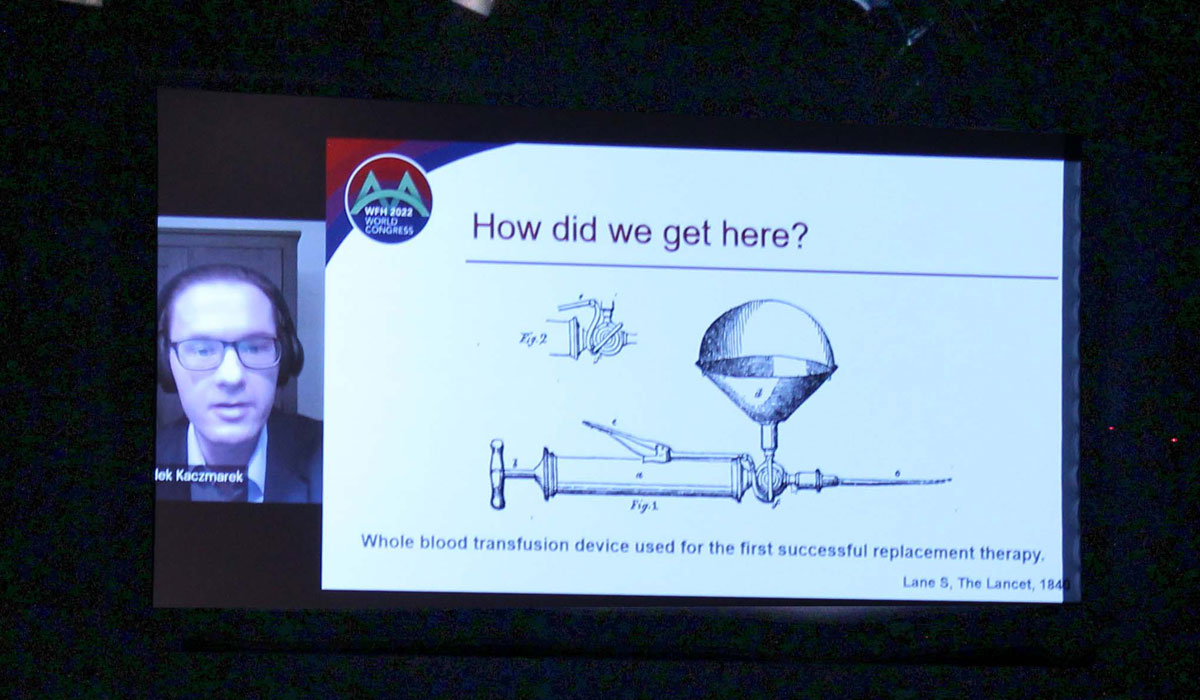
At the WFH 2022 World Congress in Montreal, Canada, the plenary “Gene therapy – are we ready now?” looked at what our prospects are with this exciting new medical avenue. The event’s speaker was Radek Kaczmarek, Postdoctoral Research Associate, Gene and Cell Therapy Group, Wells Center for Pediatric Research, Indiana University School of Medicine, U.S.A, and WFH Coagulation Product Safety, Supply, and Access (CPSSA) Committee chair (Poland/U.S.A.).


Kaczmarek covered a brief history of hemophilia treatment, from whole blood and plasma treatment, to cryoprecipitate, non-factor products, and gene therapy. He said the questions we must ask ourselves about gene therapy revolve around variability, reliability, durability, tolerability, and visibility (transparency). Kaczmarek also covered core outcomes, such as frequency of bleeds, factor activity level, duration of expression, chronic pain, utilization of the healthcare system, and the mental health of the patient.


The advance of gene therapies toward commercialization has outpaced our fundamental biological understanding of AAV gene transfer in humans. The issues that now need more attention are pre-existing immunity, immune responses, and immunosuppression; degradation of AAV capsid load; unfolded protein response (FVIII); poor transduction efficiency (necessitates high vector doses); data sharing; vector integration; standardization of assay; and reducing uncertainty.


Collaboration is critical to a successful outcome for gene therapy, says Kaczmarek, which is why it’s significant that a core outcome data set to facilitate the lifelong monitoring of safety, efficacy, and durability outcomes has been agreed upon and used to develop the WFH Gene Therapy Registry by the WFH in collaboration with ISTH SSC, EHC, NHF, ATHN, industry partners and regulatory partners.


A big question: does the state of the art match the dream? Kaczmarek says it might, but several patient subgroups miss out, such as females, children, inhibitors, people with pre-existing immunity, those who are geographically disadvantaged, etc. All of this presents a unique challenge for healthcare practitioners (HCPs) who will be introducing and delivering it to the patients.

WFH 2022 World Congress

May 8 to 11, 2022

We’ve accomplished a lot this year, we need your help to continue strong.

Would you like to read more about similar articles?

Disclaimer

The information on the WFH website is provided for general information purposes only. The WFH does not engage in the practice of medicine and under no circumstances recommends particular treatment for specific individuals. For diagnosis or consultation on a specific medical problem, the WFH recommends that you contact your physician or local treatment centre. Before administering any products, the WFH urges patients to check dosages with a physician or hemophilia centre staff, and to consult the pharmaceutical company’s printed instructions.

While every effort has been made to ensure the accuracy of the information on this site, the WFH does not guarantee the information is accurate, and is not responsible in any way whatsoever for damages arising out of the use of this website or any of the information contained herein.

Messages posted to WFH discussion forums, Facebook, Twitter, and other social media platforms do not represent the opinions of the World Federation of Hemophilia, its staff, or Board of Directors. The author of a message is solely responsibility for its content. Information posted on WFH social networks and platforms should never be a substitute for individualized professional medical advice, even when the author has medical qualifications or is considered an authority. Information posted to a discussion group should not be used to diagnose or treat a specific health problem without consulting a qualified healthcare professional. The WFH recommends that you contact your physician or local treatment centre if you have any individual questions or concerns.

References and links to other websites or references to other organizations, products, services, or publications do not constitute endorsement or approval by the WFH. The WFH is not responsible and assumes no liability for the content of any linked websites.

Fraud Alert

Unauthorized solicitations – Warning

The WFH has been made aware of various correspondences—circulated via e-mail and telephone—coming from individuals impersonating WFH staff or falsely stating that they are associated with the WFH. These correspondences, which may seek to obtain money using the name of someone affiliated with the WFH, are fraudulent and come from outside of our organization.

If you receive a suspicious solicitation, exercise extreme caution. In the case of an email, look at the email address to see if it looks suspicious (for example, all WFH emails come from @wfh.org).

We are asking you to remain vigilant, and if you have any doubts about the correspondence, please forward the email to the WFH at [email protected] or call +1 514-875-7944.