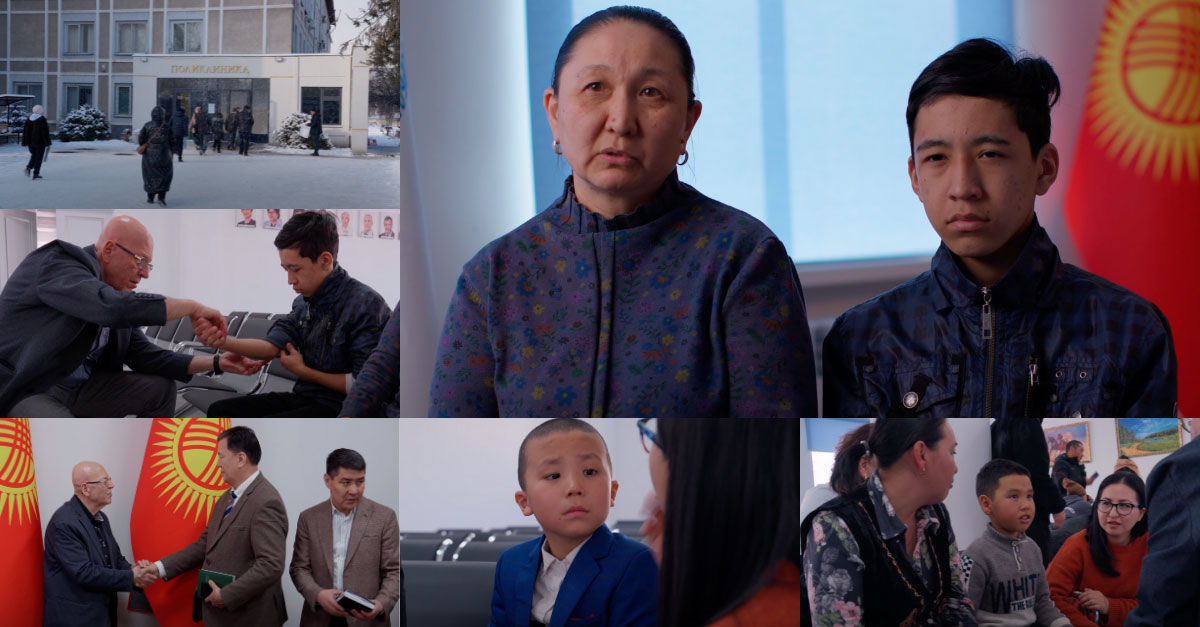
“This week we were in Bishkek, where we visited the treatment facilities,” said Assad Haffar, MD, Director, Humanitarian Aid and Medical Training, WFH. “Comparing this visit to [the first visit in 2019], we can see a lot of improvement, a lot of new things that have been developed in both [the adult and pediatric hospitals] in terms of diagnosis, in terms of management of hemophilia, and in terms of the staff experience, and the confidence of the medical professionals when they deal with bleeding disorders.”
Before the WFH and the WFH Humanitarian Aid Program began collaborating with healthcare professionals and the Kyrgyz Hemophilia Society, the national member organization (NMO) in the country, the situation was very difficult for the local inherited bleeding disorders community. Akmaral, the mother of Akynoos, a boy with hemophilia, recalls that her son would have frequent bleeds when he was younger. Now, things are better. “Thanks to the WFH Humanitarian Aid Program, he now has good joint health,” she explains. “So, thanks to this humanitarian aid, we… have [less] stress now.” Akynoos himself affirms the change that access to treatment has brought to his life: “I feel good thanks to [the treatment products]. I feel better now than I did in childhood… and I feel stronger.”
We constantly try to convey the voice of patients to the authorities, to the state, to the Ministry of Health … in recent years, they have started to hear us. Many problems have begun to be resolved.
—Ilzat Gapparov, Vice President, Kyrgyz Hemophilia Society,
The WFH has supported the NMO with advocacy advice—a key reason why so many improvements in care have been possible. Ilzat Gapparov, Vice President, Kyrgyz Hemophilia Society, says that learnings have helped the NMO make progress with decision-makers: “We constantly try to convey the voice of patients to the authorities, to the state, to the Ministry of Health … in recent years, they have started to hear us. Many problems have begun to be resolved, [such as] issues with diagnostics, physiotherapy, rehabilitation.”
WFH Regional Manager Karine Kocharian explains the best approach for an effective advocacy campaign: “What was very important from the beginning was to help the organization to develop their relationships with the government, and to [work] with them in order to make long term changes in the health care system, so that people in all the regions have access to treatment.”
Looking ahead, Akynoos is optimistic: “I think my future will be wonderful. Things will be better than before. And I don’t think my hemophilia will prevent me from achieving any success or anything else.”
The WFH is present in Kyrgyzstan through the WFH Humanitarian Aid Program, and other endeavours such as a WFH Youth Twinning, the WFH GAP Program—the predecessor to the WFH Path to Access to Care and Treatment (PACT) Program—and a WFH country program.
This is the final article in a three-part series on improving care for PWBDs in Kyrgyzstan. To read the first article, “Access to treatment improves levels of care in Kyrgyzstan”, click here. To read the second article, “WFH brings new hope to people with hemophilia in Kyrgyzstan”, click here. To read about the Kyrgyz Hemophilia Society, the NMO, click here.
Over 5 million IUs of factor were donated to Kyrgyzstan through the WFH Humanitarian Aid Program in 2024. Since 2015, over 37 million IUs of factor have been donated to the country. To find out more about the WFH Humanitarian Program, please click here.
About the WFH Humanitarian Aid Program
The WFH Humanitarian Aid Program improves the lack of access to care and treatment by providing much-needed support for people with inherited bleeding disorders in developing countries. By providing patients with a more predictable and sustainable flow of humanitarian aid donations, the WFH Humanitarian Aid Program makes it possible for patients to receive consistent and reliable access to treatment and care. None of this would be possible without the generous support of Sanofi and Sobi, our Founding Visionary Contributors; Bayer, CSL Behring and Roche, our Visionary Contributors; Grifols, our Leadership Contributor; and Takeda, our Contributor. To learn more about the WFH Humanitarian Aid Program, visit www.treatmentforall.org.