WFH initiatives in Kyrgyzstan include training and donated product support through the WFH Humanitarian Program; ongoing collaboration with the Kyrgyz Hemophilia Society Community of Handicapped-Hemophiliacs of the Republic of Kyrgyzstan (the WFH national member organization [NMO]); a WFH Youth Twinning Project with Federazione delle Associazioni Emofilici Onlus (Italy); the WFH GAP Program until 2022 (the predecessor of the WFH Path to Access to Care and Treatment (PACT) Program); and a WFH country program.
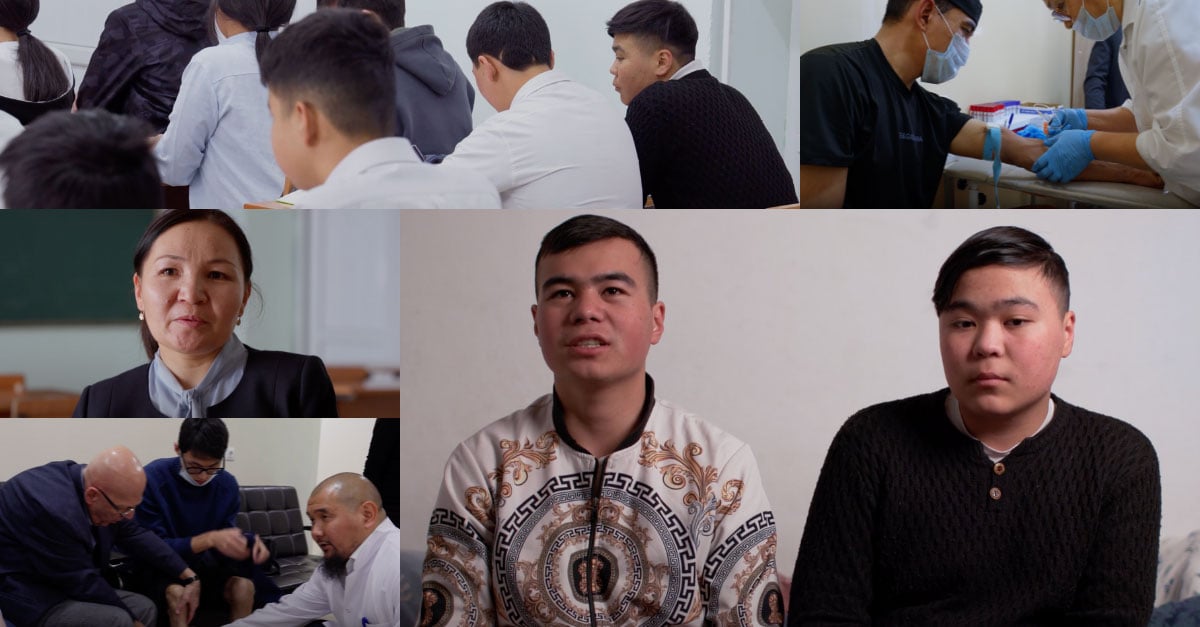
Access to proper medical treatment was lacking in Kyrgyzstan for many years—making life very difficult for the community of PWBDs. For brothers Syimyk and Bekbolsun, a hemophilia A diagnosis brought significant challenges, including frequent hospital stays and disruptions to their education. “When they tested me, it turned out that I had hemophilia A. Because of the condition, I missed a lot of classes,” Syimyk recalled. The lack of consistent medical treatment forced them to stay in hospitals for extended periods, affecting their quality of life.
Nurbek Rozaliev, President of the Kyrgyz Hemophilia Society, shared his own experience growing up with the condition. He explained that when he was a child, he didn’t have adequate treatment. “There was no treatment at all,” he said, frankly. Acute bleeds often resulted in prolonged hospital stays, sometimes lasting months. This was a typical experience for him, for the Syimyk and Bekbolsun brothers—and, sadly, for the majority of PWBDs in the country.
When we joined the WFH, proper advocacy for hemophilia patients began. Thanks to the state and the WFH, our patient mortality rate significantly decreased, and the need for hospital admissions was also reduced. If it weren’t for the WFH, we wouldn’t be at the level we are now.
—Timur Narbekov, MD, hematologist
Timur Narbekov, MD, a hematologist, highlighted the transformative role of the WFH. He explained that patient mortality rates—as well as the need for hospital admissions—significantly decreased when his hemophilia treatment centre (HTC) started working with the WFH. Until 2008, Kyrgyz hemophilia patients relied on fresh frozen plasma and cryoprecipitate, which were insufficient to manage hemophilia effectively. Today, due to access to better and higher quantities of treatment products—donated by the WFH Humanitarian Aid Program—many patients can self-administer treatment at home and avoid frequent hospital visits.
For Syimyk and Bekbolsun, access to treatment has dramatically improved their daily lives. “Now that there is enough medicine, people like us don’t get sick like we used to. We take preventive measures every two or three days and go to school like everyone else,” they said.
Rozaliev expressed optimism about the future of hemophilia patients in Kyrgyzstan, emphasizing that access to care has given young patients new opportunities. Narbekov extended his gratitude to the WFH for its continued support which is helping to ensure that patients receive the care they need to enjoy a better quality of life.
Over 5 million IUs of factor were donated to Kyrgyzstan through the WFH Humanitarian Aid Program in 2024. Since 2015, over 37 million IUs of factor have been donated to the country.
To find out more about the WFH Humanitarian Program, please click here. To read about the Kyrgyz Hemophilia Society Community of Handicapped-Hemophiliacs of the Republic of Kyrgyzstan, the NMO in Kyrgyzstan, click here.
About the WFH Humanitarian Aid Program
The WFH Humanitarian Aid Program improves the lack of access to care and treatment by providing much-needed support for people with inherited bleeding disorders in developing countries. By providing patients with a more predictable and sustainable flow of humanitarian aid donations, the WFH Humanitarian Aid Program makes it possible for patients to receive consistent and reliable access to treatment and care. None of this would be possible without the generous support of Sanofi and Sobi, our Founding Visionary Contributors; Bayer, CSL Behring and Roche, our Visionary Contributors; Grifols, our Leadership Contributor; and Takeda, our Contributor. To learn more about the WFH Humanitarian Aid Program, visit www.treatmentforall.org.