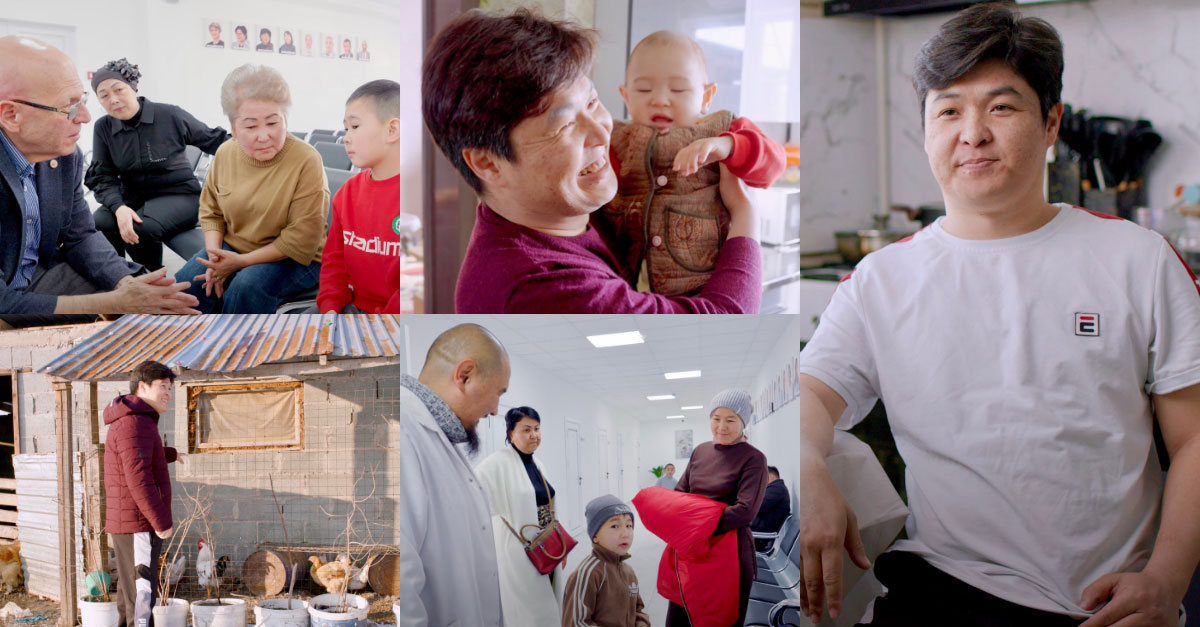
“After the fourth grade, I couldn’t walk anymore, so I was homeschooled. When I was about sixteen or seventeen, I was very stressed and depressed,” Askat explains. “I started to beat myself up, thinking I wouldn’t be good enough to do anything. If I hadn’t started receiving medicine, my life wouldn’t have changed.”
Thanks to the World Federation of Hemophilia (WFH), that change did come. Through the WFH Humanitarian Aid Program, the federation has supplied critical donated treatment products to hemophilia treatment centres (HTCs) in the country, and provided training and support to healthcare professionals and national member organization (NMO) leaders. The federation has also been active in the country through several other efforts, such as a WFH Youth Twinning Project with the Federazione delle Associazioni Emofilici Onlus (Italy); the WFH GAP Program until 2022 (the predecessor of the WFH Path to Access to Care and Treatment (PACT) Program); and a WFH country program.
Before the intervention of the World Federation of Hemophilia, the situation in Kyrgyzstan was dire. “There was no cryoprecipitate, no fresh frozen plasma. Patients came into the hospital with terrible pain, and they had to just lay there and wait,” said Meeri Eralieva, MD, of the National Centre of Hematology in Bishkek. “The quality of life for patients has improved every year [since the WFH Humanitarian Aid Program started providing donations]. Thanks to the WFH, we learned that life can be different. You can do something, strive for something.”
Joint replacement surgeries are now being performed for the first time in the country. Many patients have transitioned to home therapy and prophylactic treatment, reducing their pain and the frequency of their hospital visits.
Our organization and the WFH have become a good team. There are many active members in the society who have been trained by the WFH and are now leading advocacy efforts in our country.
— Ilzat Gapparov, Vice President of the Kyrgyz Hemophilia Society Community of Handicapped-Hemophiliacs of the Republic of Kyrgyzstan (the NMO in Kyrgyzstan)
Today, Askat raises chickens, enjoys time with his wife and two children, and lives without constant fear. “I am grateful to the WFH for investing so [many resources] for us…for putting in so much effort for our cause and spending so much time to come to Kyrgyzstan and support us.”
Over 5 million IUs of factor were donated to Kyrgyzstan through the WFH Humanitarian Aid Program in 2024. Since 2015, over 37 million IUs of factor have been donated to the country.
To find out more about the WFH Humanitarian Program, please click here. To watch the first video in this series on Kyrgyzstan, click here. To read about the Kyrgyz NMO, click here.
About the WFH Humanitarian Aid Program
The WFH Humanitarian Aid Program improves the lack of access to care and treatment by providing much-needed support for people with inherited bleeding disorders in developing countries. By providing patients with a more predictable and sustainable flow of humanitarian aid donations, the WFH Humanitarian Aid Program makes it possible for patients to receive consistent and reliable access to treatment and care. None of this would be possible without the generous support of Sanofi and Sobi, our Founding Visionary Contributors; Bayer, CSL Behring and Roche, our Visionary Contributors; Grifols, our Leadership Contributor; and Takeda, our Contributor. To learn more about the WFH Humanitarian Aid Program, visit www.treatmentforall.org.