Acerca de
Nuestra Labor
Datos y herramientas
Eventos
Noticias
news-health-issues-women-girls-may9

Health issues in women and girls affected by hemophilia

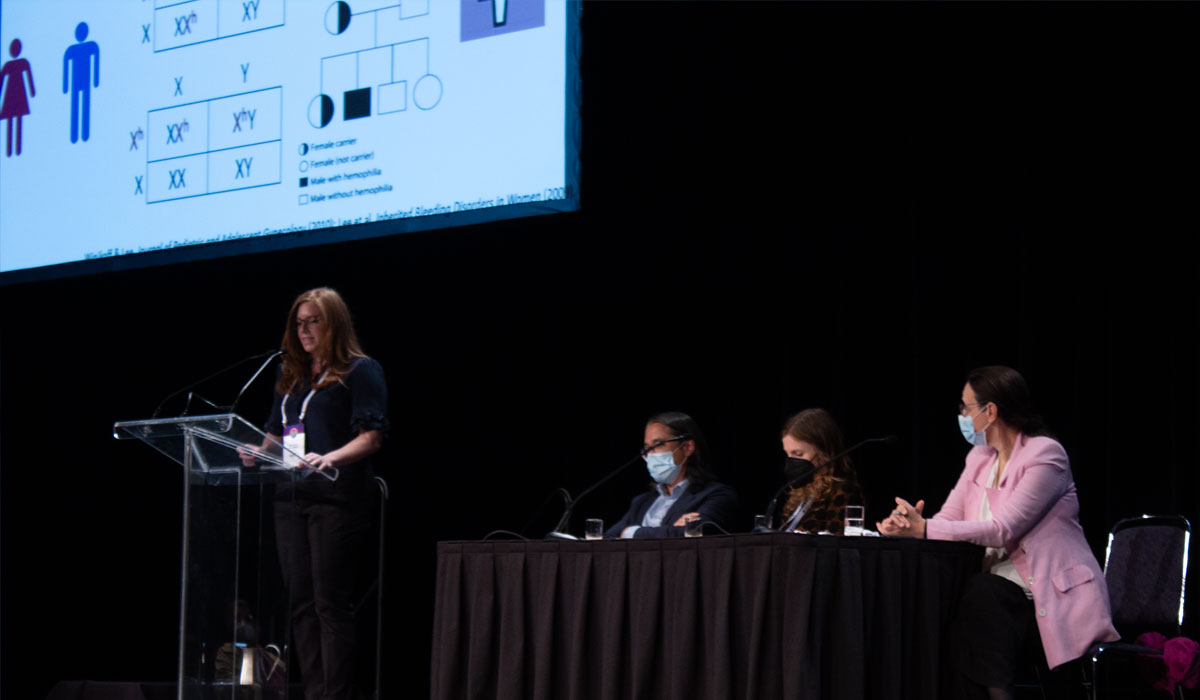
The session, “Health issues in women and girls affected by hemophilia with a focus on nomenclature, heavy menstrual bleeding, and musculoskeletal issues” was held today at the WFH 2022 World Congress in Montreal, Canada. Chaired by Roseline d’Oiron, Director at the Reference Centre for Haemophilia and Congenital Bleeding Disorders, University Paris Saclay, Paris, France, the event covered how women and girls are affected by hemophilia, and how hemophilia carriers are at risk of bleeding symptoms that may go unrecognized, including heavy menstrual bleeding (HMB) and musculoskeletal bleeding.

También disponible en: English Français

Robert Sidonio Jr., Pediatric Hematologist at Aflac Cancer and Blood Disorders, U.S.A. gave a talk called, “Nomenclature for women with hemophilia/hemophilia carriers”. He said that about 1 out of every 5 people with mild hemophilia are female, and that hemophilia carriers have an increased clinically relevant bleeding tendency. The kinds of bleeding that one can expect to see in carriers are related to tooth extraction, surgery, delivery, hemarthrosis, menorrhagia, and epistaxis. 

Angela Wayand, Assistant Professor at the Department of Pediatrics, University of Michigan, U.S.A, covered heavy menstrual bleeding (HMB) and iron deficiency in her presentation “Menstrual bleeding – iron deficiency”. She said that heavy menstrual bleeding is common in women and girls with hemophilia (WGH). HMB is associated with significant negative effects on quality of life. Iron deficiency with and without anemia is common in those with HMB. Optimal treatment requires menstrual suppression as well as iron repletion. He proposes new terminology to improve communication. The terminology and conceptual framework would be for the categorization of hemophilia A/B carriers accounting for personal bleeding history, genetic determinants and baseline factor level which will ultimately improve communication. He also recommends a focus on trial designs that accommodate those with mild hemophilia; the development of trials that allow women of reproductive age to participate easier; the development of tools using X-linked chromosome inactivation testing to predict levels and bleeding; and large-scale natural history studies with genotype, phenotype and QOL data.

“Joint health” was delivered by Michelle Sholzberg, Assistant Professor at the Department of Medicine at Unity Health Toronto, St. Michael’s Hospital, Canada. She began by saying that carriers classically have been thought to have limited (if any) bleeding symptoms. However, hemophilia carriers have higher bleeding scores compared to age-matched controls. They also have decreased joint range of motion compared to normal controls, evidence of structural damage in joints, and are at greater risk of low bone mineral density (BMD) and osteoporosis. In terms of understanding the lived experiences and exploring barriers to care, Sholzberg said that WGH feel like they are not being taken seriously and have a negative impression of the healthcare system. She went on to say that given recent evidence of musculoskeletal bleeding in women with and carriers of hemophilia, it is hypothesized that they may also be at risk for poor bone health. Sholzberg finished by stating that future approaches to better understand musculoskeletal health in women with—and carriers of—hemophilia should revolve around building the evidence and international collaboration.

WFH 2022 World Congress

May 8 to 11, 2022

We’ve accomplished a lot this year, we need your help to continue strong.

Would you like to read more about similar articles?

Disclaimer

The information on the WFH website is provided for general information purposes only. The WFH does not engage in the practice of medicine and under no circumstances recommends particular treatment for specific individuals. For diagnosis or consultation on a specific medical problem, the WFH recommends that you contact your physician or local treatment centre. Before administering any products, the WFH urges patients to check dosages with a physician or hemophilia centre staff, and to consult the pharmaceutical company’s printed instructions.

While every effort has been made to ensure the accuracy of the information on this site, the WFH does not guarantee the information is accurate, and is not responsible in any way whatsoever for damages arising out of the use of this website or any of the information contained herein.

Messages posted to WFH discussion forums, Facebook, Twitter, and other social media platforms do not represent the opinions of the World Federation of Hemophilia, its staff, or Board of Directors. The author of a message is solely responsibility for its content. Information posted on WFH social networks and platforms should never be a substitute for individualized professional medical advice, even when the author has medical qualifications or is considered an authority. Information posted to a discussion group should not be used to diagnose or treat a specific health problem without consulting a qualified healthcare professional. The WFH recommends that you contact your physician or local treatment centre if you have any individual questions or concerns.

References and links to other websites or references to other organizations, products, services, or publications do not constitute endorsement or approval by the WFH. The WFH is not responsible and assumes no liability for the content of any linked websites.

Fraud Alert

Unauthorized solicitations – Warning

The WFH has been made aware of various correspondences—circulated via e-mail and telephone—coming from individuals impersonating WFH staff or falsely stating that they are associated with the WFH. These correspondences, which may seek to obtain money using the name of someone affiliated with the WFH, are fraudulent and come from outside of our organization.

If you receive a suspicious solicitation, exercise extreme caution. In the case of an email, look at the email address to see if it looks suspicious (for example, all WFH emails come from @wfh.org).

We are asking you to remain vigilant, and if you have any doubts about the correspondence, please forward the email to the WFH at [email protected] or call +1 514-875-7944.