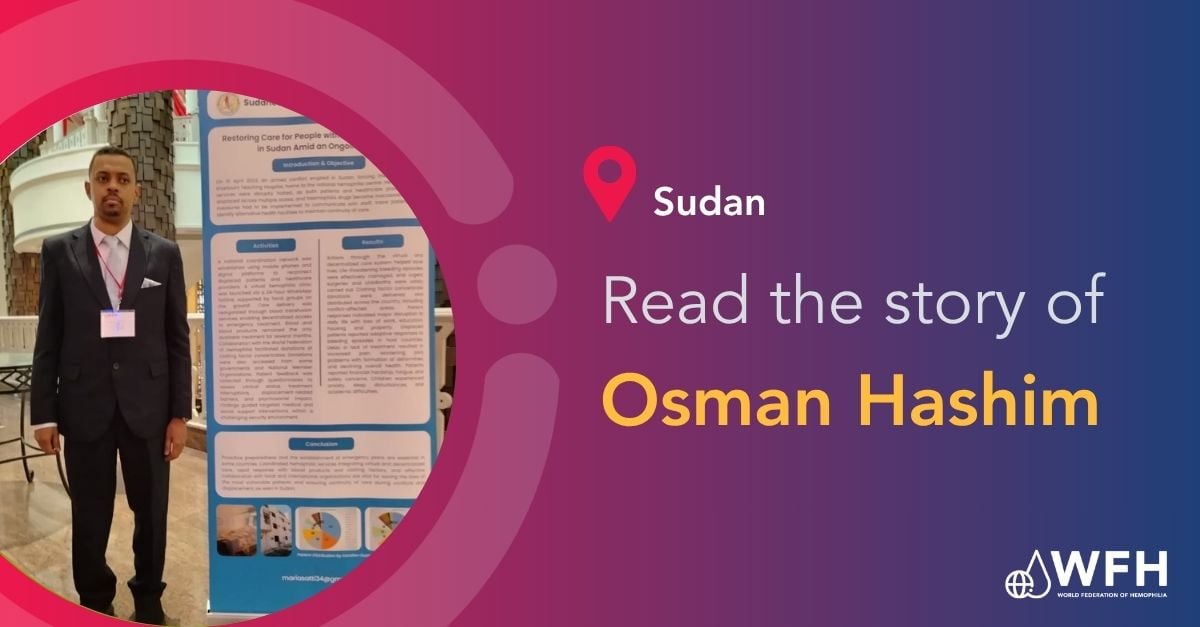
Osman Hashim is a researcher who recently participated in the WFH 2026 World Congress in Kuala Lumpur where he presented a poster. Here is the story he recently shared with the WFH.
From pain to hope: my journey with hemophilia and war
My name is Osman Hashim. I live with Hemophilia B in Sudan—not only as a person with a bleeding disorder (PWBD), but also as a pharmacist and an advocate with the Sudanese Hemophilia Care Association (SHCA).
When war broke out in Sudan on April 15, 2023, my life changed overnight. Like many others, I was displaced multiple times. But as a person with hemophilia, displacement meant more than losing a home—it meant losing access to lifesaving treatment. The hemophilia centre I relied on was destroyed, and with it, access to clotting factor.
In 2024, I noticed a growing swelling on the left side of my back. It was not just painful—it was frightening. I knew I needed surgery. But without factor IX, surgery was not just risky—it was potentially fatal.
At that moment, the reality of being a PWBD in a conflict zone became painfully clear: my survival was uncertain because treatment didn’t exist.
Fortunately, through the WFH Humanitarian Aid Program, I received the factor IX I needed. That support made it possible for me to travel to Egypt and safely undergo surgery. The diagnosis was a deep benign fibrous histiocytoma.
That moment changed everything.
It was more than a successful surgery—it was a reminder that access to care can mean the difference between life and death. It transformed my experience from one of fear and uncertainty into one of hope and purpose.
In 2026, I carried this story with me to the WFH 2026 World Congress in Kuala Lumpur, where I presented my poster titled: “Restoring Care for People with Bleeding Disorders in Sudan Amid an Ongoing War.”
My journey is not only my own. It reflects the reality of many PWBDs in Sudan and other crisis settings—where treatment exists, but access does not.
Today, I continue to advocate not just for emergency support, but for sustainable, equitable healthcare systems—because no PWBD should have to rely on luck, conflict, or geography to survive.
My journey is a testament to what is possible when care reaches those who need it most—and a call to ensure that no one is left behind.
The WFH is active in Sudan through several endeavours, including the World Bleeding Disorders Registry (WBDR); a policy dialogue with the Ministry of Health; training support to the national member organization (NMO) and healthcare professionals to strengthen efforts to support the bleeding disorders community through remote clinics; and participation at regional program events.
Almost 3.5 million IUs of factor were donated to Sudan through the WFH Humanitarian Aid Program in 2025. Since 2015, over 10 million IUs of factor have been donated. To find out more about the WFH Humanitarian Program, please click here.
About the WFH Humanitarian Aid Program
The WFH Humanitarian Aid Program improves the lack of access to care and treatment by providing much-needed support for people with inherited bleeding disorders in developing countries. By providing patients with a more predictable and sustainable flow of humanitarian aid donations, the WFH Humanitarian Aid Program makes it possible for patients to receive consistent and reliable access to treatment and care. None of this would be possible without the generous support of Sanofi and Sobi, our Founding Visionary Contributors; Bayer, CSL Behring and Roche, our Visionary Contributors; Grifols, our Leadership Contributor; and Takeda, our Contributor. To learn more about the WFH Humanitarian Aid Program, visit www.treatmentforall.org.