A core goal of the WFH Humanitarian Aid Program is to provide a consistent and sustainable supply of treatment product to countries who need it, thus allowing them to provide the highest standard of care for people with bleeding disorders (PWBDs), in line with the WFH Guidelines for the Management of Hemophilia, 3rd edition. Because most PWBDs need a consistent supply of treatment product, even small delays in shipments can have serious, or even fatal repercussions.
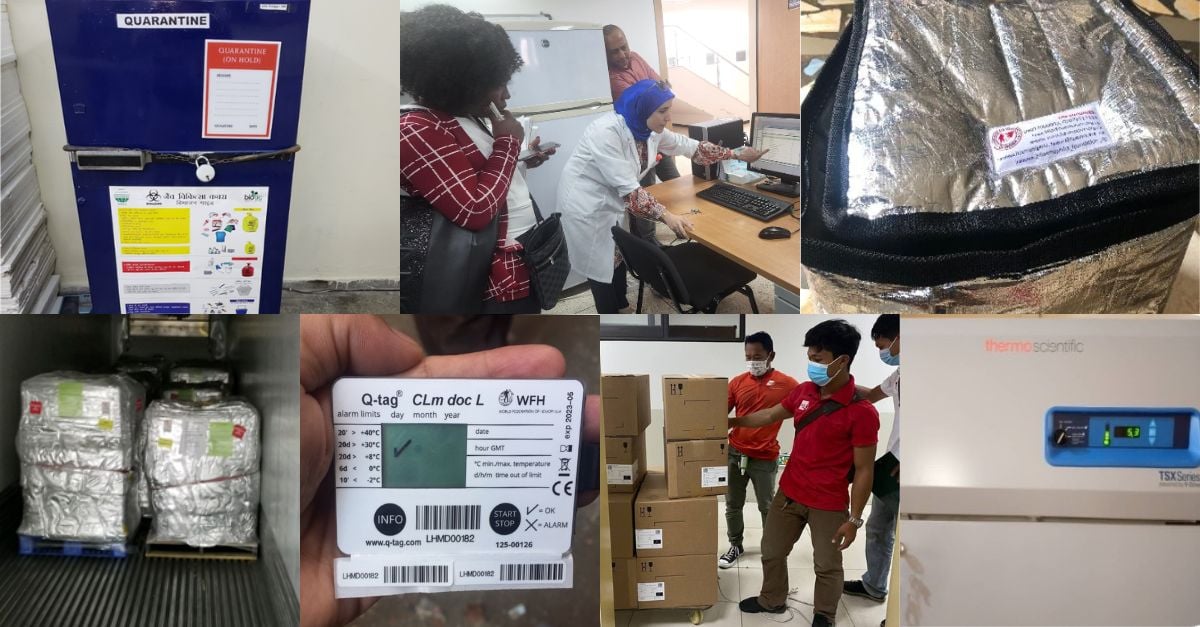
To ensure that treatment products are delivered in a timely fashion and arrived in a usable condition, the Program follows a strict process that covers very fact of the logistical process—from reception of the product from donors, to delivery to the hemophilia treatment centres (HTCs) or hospital. This aspect is of the utmost importance: treatment product that has been negatively affected during the transportation process can be less effective or even dangerous. The whole process is governed by the WFH Quality Management System (QMS) and Standard Operating Procedures (SOPs). This ensures that the WFH Humanitarian Aid Program respects all good distribution practices (GDP) requirements, and that treatment products received are in good condition and are safe to be administered to PWBDs.
Determining shipping destinations
Before any donation can be shipped, recipient organizations must demonstrate their ability to safely and effectively manage the treatment products. This includes proving that they can properly receive, store, and prepare them. Also, WFH Humanitarian Aid Program donors require clear evidence that each step of the process meets their strict standards before agreeing to ship their product to a destination.
Selecting where to send limited supplies is a critical and time-intensive process. Even with the stringent requirements placed on recipients, demand and destination options far outstrip supply. Potential sites are carefully assessed through in-person or virtual visits by the Program team to identify gaps in infrastructure and ensure readiness. The WFH then works with WFH USA and donors to develop an annual donation plan that optimizes the distribution of donated products to maximize both impact and inventory efficiency. Only after all these steps have been taken are destinations approved.
Planning the delivery itinerary
As a first step, the Program team works with recipients to ensure they have secured customs approvals—a process that can take weeks or months. During this period, product shelf life must be taken into consideration to ensure usability upon arrival.
Once a destination is confirmed, logistical planning begins. This includes assessing local storage capacity, such as the need for refrigeration, and determining the quantity and type of treatment to be sent. Decisions are based on the number of PWBDs at the location, treatment requirements, and geographic realities, as products often travel across continents from donor countries in North America or Europe.
Air transport is the most common method for delivering treatment products, although sea freight may be used for larger shipments. However, infrastructure limitations can complicate delivery. In some locations, inconsistent cold storage or security concerns—such as lack of surveillance—must be factored into planning to ensure safe handling of donated products.
Shipping the donations
Once all approvals are in place, shipments begin their journey—often involving multiple transit points. Continuous temperature monitoring, and protective materials such as thermal blankets and tracking systems help manage product integrity. Any delays, rerouting, or storage issues are managed in real time to prevent product damage or loss.
Upon arrival, products are not immediately brought to medical facilities. Temperature data must first be reviewed to confirm that conditions remained within acceptable limits during the long voyage. If any discrepancies are detected, further verification is required, potentially delaying use. Only after everything has been confirmed to be within acceptable levels can the treatments be released to healthcare facilities.
By using this strictly controlled process, the WFH Humanitarian Aid Program team ensures that donated treatment products are used as efficiently as possible and usage is maximized. All of this is done to support as many PWBDs as possible around the world.
Currently, geopolitical events are adding complexity to donation logistics. Lack of transportation options (air or sea), significant increases in the time it takes to acquire import licenses, and transportation cost increases for certain regions are all impacting the process. In order to mitigate the effects of these pressures, the WFH Humanitarian Aid Program team is working tirelessly to stay abreast of daily changes and make adjustments to limit, as much as possible, interruptions in supply.
This is the first article in a series on transporting donated treatment products by the WFH Humanitarian Aid Program. The next article will cover challenges related to shipping donated treatment products to conflict zones.
To find out more about the WFH Humanitarian Aid Program, click here.
Case Study: Armenia
The logistics involved with sending treatment product to Armenia offer a clear example of how the WFH Humanitarian Aid Program delivers donations safely and efficiently while meeting strict regulatory standards.
The process begins with product allocation, followed by the submission of an official offer letter—detailing quantities and shelf life—to the head physician at the hemophilia treatment centre (HTC) in Yerevan, with the Ministry of Health (MoH) involved from the outset. Once the offer is formally accepted, the Program team waits for the issuance of the import permit. During this period, shipment preparation begins in parallel, where possible, to minimize delays.
Because shipments are done using a passive cold chain solution, temperature control during transit is critical. Before shipping, the WFH provides formal assurance to the MoH that all safeguards are in place to maintain product integrity throughout transit.
Shipments are transported by air from either the U.S.A or Belgium, cleared through customs, and delivered to the MoH warehouse in Yerevan. Upon arrival, temperature monitoring data is reviewed by WFH quality control teams to confirm the products remain safe for use. Final approval rests with the MoH, which authorizes distribution to patients.
Typically completed within three to four weeks, this coordinated process highlights the importance of collaboration, planning, and strict quality controls in ensuring reliable access to life-saving treatment.
About the WFH Humanitarian Aid Program
The WFH Humanitarian Aid Program improves the lack of access to care and treatment by providing much-needed support for people with inherited bleeding disorders in developing countries. By providing patients with a more predictable and sustainable flow of humanitarian aid donations, the WFH Humanitarian Aid Program makes it possible for patients to receive consistent and reliable access to treatment and care. None of this would be possible without the generous support of Sanofi and Sobi, our Founding Visionary Contributors; Bayer, CSL Behring and Roche, our Visionary Contributors; Grifols, our Leadership Contributor; and Takeda, our Contributor. To learn more about the WFH Humanitarian Aid Program, visit www.treatmentforall.org.