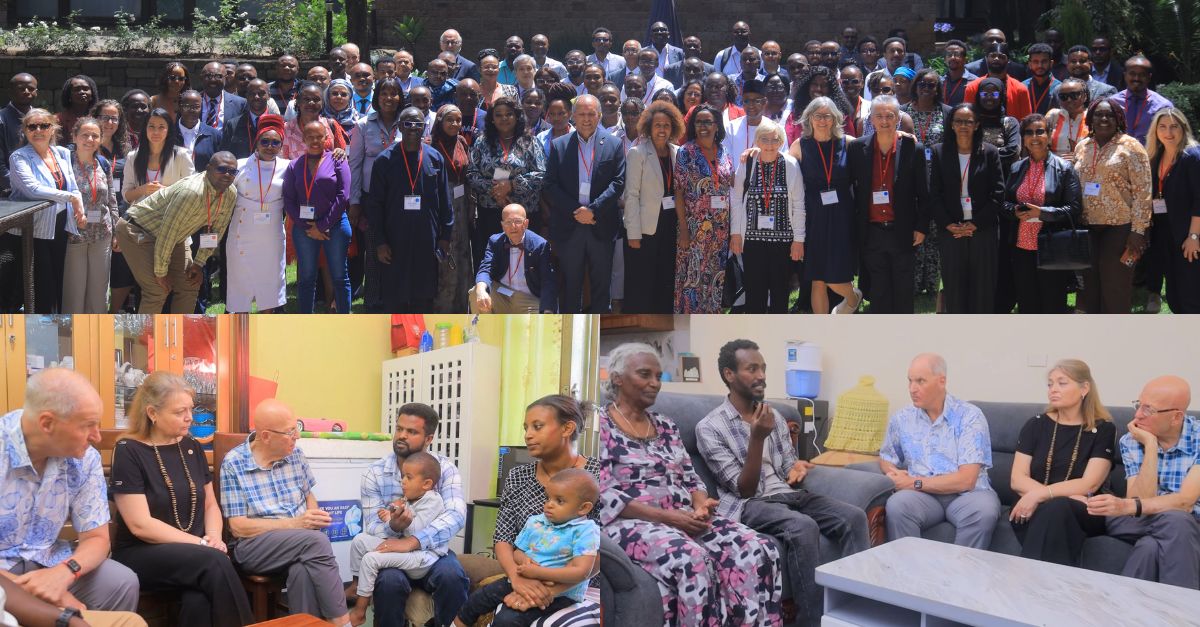
The level of care in Ethiopia has been improving thanks to training and donated treatment products provided by the WFH Humanitarian Aid Program. This support has made it possible for PWBDs to go on prophylaxis—allowing them to lead more normal lives. Here are the stories of two people who are now enjoying a greater quality of life thanks to the WFH: Kidus, a four-year-old boy with hemophilia B, and Facha, a 29-year-old man with hemophilia A.
The first visit was to the home of Kidus, who was diagnosed after a serious subdural hemorrhage. Thanks to donated factor, he was able to undergo surgery for his injury and recover fully. Now that his family and care team know he has hemophilia—and because he will have access to prophylactic treatment—Kidus has a real chance to enjoy a normal life like his friends and classmates.
When he was diagnosed with hemophilia, my feeling was good because he was diagnosed so we knew his illness [and the steps forward].
—Efrem Basazinew, MD, father of Kidus, a boy with hemophilia
For Facha, a 29-year-old man with hemophilia A, a lack of understanding of his condition by his treatment team and his family when he was a child had serious consequences. Diagnosed at age five after a head injury, he and his family were initially advised to avoid external trauma, but were not fully informed about the risks of internal bleeds. After a school injury hurt his knee, his parents tried treating him at home, unintentionally delaying his medical treatment. His leg became severely swollen, resulting in a monthlong stay in the hospital. Fortunately, access to treatment products allowed him to recover, and the knowledge his family learned about internal bleeds helped him manage his condition going forward.
“I’m here because of the factor that I received—I’m alive because of the treatments that I received,” he explains. “Currently, I’m able to live a normal life because of the treatments that were given to me.”
Today, Facha helps support other young people as a founding member of the Ethiopian Hemophilia Society and its youth group. His experience demonstrates how education can empower people with hemophilia and their families to recognize symptoms, seek timely care, and prevent complications.
Humanitarian aid support is most effective when treatment donations are paired with training, clinical education, and community awareness. By strengthening knowledge through events such as the conference in Ethiopia along with providing access to factor, the WFH and local partners are helping build a future in which more people with hemophilia in Ethiopia and other countries can live healthier, fuller lives.
To read an article on the conference, “WFH Regional Conference: Advancing Bleeding Disorders Care,” click here.
Over seven million IUs of factor were donated to Ethiopia through the WFH Humanitarian Aid Program in 2025. Since 2015, almost 40 million IUs of factor have been donated. To find out more about the WFH Humanitarian Program, please click here.
The “WFH Regional Conference: Advancing Bleeding Disorders Care” event was supported in part thanks to funding provided by WFH Humanitarian Aid Program Visionary Contributor CSL Behring. The WBDR is made possible by the support of our visionary partner Sobi, and our collaborating partners Grifols, Pfizer and Sanofi.
About the WFH Humanitarian Aid Program
The WFH Humanitarian Aid Program improves the lack of access to care and treatment by providing much-needed support for people with inherited bleeding disorders in developing countries. By providing patients with a more predictable and sustainable flow of humanitarian aid donations, the WFH Humanitarian Aid Program makes it possible for patients to receive consistent and reliable access to treatment and care. None of this would be possible without the generous support of Sanofi and Sobi, our Founding Visionary Contributors; Bayer, CSL Behring and Roche, our Visionary Contributors; Grifols, our Leadership Contributor; and Takeda, our Contributor. To learn more about the WFH Humanitarian Aid Program, visit www.treatmentforall.org.