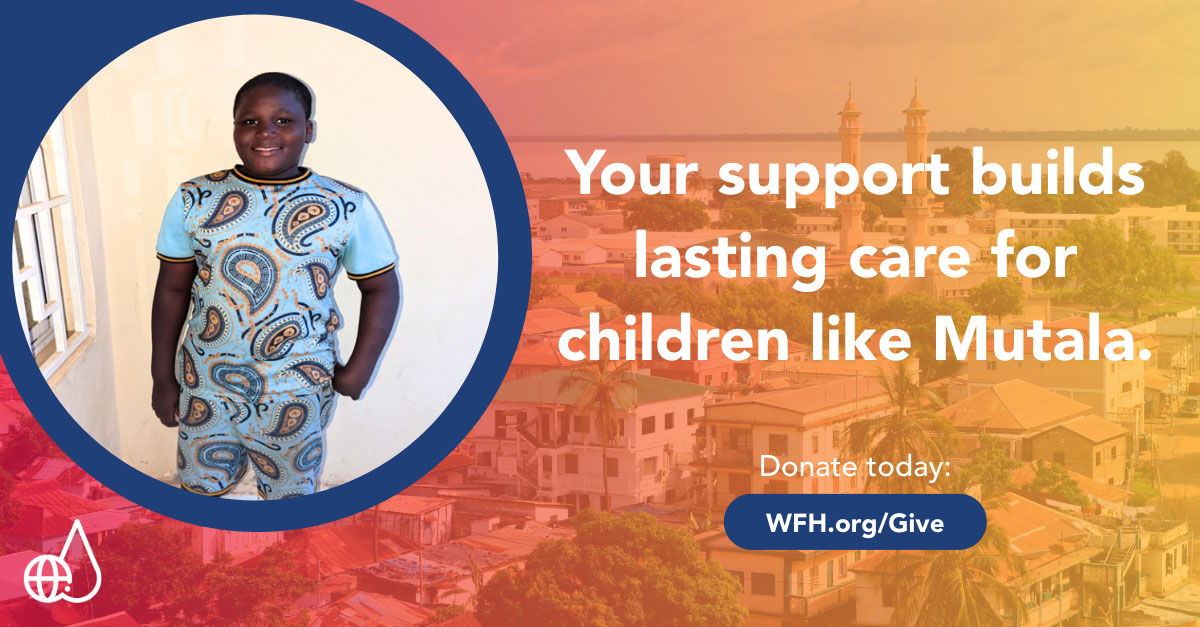
The World Federation of Hemophilia (WFH) immediately responded to Mafaal Saidy’s message. A member of the WFH Humanitarian Aid Program team contacted him directly and advised him to take his son to Dakar, Senegal, where he could be seen by Saliou Diop, MD, Director of the Blood Transfusion Centre there.
In Dakar, new tests revealed that Mutala had been misdiagnosed. He didn’t have hemophilia A, as initially believed—he had hemophilia B. With the correct diagnosis, he started receiving the correct treatment product, donated by the WFH Humanitarian Aid Program. The bleeding stopped, and for the first time in weeks, Mutala was pain-free.
Diop gave Mafaal a supply of factor IX to take home, and the WFH continued to follow up with the boy, even covering travel expenses so he could return for check-ups. Six months later, his health was stable—and he had not experienced a single bleed.
This exceptional level of care was made possible thanks to the generous support of donors like you. Without access to accurate diagnosis, donated treatment products, and trained physicians, Mutala’s story might have ended very differently.
Change in The Gambia is taking place because of a concerted, long-term effort by the WFH and by local organizations. In 2019, the Safe Motherhood and Hemophilia Foundation The Gambia was officially established. With WFH’s support, the foundation was accredited as a national member organization (NMO) during the WFH 2022 General Assembly. Working closely with the NMO, the WFH helped train two hemophilia care professionals, establish a working hemophilia treatment centre (HTC) and identify 16 patients.
The WFH Humanitarian Aid Program has also contributed significantly to the country, providing 700,000 IU of factor VIII and 200,000 IU of factor IX to The Gambia between 2021 and 2025. That generosity has enabled physicians to treat increasingly complex cases and effectively manage bleeding episodes. By 2025, the number of diagnosed patients in The Gambia had more than doubled.
Today, the NMO is participating in the WFH Twinning Program with Hemophilia of Georgia (U.S.A), with the goal of strengthening their organizational capacity, improving services for patients and families, and fostering lasting collaboration and knowledge exchange. The Twinning experience has already achieved remarkable milestones:
- Finalized a national education and advocacy plan
- Held an awareness campaign in the rural area of Mansakonko
- Produced a “lived experiences” video featuring five adults with bleeding disorders
- Created educational materials to support community outreach
- Began development of a new website (launching in 2025)
- Designed a national communication campaign to broaden awareness
Now ten years old, Mutala lives a near-normal life, and access to donated factor IX has kept him safe and has kept his condition stable.
I would like to thank the WFH for all the medications I receive for my treatment, I do not know what I would have done without your help.
—Mutala Saidy, boy with hemophilia A, The Gambia
The generosity of our sponsors is not just providing medication, it is building care infrastructure, training professionals, and empowering communities. It is a beautiful reminder that your generosity and compassion changes lives.
Every donation brings us closer to a future where children like Mutala can live full, healthy lives—where diagnosis is no longer delayed, and treatment is never out of reach.
Please support our annual fundraising campaign today so that the WFH can continue this crucial work across the globe.
