In 2014, this call to action was answered, and the pace of donations increased dramatically as sponsors began signing more formal donation agreements with the Program, with over 600 million IUs of treatment products donated in the first 5 years alone. Sanofi and Sobi signed contracts in 2014. Grifols joined a year later in 2015, CSL increased significantly their annual donation in 2018 and Bayer and Roche joined in 2019. The last few years have seen more sponsors formalize agreements, with Takeda penning a contract 2021, and Japan Blood Products Organization (JB) following in 2022.
Now—ten years after the first major donation—the totals are staggering: 2 billion IUs of factor replacement therapy. 10 million mgs of non-factor replacement therapy. All donated, all given to those who need it most. This has allowed the WFH Humanitarian Aid Program’s collaborators to support almost 30,000 patients, treat over 400,000 bleeds, perform over 10,000 surgeries, and put almost 3,000 children with bleeding disorders on prophylactic treatment.
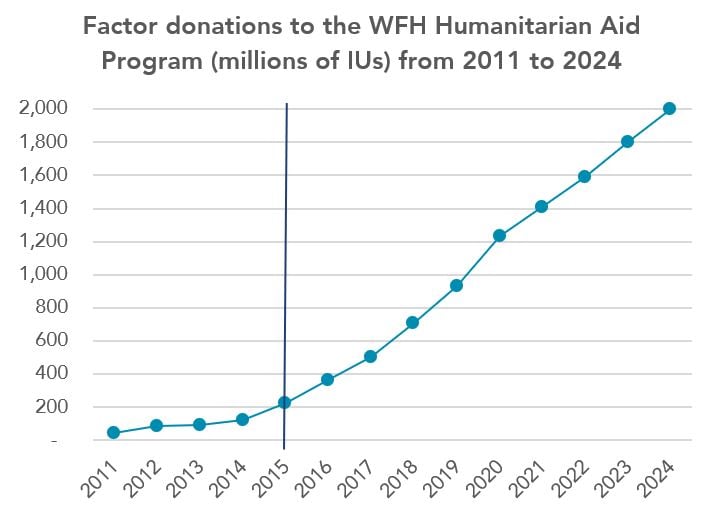
Donations increased significantly after the WFH call to action in 2014.
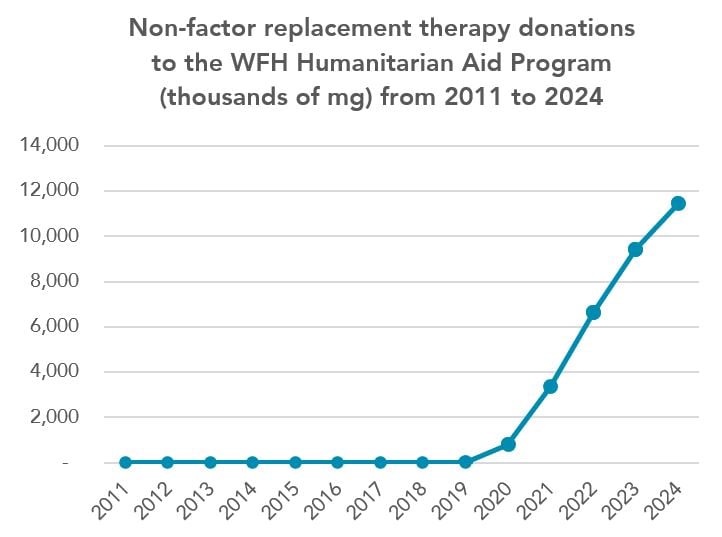
Donations of non-factor replacement therapy began in 2020 and have increased rapidly since then.
In addition to treatment products, these sponsors have also contributed funding which has allowed the Program to provide training for healthcare professionals (HCPs) on the effective and safe use of treatment products. Education initiatives were also launched to ensure that individuals with bleeding disorders can best care for themselves to ensure they can have the best quality of life possible.
From the bottom of my heart, and on behalf of people with bleeding disorders everywhere, I would like to thank our generous sponsors. Your donations have helped transform and save lives. Watch our many WFH Humanitarian Aid Program videos. You will see PWBDs thanking you and telling you about how you have saved their lives. You have truly made a difference.
—Cesar Garrido, President, WFH
By providing a predictable supply of donations to countries around the world, the WFH Humanitarian Aid Program has been able to truly enhance the quality of life of PWBDs. Many of these people are children—meaning that unlike their parents and grandparents, they will not have to live a life marred by permanent joint damage or other comorbidities. It also means that these children can look forward to a longer life than those who came before them. Instead of death, there is now hope. Instead of parents sacrificing everything for their children, parents can now work and provide their families with more than just the basic necessities of life.
The generosity of our sponsors has also helped the WFH Humanitarian Aid Program collaborate more closely with national member organizations (NMOs) and hemophilia treatment centres (HTCs). This means that in addition to medical care, PWBDs can enjoy a better emotional support system in their communities.
In short, this ten-year celebration of sponsor generosity is a celebration of life—and of hope.
To find out more about how Biogen and Sobi were the first to respond to the call to action, please click here. To find out more about the WFH Humanitarian Aid Program, click here.
About the WFH Humanitarian Aid Program
The WFH Humanitarian Aid Program improves the lack of access to care and treatment by providing much-needed support for people with inherited bleeding disorders in developing countries. By providing patients with a more predictable and sustainable flow of humanitarian aid donations, the WFH Humanitarian Aid Program makes it possible for patients to receive consistent and reliable access to treatment and care. None of this would be possible without the generous support of Sanofi and Sobi, our Founding Visionary Contributors; Bayer, CSL Behring and Roche, our Visionary Contributors; Grifols, our Leadership Contributor; and Takeda and Japan Blood Products Organization, our Contributors. To learn more about the WFH Humanitarian Aid Program, visit www.treatmentforall.org.