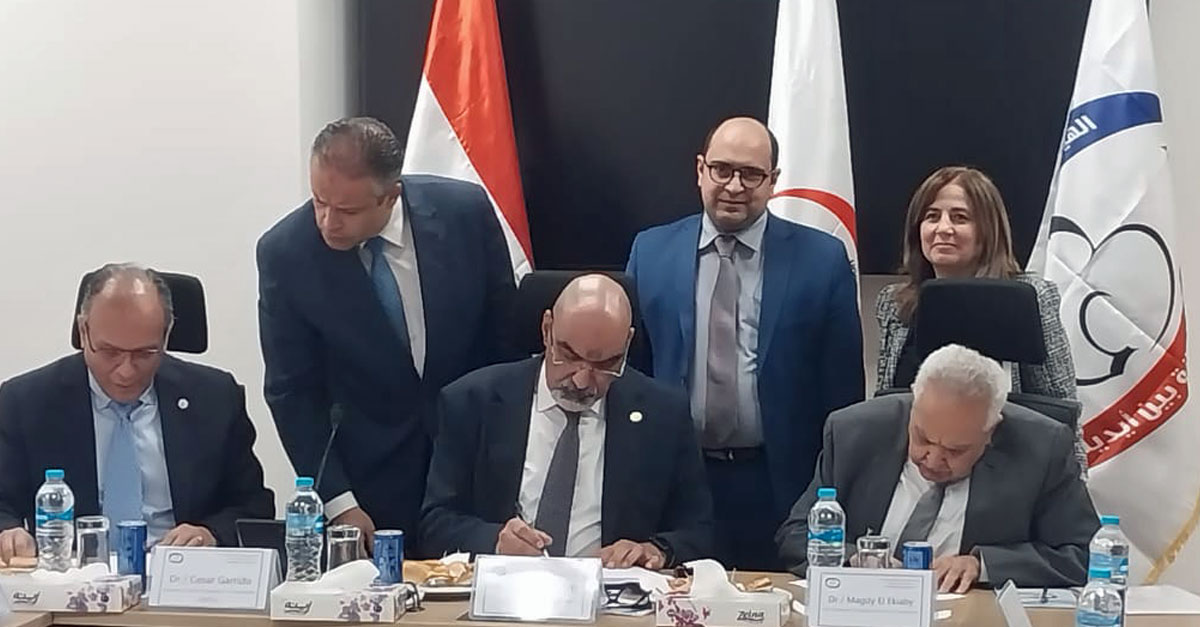
The WFH first began collaborating with stakeholders in the Egyptian bleeding disorders community in early 2000. In the nearly 24 years since then, the WFH has been able to support the local bleeding disorder community through a sustained commitment with the Egyptian government. This had been done thanks to medical education, multiple WFH programs—including the WFH PACT Program, the WFH Twinning Program, and the WFH Humanitarian Aid Program ,among others—that have been integral part of the overall national bleeding disorders care strategy. Thanks to these efforts, the WFH has helped nearly double the number of identified people with bleeding disorders (PWBDs) in the country. In 2023 alone, 463 PWBDs were identified. The MOU is thus the result of the long-standing and ongoing collaboration between the WFH and the Egyptian bleeding disorders community. The length of WFH collaboration in the country is a reflection of the commitment of the WFH, but also the reality of working in a very populous nation that has a commensurately large bleeding disorders community.
Last year was a busy one for the WFH in Egypt, with many events and endeavours working together to bring about change. In October, Cedric Hermans, MD—a WFH board member—led a medical workshop in Cairo focused on primary and secondary prophylaxis in pediatric hemophilia treatment centres (HTCs). The workshop led to a close collaboration with stakeholders, improved outreach and identification techniques.
In 2023, the WFH also supported the development of national treatment guidelines, and a consensus paper on immune tolerance induction (ITI). WFH team members also actively participated in national conferences, including the annual Egyptian Society for Pediatric Hematology and Oncology (ESPHO) conference.
Egypt was chosen to co-pilot an in-country training program with the WFH-accredited International Hemophilia Training Centre (IHTC) at Shabrawichy Hospital. This endeavour has not only helped provide an avenue for experience sharing, but has also helped to provide hands-on training for nurses, physiotherapists, pediatric hematology specialists and laboratory specialists.
The WFH has also worked with the national member organization (NMO)—the Egyptian Society of Hemophilia—to identify focus areas following a capacity development framework joint review exercise. This collaboration is making it possible for the NMO to actively lead advocacy for the introduction of universal prophylaxis in Egypt. Currently, more than 90% of all children below 18 years of age with severe hemophilia are on emicizumab or high dose prophylaxis, and the goal is to increase this to 100%. The NMO has already led two sessions with the government to discuss introducing universal prophylaxis and home therapy.
The WFH Humanitarian Aid Program has been active in Egypt for over a decade, with 94.6 million IUs of factor donated to the country since 2015. Just last year, 25.6 million IUs of factor were donated to Egypt. These massive donations have had a real impact on the local bleeding disorders community. Ahmed Elekiaby, MD, a physician at Shabrawichy Hospital in Giza, credits the WFH Humanitarian Aid Program for boosting government funding, resulting in tangible improvements in hemophilia treatment in Egypt.
To find out more about the WFH PACT Program please click here. To find out more about the WFH Twinning Program, please click here. To find out more about the WFH Humanitarian Aid Program please click here.
About the WFH Humanitarian Aid Program
The WFH Humanitarian Aid Program improves the lack of access to care and treatment by providing much-needed support for people with inherited bleeding disorders in developing countries. By providing patients with a more predictable and sustainable flow of humanitarian aid donations, the WFH Humanitarian Aid Program makes it possible for patients to receive consistent and reliable access to treatment and care. None of this would be possible without the generous support of Sanofi and Sobi, our Founding Visionary Contributors; Bayer, CSL Behring and Roche, our Visionary Contributors; Grifols, our Leadership Contributor; and Takeda and Japan Blood Products Organization, our Contributors. To learn more about the WFH Humanitarian Aid Program, visit www.treatmentforall.org.