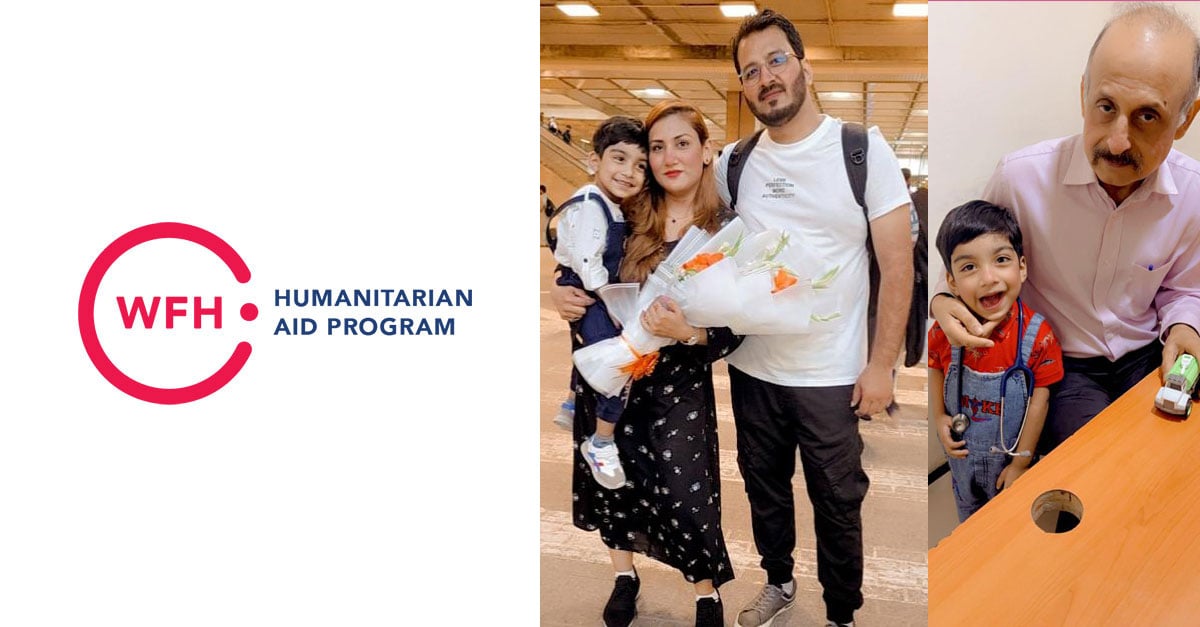
WFH support for outreach is delivered through many different endeavours, such as the Cornerstone Initiative and the WFH Path to Access to Care and Treatment (PACT) Program, both of which work to provide countries with the training and guidance they need to increase the level of care offered to local bleeding disorders communities. Another key program for outreach is the WFH Humanitarian Aid Program, which offers education and donated factor to countries in need. In Pakistan, a young boy named Muhammad Ahmed benefitted from the Program’s support—and this support saved his life.
Muhammad Ahmed was diagnosed with Tetralogy of Fallot congenital heart disease in Karachi, Pakistan, five days after he was born. Even though physicians felt that his chances of survival were slim, they nevertheless opted to perform surgery on him to correct the issue. As part of the process, a blood sample was taken—but this routine procedure resulted in a hematoma and continual bleeding. After another test was done, Mohammad was found to have moderate hemophilia B.
The physicians did what they could, but despite giving him plasma infusions, his blood hemoglobin level started going down, and his bleeding continued. In this increasingly serious situation, the patient’s family reached out to Raheel Ahmed Khan, the founder of the Hemophilia Patient Welfare Society-Karachi (HWSK). Through the HWSK, Muhammad began receiving donated factor provided by the WFH Humanitarian Aid Program.
While his condition stabilized, surgeons at the Liaquat National Hospital and Medical College were concerned about being able to perform the surgery because of the boy’s hemophilia, and because of a lack of resources. They put the family in touch with Rajesh Sharma, MD, at the Apollo Hospital in Delhi, India. Sharma accepted the case, and Fareed Malik, from the Hemophilia Foundation-Pakistan (HFP)—the Pakistani national member organization (NMO)—organized the logistics to bring Mohammad and his family to India.
Patients with hemophilia B require a large amount of factor during surgery. Consequently, the team at Apollo Hospital, Malik, and Prem Roop Alva, the president of the Hemophilia Foundation-India (HFI), approached Assad E. Haffar, MD, Medical & Humanitarian Aid Director at the WFH, to secure the necessary supplementary factor for the procedure. Thanks to this donated factor, Muhammad’s heart surgery was successful, and he was put on a 15-day follow-up. At the end of the whole procedure and the initial recovery period, the family returned to Pakistan.
Muhammad is now on prophylaxis, using factor provided by the HFP through the WFH Humanitarian Aid Program. Because he was diagnosed young, he has a chance at a normal life: as long as he receives regular factor, he won’t suffer from recurring bleeds and permanent joint damage, as do so many other boys with his condition in Pakistan.
Since 2015, over 62 million IUs of factor were donated to Pakistan. Nearly 12 million IUs of factor—and nearly 500,000 mg of non-factor replacement therapy—were donated to the country through the WFH Humanitarian Aid Program in 2022. To find out more about the WFH Humanitarian Aid Program, please click here.
About the WFH Humanitarian Aid Program
The WFH Humanitarian Aid Program improves the lack of access to care and treatment by providing much-needed support for people with inherited bleeding disorders in developing countries. By providing patients with a more predictable and sustainable flow of humanitarian aid donations, the WFH Humanitarian Aid Program makes it possible for patients to receive consistent and reliable access to treatment and care. None of this would be possible without the generous support of Sanofi and Sobi, our Founding Visionary Contributors; Bayer, CSL Behring and Roche, our Visionary Contributors; Grifols, our Leadership Contributor; and Takeda and Japan Blood Products Organization, our Contributors. To learn more about the WFH Humanitarian Aid Program, visit www.treatmentforall.org.