WFH support in Cambodia is delivered in collaboration with many stakeholders—including the Cambodia Hemophilia Association, the national member organization (NMO), and government representatives—through efforts such as the WFH Humanitarian Aid Program and the International External Quality Assessment Scheme (IEQAS). In the case of the WFH Humanitarian Aid Program, training for specialists and physicians is provided on the efficient use of donated treatment products, with the objective of doing as much as possible with what is donated.
Care levels began to significantly improve in the country when the Cambodia Hemophilia Association started working with the WFH. Sithan Kong, the President of the Cambodia Hemophilia Association, explains: “With the collaboration with the WFH, [we can] connect with the government, lobby with the government, develop a strategy to approach them.”
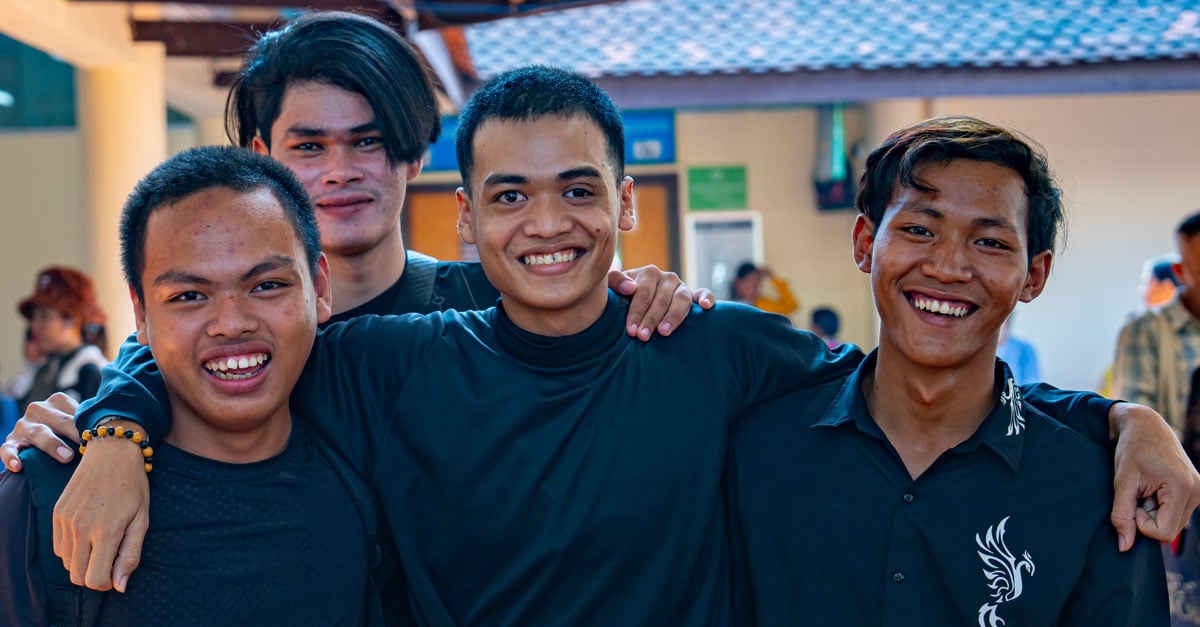
Donated treatment products provided by the WFH Humanitarian Aid Program have had an impact on children in Cambodia by allowing them to receive prophylactic treatment. For many of them, this development means going from a life lived from bleed to bleed—and one emergency room visit to the next—to a more normal existence. “There are enough treatment products available [now],” said Sung Sreng, a hemophilia nurse at Angkor Children Hospital in Siem Reap. “[This] shows that we have effectively collaborated with the NMO and the WFH. Moving forward, we would like to foster even closer and more impactful collaboration to benefit children.”
Loeub Poy, a boy with hemophilia, shares how his life has changed since he started receiving WFH support: “[Before receiving aid] I stopped studying, I couldn’t do anything… I couldn’t walk even for two hours without getting swelling… With non-factor replacement therapy, I can walk as long as I want.” For Morn Eout, his caregiver, this change means that she can go to work to earn money and send it to her family.
I would like to express my gratitude to the WFH for providing treatment products to Cambodian children. Thank you so much.
—Sung Sreng, hemophilia nurse, Ankor Children’s Hospital
These encouraging developments in Cambodia prove that collaboration is the most effective way to create lasting care in a country and help it get closer to achieving sustainable care. To read another article on the work the WFH has done in Cambodia—and to watch a video—click here.
The WFH Humanitarian Aid Program has donated nearly 18 million IUs of factor and over 329,000 mg of non-factor replacement therapy to Cambodia since 2015. Over 3.3 million IUs of factor, and nearly 109,000 mg of non-factor replacement therapy were donated in 2023. To find out more about the WFH Humanitarian Aid Program, please click here.
About the WFH Humanitarian Aid Program
The WFH Humanitarian Aid Program improves the lack of access to care and treatment by providing much-needed support for people with inherited bleeding disorders in developing countries. By providing patients with a more predictable and sustainable flow of humanitarian aid donations, the WFH Humanitarian Aid Program makes it possible for patients to receive consistent and reliable access to treatment and care. None of this would be possible without the generous support of Sanofi and Sobi, our Founding Visionary Contributors; Bayer, CSL Behring and Roche, our Visionary Contributors; Grifols, our Leadership Contributor; and Takeda and Japan Blood Products Organization, our Contributors. To learn more about the WFH Humanitarian Aid Program, visit www.treatmentforall.org.