WFH Regional Managers—who are based in their geographic region of responsibility—work closely to assess the needs of the country to ensure that support is optimized. In Cambodia, this involves the WFH Humanitarian Aid Program and WFH Country Programs. The overall goal is to improve the level of care in the country.
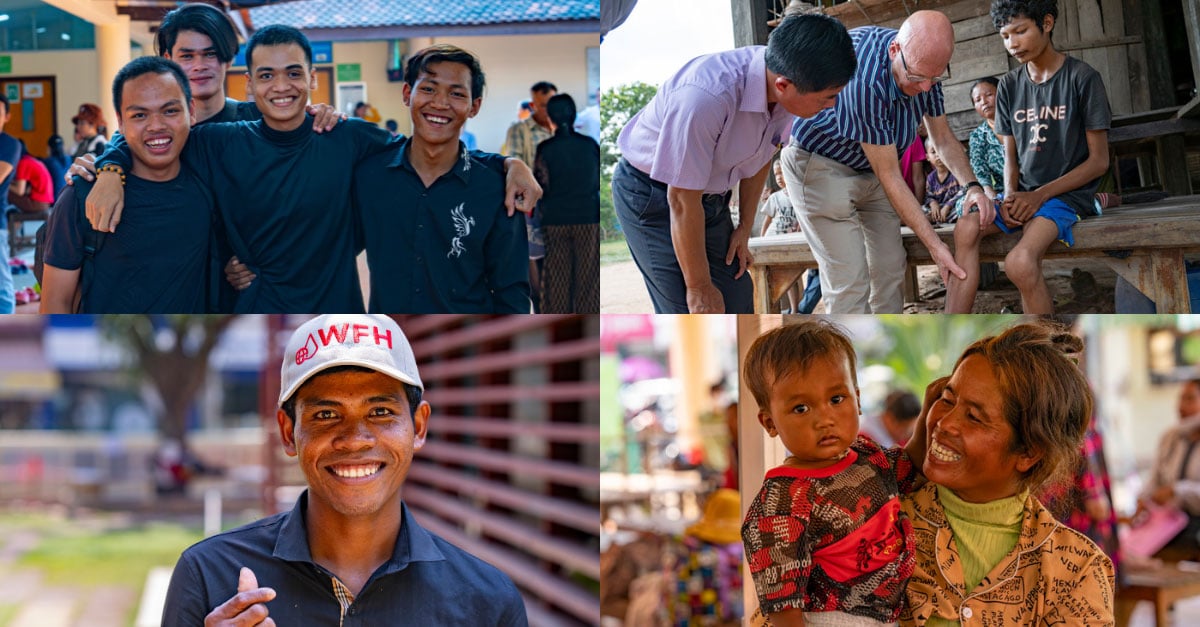
Early this year, the Program team went to Cambodia to see first-hand what progress is being made, and where to focus resources. They saw very quickly that care has improved significantly since the WFH first started working in the country 15 years ago. Their visit included a stop at Angkor Hospital for Children, which is the main HTC in the city. There they met parents and their children—many of whom now have access to prophylactic care. “I saw one patient who used to get treatment three, four times a week,” explains Hazri Aris, WFH Regional Manager for Southeast Asia & Western Pacific. “With [prophylactic] treatment, they only need to get treatment once a month, which is life changing.” Prophylaxis means children are able to go to school, and parents are able to go to work. Where before hemophilia was managed from one emergency to the next, now PWBDs only go to HTCs when they have an appointment.
The WFH plays a very important role, donating products for patients. We rely on these donations for patients to survive.
—Sithan Kong, President, Cambodia Hemophilia Association
The Program provides donated treatment products to Cambodia and supports the effective use these donations through training with different stakeholders. This tailored support is key to optimizing care. Sung Sreng, a hemophilia nurse at Ankor Children’s Hospital, says that collaboration is essential for making the whole process run smoothly. “There is good cooperation between the national association and the WFH, so if we think ahead, lets ensure we continue to work together for the benefit of people with hemophilia in Cambodia.” A pediatric hematologist at the HTC—Sing Heng, MD—says that close collaboration between the WFH and the HTC has drastically reduced disabilities in PWBDs over the last 15 years.
“[Our last] visit to Siem Reap Angkor Children Hospital… was five years ago. This [new] visit was to see the improvement of the health of the people who are getting our humanitarian aid donations…” explains Assad E. Haffar, MD, Medical & Humanitarian Aid Director, WFH. “The results were quite positive… many of the patients that I saw five years ago… are now getting better in terms of their health.” Haffar went on to praise the increased engagement of the Cambodia Hemophilia Association with HTCs, PWBDs, and governments.
Overall, by collaborating with multiple stakeholders, the WFH and the WFH Humanitarian Aid Program are helping to increase the level of care for the inherited bleeding disorders community in Cambodia. Slowly but surely, the country is getting closer to being able to offer sustainable care to PWDS in the country.
The WFH Humanitarian Aid Program has donated nearly 18 million IUs of factor and over 329,000 mg of non-factor replacement therapy to Cambodia since 2015. Over 3.3 million IUs of factor, and nearly 109,000 mg of non-factor replacement therapy were donated in 2023. To find out more about the WFH Humanitarian Aid Program, please click here.
About the WFH Humanitarian Aid Program
The WFH Humanitarian Aid Program improves the lack of access to care and treatment by providing much-needed support for people with inherited bleeding disorders in developing countries. By providing patients with a more predictable and sustainable flow of humanitarian aid donations, the WFH Humanitarian Aid Program makes it possible for patients to receive consistent and reliable access to treatment and care. None of this would be possible without the generous support of Sanofi and Sobi, our Founding Visionary Contributors; Bayer, CSL Behring and Roche, our Visionary Contributors; Grifols, our Leadership Contributor; and Takeda and Japan Blood Products Organization, our Contributors. To learn more about the WFH Humanitarian Aid Program, visit www.treatmentforall.org.