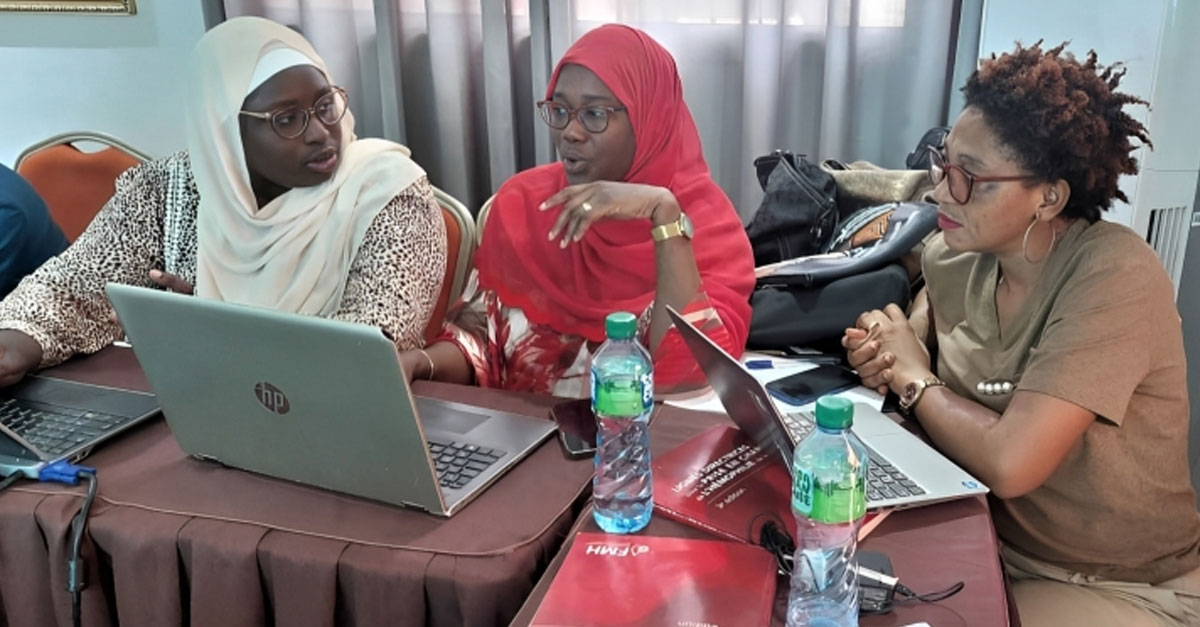
Three women gathered around laptops have a discussion

PACT Program helps move care forward in Senegal

The WFH Path to Access to Care and Treatment (PACT) Program is a 5-year initiative designed to improve outreach and diagnosis and increase access to sustainable care for people with inherited bleeding disorders. This is achieved through training, education, partnerships, in-country initiatives, and evidence-based advocacy efforts. The Program has been active in Senegal since 2022, and it has already had an impact on the local bleeding disorders community by facilitating dialogue between the Association Sénégalaise des Hémophiles (ASH)—the WFH national member organization (NMO)—and the Ministry of Health (MoH).

Also available in: Français Español

In most resource-limited countries like Senegal, access to care for people with hemophilia and other bleeding disorders has been difficult due to many challenges, including lack of funding, capacity, and government commitment. With other competing health priorities, hemophilia and other bleeding disorders are often left on the wayside.

When Senegal joined the WFH Path to Access to Care and Treatment (PACT) Program in 2022, one of the priority areas that the Association Sénégalaise des Hémophiles (ASH) identified was to strengthen the government’s commitment and support for hemophilia and other bleeding disorders, which is also in line with the main goals of the Program.

Prior to the introduction of the PACT Program in Senegal, the engagement of the Republic of Senegal’s Ministry of Health and Social Action with the bleeding disorders community had been gradually improving over the years. However, agreements and commitments made by the Ministry were mostly informal. This changed under the PACT Program. ASH, through its advocacy work, fostered stronger collaboration with the Ministry resulting in the integration of hemophilia into the government’s healthcare strategic plans—highlighted as the second objective in “Le Plan National de Développement Sanitaire” and “Le Plan stratégique de lutte contre les Maladies non-transmissible”.

For ASH and the wider bleeding disorders community, this is significant as it meant that more government resources will now be allocated to hemophilia care, an area that was previously neglected for far too long.

The Ministry of Health understands the importance of patient associations. This is reflected in the sustained support we receive from the directorate of NCDs and the hemophilia treatment centre (HTC)—the Centre National de Transfusion Sanguine (CNTS)—for our important activities. The PACT program provides us with an opportunity to better collaborate as a partner with the Ministry and increase our visibility and leadership in the country.

—Abdoulaye Loum, President of the Association Sénégalaise des Hémophiles (ASH)

One of the key factors that contributed to this outcome was the inclusion of representatives from the Ministry and the CNTS along with ASH in the PACT Program technical working group from the onset of the program. The group was able to provide guidance which respected the government’s vision of health care during the formulation and validation of the PACT National Access Plan in Senegal. This Plan was subsequently integrated into the Senegal Alliance of NCDs’ “Accelerating plan for fighting against NCDs 2023-2025”. The Ministry of Health (MoH) and the CNTS have also helped ASH in many other areas. For example, they supported—with the backing of the President of Senegal—a successful telethon organized this year to raise funds for ASH.

Abdoulaye Loum, President of the Association Sénégalaise des Hémophiles (ASH)

What has been accomplished by the WFH Path to Access to Care and Treatment (PACT) Program in Senegal is encouraging—and the advancements should continue. As the country gets closer to sustainable care, the quality of care—and quality of life—for people with bleeding disorders will improve.

To learn more about the WFH Path to Access to Care and Treatment (PACT) Program, please click here.

The PACT Program is supported by funding from Roche and Sanofi, our visionary partners; CSL Behring and Pfizer, our leadership partners; and Bayer, Biotest and Grifols, our collaborating partners.

We’ve accomplished a lot this year, we need your help to continue strong.

Would you like to read more about similar articles?

Disclaimer

The information on the WFH website is provided for general information purposes only. The WFH does not engage in the practice of medicine and under no circumstances recommends particular treatment for specific individuals. For diagnosis or consultation on a specific medical problem, the WFH recommends that you contact your physician or local treatment centre. Before administering any products, the WFH urges patients to check dosages with a physician or hemophilia centre staff, and to consult the pharmaceutical company’s printed instructions.

While every effort has been made to ensure the accuracy of the information on this site, the WFH does not guarantee the information is accurate, and is not responsible in any way whatsoever for damages arising out of the use of this website or any of the information contained herein.

Messages posted to WFH discussion forums, Facebook, Twitter, and other social media platforms do not represent the opinions of the World Federation of Hemophilia, its staff, or Board of Directors. The author of a message is solely responsibility for its content. Information posted on WFH social networks and platforms should never be a substitute for individualized professional medical advice, even when the author has medical qualifications or is considered an authority. Information posted to a discussion group should not be used to diagnose or treat a specific health problem without consulting a qualified healthcare professional. The WFH recommends that you contact your physician or local treatment centre if you have any individual questions or concerns.

References and links to other websites or references to other organizations, products, services, or publications do not constitute endorsement or approval by the WFH. The WFH is not responsible and assumes no liability for the content of any linked websites.

Fraud Alert

Unauthorized solicitations – Warning

The WFH has been made aware of various correspondences—circulated via e-mail and telephone—coming from individuals impersonating WFH staff or falsely stating that they are associated with the WFH. These correspondences, which may seek to obtain money using the name of someone affiliated with the WFH, are fraudulent and come from outside of our organization.

If you receive a suspicious solicitation, exercise extreme caution. In the case of an email, look at the email address to see if it looks suspicious (for example, all WFH emails come from @wfh.org).

We are asking you to remain vigilant, and if you have any doubts about the correspondence, please forward the email to the WFH at [email protected] or call +1 514-875-7944.