PWBDs in the country usually reach the LAH through referrals from hematologists and treating physicians, recommendations from other families, or social media. Before registration, each patient must provide laboratory results, a medical report, and identification documents confirming their diagnosis. So far, the organization has registered 123 non-Lebanese PWBDs, mainly Syrians, as well as Palestinians and Iraqis. In 2025, the association supported 53 non-Lebanese PWBDs, providing donated treatment products provided by the WFH Humanitarian Aid Program. Treatment is provided at the LAH hemophilia treatment centre (HTC), and when possible, families are given additional doses for home treatment to reduce the burden of frequent travelling.
Before we found the Lebanese Association for Hemophilia, I was always afraid because I didn’t know how I would help my son when he started bleeding. Today, thanks to the treatment provided by the WFH Humanitarian Aid Program, I can care for him at home, and he can go to school, play, and smile like other children. This support has given our family hope when we had nowhere else to turn.
—Mother of Mohammad Hussein, a 13-year-old Syrian boy with severe hemophilia A
For many families, being able to access treatment can be a case of life or death, and they will do whatever is possible to reach the LAH, often travelling long distances and absorbing significant transportation costs. Fortunately, the LAH continues to provide treatment free of charge when patients can attend its centre.
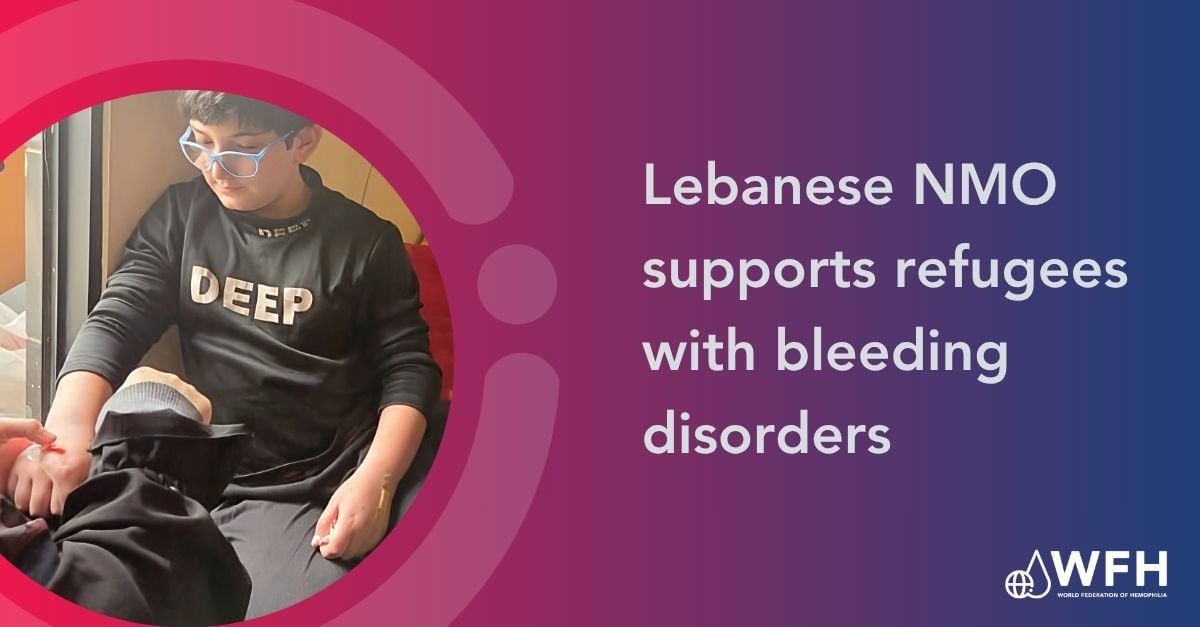
One of the patients supported by the LAH is Mohammad Hussein, a 13-year-old Syrian boy with severe hemophilia A, who is part of a family with no stable source of income. After arriving in Lebanon in 2023, his family found LAH through a neighbour. The association was able to provide Mohammad with one month of secondary prophylaxis, followed by continued on-demand treatment. This support is significantly reducing his bleeding episodes and bruising, allowing him to move with greater confidence, attend school without fear of physical activity, and improve his overall quality of life. The association also provided him with medical consultations, physiotherapy support, and follow-up care; and his mother received home infusion training.
The WFH provides leadership and education support to LAH leaders and offers opportunities for members of the NMO to share their experiences with neighbouring countries, such as youth leadership and physiotherapy training in Jordan. The WFH is currently providing support to the LAH to allow it to continue to function during today’s difficult geopolitical circumstances.
Humanitarian aid donations received by the LAH through the World Federation of Hemophilia have made a remarkable difference in Mohammad’s daily life—and the lives of many other people in Lebanon, including Lebanese nationals. Through humanitarian aid donations and local commitment, LAH is helping vulnerable families access care, reduce bleeding complications, and regain hope.
The WFH Humanitarian Aid Program has donated almost 27.5 million IUs of factor to Lebanon since 2015. Almost 1.9 million IUs of factor were donated in 2025 alone. To find out more about the Program, please click here.
About the WFH Humanitarian Aid Program
The WFH Humanitarian Aid Program improves the lack of access to care and treatment by providing much-needed support for people with inherited bleeding disorders in developing countries. By providing patients with a more predictable and sustainable flow of humanitarian aid donations, the WFH Humanitarian Aid Program makes it possible for patients to receive consistent and reliable access to treatment and care. None of this would be possible without the generous support of Sanofi and Sobi, our Founding Visionary Contributors; Bayer, CSL Behring and Roche, our Visionary Contributors; Grifols, our Leadership Contributor; and Takeda, our Contributor. To learn more about the WFH Humanitarian Aid Program, visit www.treatmentforall.org.