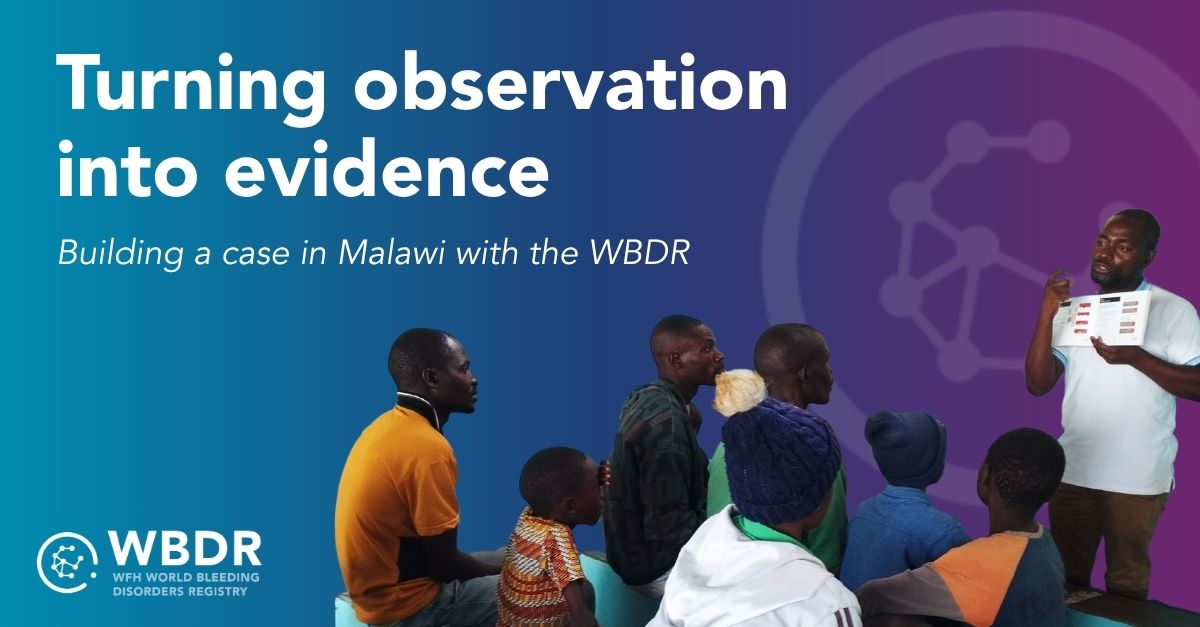
When the WFH began supplying clotting factor concentrates to Malawi through the WFH Humanitarian Aid Program, patients were able to—sometimes for the first time—treat bleeds on demand or through prophylaxis. At Kamuzu Central Hospital in Lilongwe, clinicians and families noticed clear improvements thanks to the donations, but these changes had not been formally documented. To turn years of observation into hard evidence, the treatment centre used a WFH World Bleeding Disorders Registry (WBDR) Research Support Program (RSP) grant to record what was happening before and after factor became available. The WBDR is the only global registry that collects standardized data on people with hemophilia and other inherited bleeding disorders, and an RSP grant is designed to help hemophilia treatment centres (HTC) collect, analyze and use their WBDR data.
The findings from the grant were presented at the WFH 2026 World Congress in Kuala Lumpur, Malaysia, and showed clear improvement thanks to the treatment product donations. The study followed 32 boys and men, most of them with severe hemophilia A, and compared their lives before and after they had access to factor. The researchers found that bleeding episodes were nearly halved, falling from about eight a year to four. Bleeds into the joints—which cause the most lasting damage—also became less frequent. The time lost to bleeding each year, whether from school, work, or other activities, dropped from about 17 days to seven. And when participants were asked about their health, their quality-of-life scores rose as well.
For the treatment centre, the real value of the findings is the next steps that they make possible. With evidence generated through the WBDR, the team can now advocate more effectively for the inclusion of bleeding disorders in national health priorities, demonstrating the importance of early diagnosis and consistent access to treatment. The research findings are proof that a single treatment centre—with a modest grant and using a standardized registry like the WBDR—can turn evidence into action.
To find out more about the WFH World Bleeding Disorders Registry (WBDR) Research Support Program (RSP), please click here.