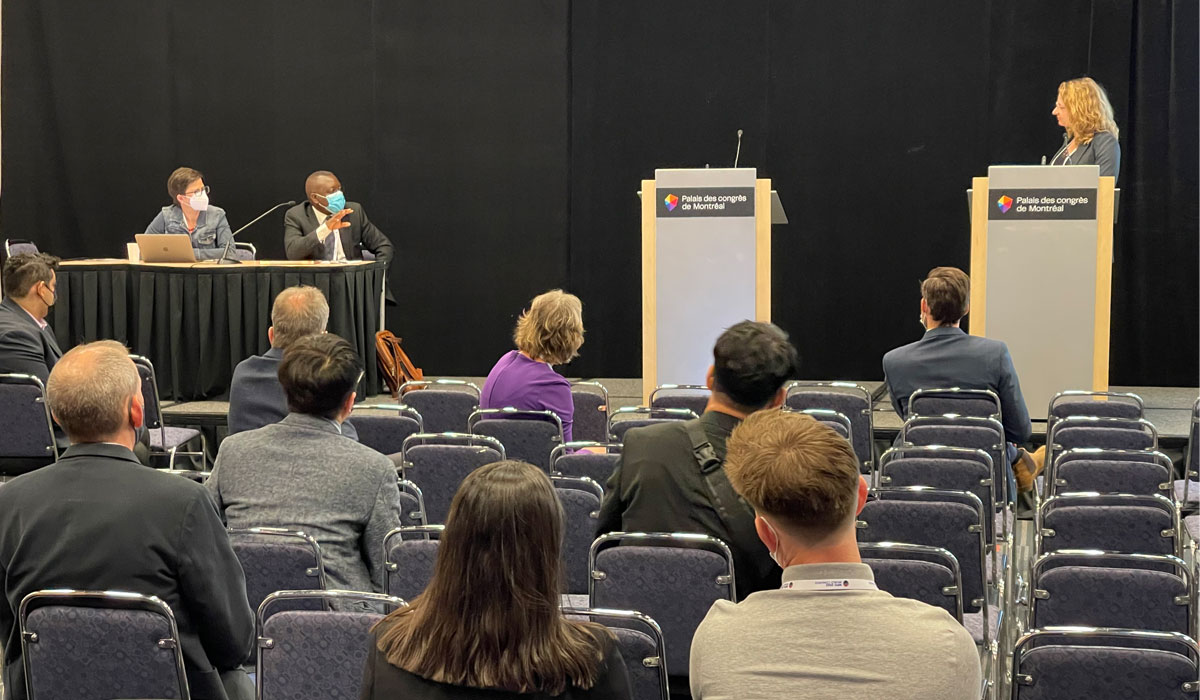
The first presentation of the session was, “Patients’ and Healthcare Providers’ Experiences with Hemophilia Care in the Netherlands: a Survey and Interview Study” given by Martijn Brands, MD, PhD-candidate at the Department of Pediatric Hematology, Emma Children’s Hospital, Amsterdam UMC, University of Amsterdam, Netherlands. Brands began by covering the patient perspective. The study showed that 96.5% of patients are very satisfied with their care. Patients usually ask what the new treatment options are, and how they can learn from others and better organize care for themselves. When it comes to new developments, patients also wonder if the new treatment will come to their country, and if it will be prescribed by their healthcare practitioner (HCP).
Brands also reported his findings regarding the difference between getting care from hemophilia treatment centres (HTCs) versus non-HTCs. The study found that care at HTCs is faster, friendlier, and more engaged. Also, when treated at non-HTCs, patients see multiple doctors, so there is sometimes less accountability. The issue of having access to a computer for virtual care was also discussed. In this case, the concern is that some patients don’t have access to a computer, and those that do sometimes feel that the quality of virtual care is inferior to that of home care. The conclusion is that care delivered outside of HTCs is less organized than care delivered within HTCs. Also, HTCs can improve coordination by appointing one professional who is responsible, and by improving the digital exchange of health information.
Lieke Baas, PhD Candidate, Julius Centre for Health Sciences and Primary Care, University Medical Centre Utrecht, Netherlands gave a talk called, “Ethical concerns of gene transfer for haemophilia: A qualitative interview study”. The talk shared into Dutch stakeholders’ morally reasoned opinions on gene transfer for people with severe hemophilia. Some concerns regarding gene therapy treatment were feared increased dependence, continued uncertainty even if the person is considered “cured”, different perception of risks and burdens, individual differences, and physician trust. One conclusion was that no participant considered themselves hemophilia-free after treatment. Despite the many questions, however, no participants were opposed to gene therapy, and many participants were eager to participate in research.
“Management of women with type 2B von Willebrand disease during pregnancy and postpartum: Evidence from literature, data from international registry and physician survey” was given by Abdelrahman Noureldin from Queen’s University, Canada. Von Willebrand disease (VWD) presents challenges, including with diagnosis. Specifically, poor application of RIPA/ RIPA mixing studies; genotype phenotype variations; poor awareness; and the physiological rise in VWF during pregnancy are all of concern. The research looked at demographic data, hemostatic lab parameters, bleeding complications, lab parameters stratified by bleeding, treatment modalities, mode of delivery and pregnancy outcomes, and international survey data. The conclusions were that the patients had a high risk of bleeding complications; that there was no safe target of VWF levels identified; that diverse practices exist in terms of types, dosing and timing of therapy; and that international guidance was needed to inform management.