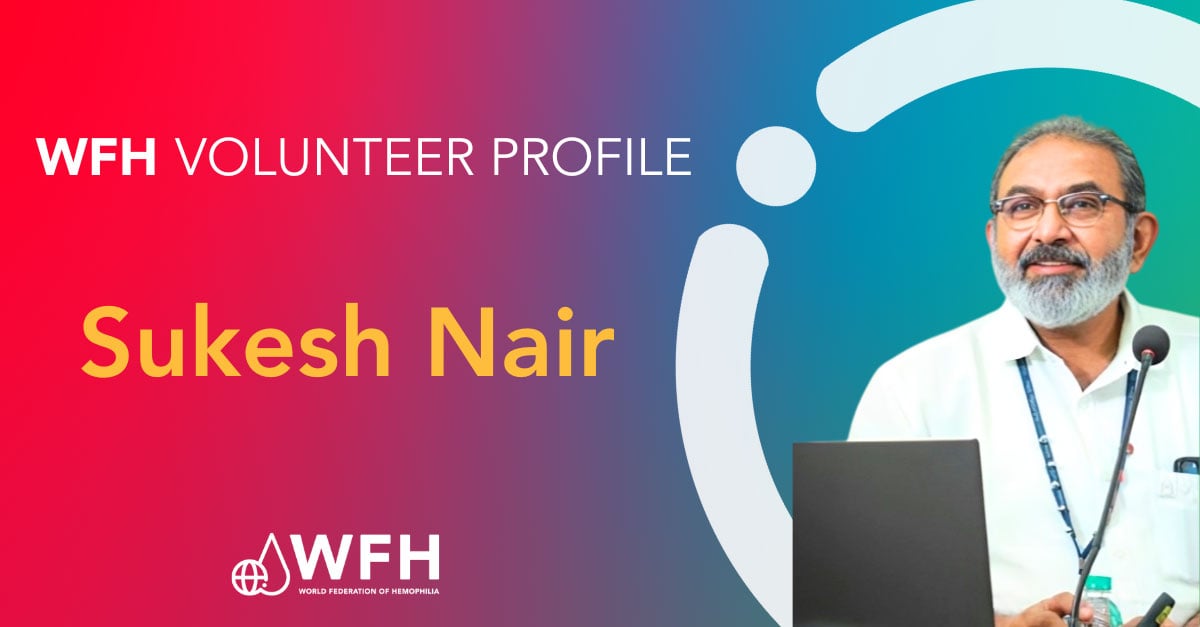
Today, we are profiling a WFH volunteer who has generously given—and continues to give his time to the global inherited bleeding disorders community. Read on to hear the story of Sukesh Nair, MD, from India.
When did you first start volunteering within the bleeding disorders community and in what capacity?
I first participated in a WFH laboratory workshop with the Hemophilia Federation India (HFI) in Coimbatore, India, in 1996. I was a young faculty member at Christian Medical College in Vellore, India. My involvement with the WFH really began to pick up in 2003 after I got back from my fellowship in hematology in Sydney, Australia. At that point I started to do many WFH laboratory workshops.
You have been a volunteer for the WFH for some time. What has motivated you to give your time to our cause?
I got an opportunity to attend the second “training the trainers” workshop held at the Katharine Dormandy Haemophilia and Thrombosis Centre at the Royal Free Hospital in London, U.K., following the WFH 2004 World Congress in Bangkok, Thailand. This gave me an opportunity to meet many WFH staff. After this I got an opportunity to go to Abuja, Nigeria, to do a laboratory workshop for the country’s NMO.
The experiences I had at that point in my career opened my eyes to a situation in the world that I hadn’t seen before: the lack of facilities, lack of skilled personnel and more so lack of urgency in favour of the bleeding disorders communities in many countries. Also, it dawned on me that to address this need, an organization like the WFH would need many volunteers.
Making workshop experiences more hands-on was something I felt I could bring to the table as a volunteer. I developed the idea of initially getting diagnostic companies involved in workshops to make sure the reagent maintains its quality by the time it reaches the lab. I also wanted these companies to see the daily challenges that lab workers in laboratories have. Later, this approach extended beyond just reagents to having the companies handle all the requirements for a workshop.
You served as a member of a committee and as a faculty in many WFH workshops. What do you value the most out of those experiences?
Being chair of the WFH Lab Sciences Committee was an enriching experience. It brought me to many parts of the world, to meet many people, make good friends—some for life—and have some great memories. At the same time, it was sometimes discouraging to see how things are in many countries. There were moments when I felt that perhaps nothing will come out of the effort that is being invested by the WFH and its volunteers. However, one can always see the light at the end of the tunnel if one perseveres. In my case, this happened when I was able to motivate at least one person in each workshop—really light a fire in them. I’ve done this many times and it’s a wonderful feeling.
You were the recipient of the WFH International Healthcare Volunteer Award in 2024. How did you feel about being acknowledged by WFH?
It felt great not only to receive the recognition, but also to hear the roar that filled the auditorium when my name was announced. There are many people I know who deserved that award more than I—for I have seen their hard work—but that roar still rings in my ears.
What advice do you have for anyone who might be thinking about volunteering with the WFH or with their NMO?
Being a volunteer or being asked to volunteer is itself a recognition and hence comes with a lot of responsibility—especially when the organization is the WFH. For the first time it is natural to have a feeling that we will bring about a sea change to benefit the community and leave a mark. It is good to have that confidence, but it’s also important to not get discouraged when you realize how hard it is to bring change to anything.
For people who work in a technical setting, it’s important to realize that the latest techniques which you are used to employing may not be available at the place where you are going to do your training. Hence, it is a good habit to understand the current situation before you embark on your volunteering journey. This will give you the time to prepare yourself. In my case, I had to prepare myself to train people on techniques like bleeding time for people with severe von Willebrand disease or platelet disorders; activated clotting time in severe hemophilia; and spiking with concentrate to correct deficiencies—all in settings that I was not used to.
In general, I recommend that volunteers on the medical side focus on methods to identify and diagnose patients that present with severe bleeding symptoms rather than milder forms. Also, you should realize that many hemophilia treatment centres (HTCs) have access to different treatment products, so the challenge is really to give the right diagnosis and the right treatment.
Ultimately, nothing can replace the importance of quality volunteering time.
To read about Deon York—another long-time WFH volunteer—click here. To find out more about volunteering with the WFH, click here.
Read about more WFH volunteers
To find out more about volunteering with the WFH, click here. To read about other WFH volunteers who have had an impact on our community, see below:
- To read the story of Deon York (Ireland), a former WFH board member, click here
- To read the story of Mary Byrne, a laboratory scientist from Ireland, click here
Join us
You can take your impact even further by contributing to the work we do. Every gift, no matter how small, helps provide life-saving support and improve outcomes for people living with bleeding disorders worldwide.
