The WHO EML has a critical role in guiding national governments on the selection and financing of essential medicines for a range of conditions, including hemophilia. These revisions mean that decision makers will be using up-to-date recommendations when making key decisions that will impact treatment for people with hemophilia.
The updates to the WHO EML mean that thousands of PWBDs now have greater hope for a better future. The WFH is proud to have led a united global effort to make this milestone possible. Together, we are shaping a future where our vision of Treatment for All can become a reality.”
—Cesar Garrido, President, WFH
The request to update the WHO EML was built on key revisions that were needed to improve listings for the treatment of hemophilia and VWD. Today, prophylaxis is the internationally recognized standard of care for people with hemophilia. A range of virally safe and effective therapies are available for people with hemophilia and VWD. Conversely, cryoprecipitate (whether pathogen-reduced, PR-Cryo, or not) cannot be used for prophylaxis. Furthermore, cryoprecipitate poses a significant risk of transmission of bloodborne infections.
The revisions introduced in the recently published 24th EML and 10th EMLc will help to increase equitable access to safer and more effective therapies for PWBDs worldwide. Outlined below are the critical changes made to the EML and EMLc, in relation to the medicines indicated for treatment of hemophilia and VWD.
New medicines added to the EML and EMLc
- Bi-specific monoclonal antibody, emicizumab, was included on the core list
- Recombinant FVIII and FIX clotting factor concentrates (CFCs) was included on the core list
Revisions made to existing medicines listed on EML and EMLc
- Plasma-derived FVIII and FIX CFCs were transferred from the complementary to the core list
- Desmopressin was transferred from the complementary to the core list
Medicines or formulations deleted on EML and EMLc
- Both pathogen-reduced and non-pathogen reduced cryoprecipitate were removed as indications for the treatment of hemophilia and VWD
- Factor IX Complex (also known as prothrombin complex concentrate (PCC)) was deleted as a therapeutic alternative to FIX CFCs
The WHO’s decision to update the Essential Medicines Lists marks a major step forward in ensuring access to modern, effective treatments for people with bleeding disorders worldwide. This milestone was only possible thanks to the strong support and collaboration of scientific and patient advocacy organizations across the world. Together, we have helped align global policy with the best clinical standards, making the EML a strong advocacy tool to countless patients and families in countries that don’t have full access to these therapies.
—Glenn Pierce, MD, PhD, Vice President, Medical, WFH
This milestone for our community was realized thanks to a joint effort led by the WFH, underscoring the wide-reaching commitment across institutions, experts, and organizations to update the EML.
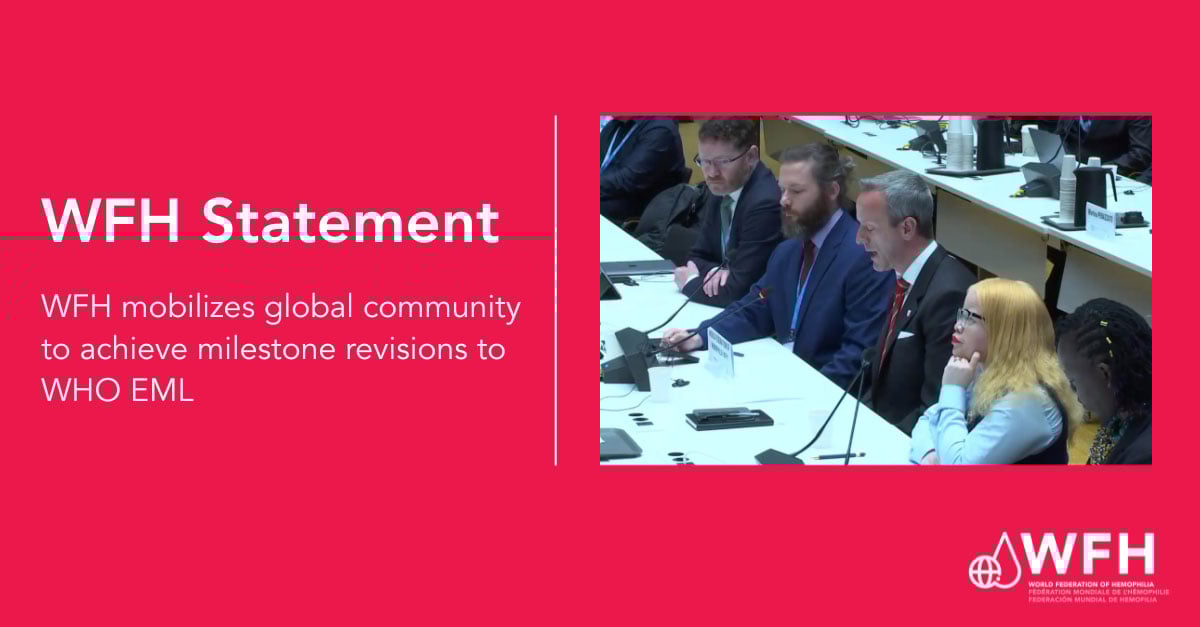
The process included the WFH undertaking a two-year-long ongoing direct dialogue with the WHO Headquarters and consulting with the EML Secretariat closely throughout the application process. The WFH was also an active participant at the meeting of the WHO 25th Expert Committee on the Selection and Use of Essential Medicines, and made a statement in favour of updating the guidelines during the public session on May 5, 2025.
The WFH also summarized its concerns about the outdated recommendations in “Risk of harm to people with haemophilia from the 2023 WHO Essential Medicines List” published in The Lancet Haematology in September 2024.
The WFH would like to acknowledge and express its gratitude to its national member organizations (NMOs), expert clinicians, hemophilia treatment centres (HTCs) and scientific and patient advocacy associations from around the globe that supported this endeavour. A joint letter of support addressing the WHO Director General was endorsed by 115 WFH NMOs, while another was signed by over 120 expert clinicians representing every region of the world. Additional individual letters of support came from leading medical and patient associations, including the European Association for Haemophilia and Allied Disorders (EAHAD), the European Haemophilia Consortium (EHC), the International Society on Thrombosis and Haemostasis (ISTH), the Association for Haemophilia and Allied Disorders – Asia Pacific (AHAD-AP), Grupo Cooperativo Latinoamericano de Hemostasia y Trombosis (CLAHT), the Association for the Advancement of Blood and Biotherapies (AABB), the Indian Association for Haemophilia and Allied Disorders (IAHAD), the International Patient Organization for Primary Immunodeficiencies (IPOPI), Rare Diseases International (RDI), the Plasma Protein Therapeutics Association (PPTA), the International Plasma and Fractionation Association (IPFA), the Cerus Corporation, and other organizations.
This wealth of support from our NMOs, expert clinicians, partners and collaborating scientific and patient associations is a true testament of how our global bleeding disorders community can come together for a common cause and in service of our shared vision of Treatment for All.
The three WFH submissions for the 2025 update of EML and EMLc, respective letters of support and the WFH Statement made at the meeting of the WHO 25th Expert Committee on the Selection and Use of Essential Medicines can be viewed here.
To view the WFH publication on “Risk of harm to people with haemophilia from the 2023 WHO Essential Medicines List” published in The Lancet Haematology, please click here.
To view the recently-published 24th Essential Medicines List and the 10th Essential Medicines List for Children of the World Health Organization (WHO), please click here.