The situation for people with bleeding disorders (PWBDs) in the West African country of Senegal was very dire until 2015, when the WFH Humanitarian Aid Program’s expansion meant that, for the first time, regular and predictable treatment product donations and training were made available to the country.
Aissatou Toure, MD, is a Hematologist at the Centre National de Transfusion (National Blood Transfusion Centre). She explains that WFH Humanitarian Aid Program donations have been a huge help forward for the Senegalese bleeding disorders community because the government doesn’t buy any treatment products. She says that PWBDs benefit, but so do physicians like her who can better manage their patients, because less patients in their clinics means they no longer have to work from one emergency to the next.
“There are a lot of students who have benefitted from donations, and their families are really happy with the improvements in care that [non-factor replacement therapy] treatments provide,” says Saliou Diop, MD, a Hematologist and the Director of the Centre National de Transfusion. He goes on to say that where once a child might bleed four or five times a month, now, with the new treatment, they might not have a single bleed.
With this new treatment, this is the first time I’ve seen my child go to school for the whole school year, without having any hemophilia-related absences.
—Maimouna, mother of Abdou, a 6-year-old boy with hemophilia
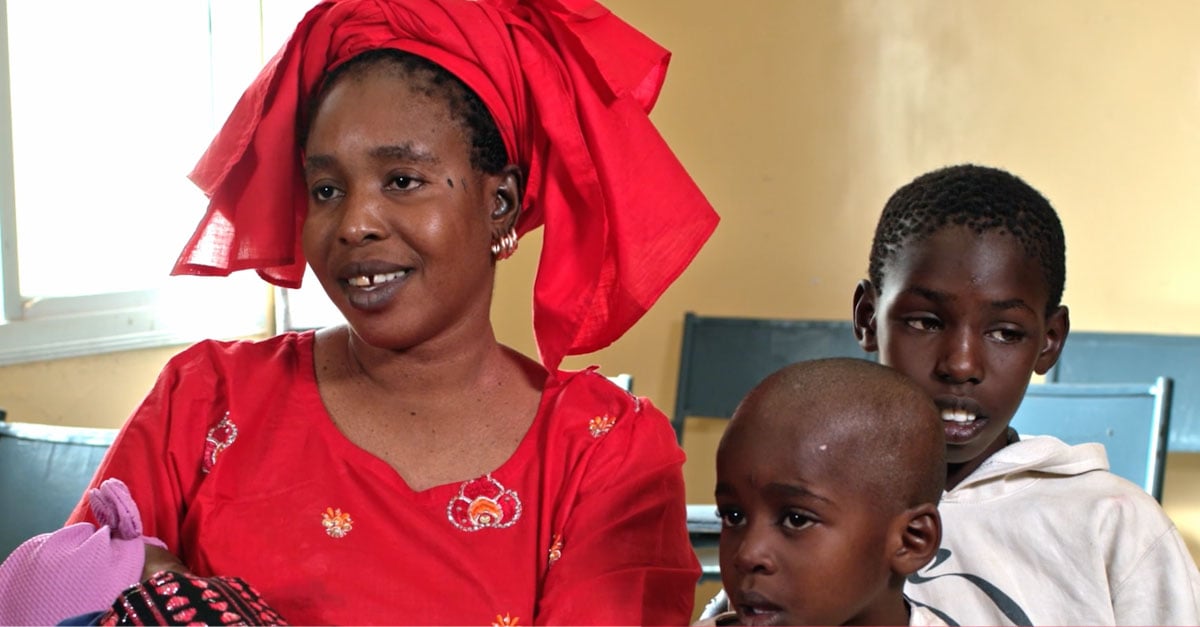
Fatima is a mother of two children with hemophilia. She recalls having many sleepless nights where she would have to care for her boy who was suffering from an acute bleed. It was tough on the child, on her, and on the family. Now, things are different. She says that today when her son is injured, it doesn’t result in a debilitating bleed anymore. “When school started and he was injured, he couldn’t go to school,” she says. “[Now] he plays soccer without any problem and he’s not injured when he comes back.”
A similar story is shared by Mathieu, the father of Landry, a 9-year-old boy with hemophilia. He says his son’s life revolved around missing school before WFH Humanitarian Aid Program donations. Now, Landry goes to school like any other boy. “I’m more comfortable, I’m less on edge,” Mathieu says. “Previously, when I couldn’t see him, I would worry. But now I’m less and less worried.” This theme of healthier kids with a bleeding disorder and happier parents is getting more and more common in Senegal. Parents are now less stressed, and they can work more consistently because their child is not sick all the time.
“In 2015, we noticed a lot of joint problems, a lot of complications [related to] bleeding episodes,” explains Assad Haffar, MD, WFH Medical & Humanitarian Aid Director. “[Now] we can hardly detect any complications, particularly since [the WFH] was here in 2015.” Children who once would miss months of school have now gone on to university and rewarding careers in the workforce. Of course, the community is extremely grateful for the change that the WFH Humanitarian Aid Program has brought to Senegal. “We have nothing but good things to say about the Program,” says Abdoulaye Loum, President, Association Sénégalaise des Hémophiles (Senegalese Hemophilia Society). “This program provides us with the necessary factor to be able to treat the different people with hemophilia in Senegal. And not only those who are in Dakar [the capital city], but in the whole of Senegal.” Loum himself has benefitted from the higher level of care in the country: in the past, his inhibitors resulted in him having many bleeds and, as a result, joint damage. Now, thanks to Program donations, he has hardly any bleeds.
Since 2015, nearly 11 million IUs of factor have been donated to Senegal. Just over 1.2 million IUs of factor were donated in 2022 alone, along with almost 73,000 mg of non-factor replacement therapy. To find out more about the WFH Humanitarian Aid Program supporting advocacy in Senegal, watch the video here. To find out more about the WFH Humanitarian Aid Program, please click here.
About the WFH Humanitarian Aid Program
The WFH Humanitarian Aid Program improves the lack of access to care and treatment by providing much-needed support for people with inherited bleeding disorders in developing countries. By providing patients with a more predictable and sustainable flow of humanitarian aid donations, the WFH Humanitarian Aid Program makes it possible for patients to receive consistent and reliable access to treatment and care. None of this would be possible without the generous support of Sanofi and Sobi, our Founding Visionary Contributors; Bayer, CSL Behring and Roche, our Visionary Contributors; Grifols, our Leadership Contributor; and Takeda and Japan Blood Products Organization, our Contributors. To learn more about the WFH Humanitarian Aid Program, visit www.treatmentforall.org.