WFH Humanitarian Aid Program donations have been nothing short of transformative for the Jamaican bleeding disorders community. In the past, people with bleeding disorders (PWBDs) would have suffered through painful, acute bleeds which would have most often led to permanent joint damage. Even more tragically, the life of many PWBDs in Jamaica was cut all too short because of a catastrophic bleed. Now, many PWBDs in the country have access to prophylactic care and have gone months—or even years—between bleeds.
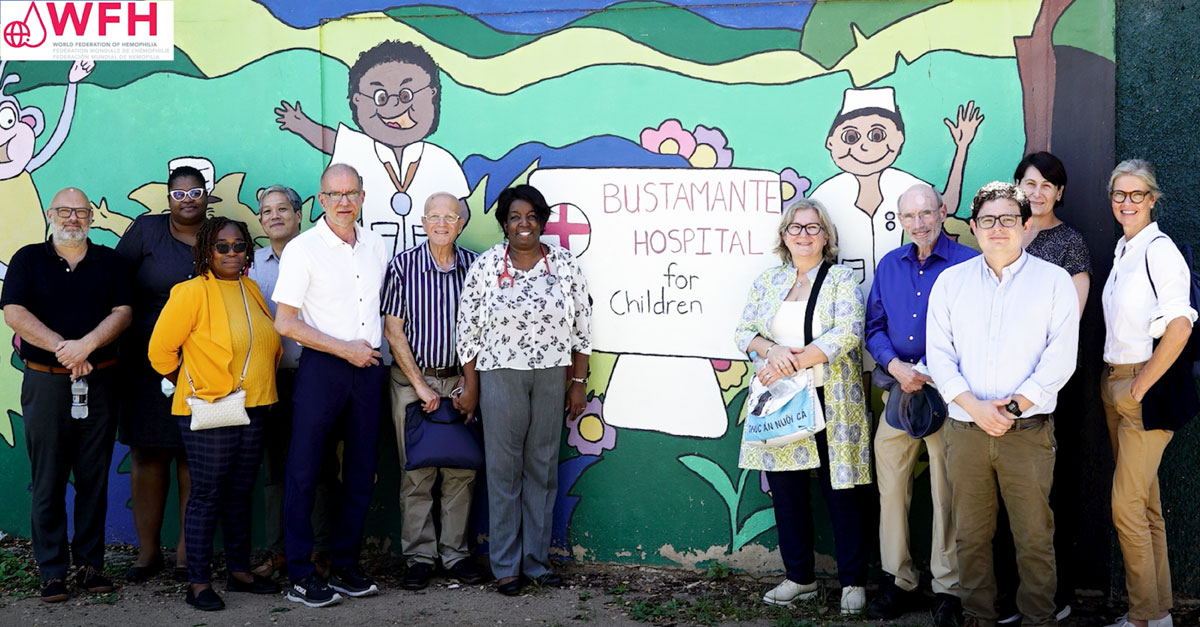
In October 2023, the WFH Humanitarian Aid Program team went to Jamaica to establish how care was improving in the country, and to optimize future aid. They heard many encouraging examples of how WFH support is changing lives.
The first stop for the team was at the Bustamante Hospital for Children, where they heard the story of how donations literally saved one newborn’s life. About 24 hours after birth, the boy developed a head bleed which wouldn’t clot. It wasn’t long before the situation became serious: he had a hemoglobin level of 2.1 and his mother feared for his life. Doctors said they had only seen hemoglobin levels that low once before—in a child who subsequently died. Fortunately, the hospital had factor on site, and they quickly administered some to the boy. He soon recovered, was put on prophylaxis—and he hasn’t had a bleed since 2021.
For another mother, access to factor has meant more than her son enjoying a more normal life. It has meant that she can go back to work and help support her family. She explains that in the early stages when her son was very young, she had to go to the hospital so often that having a job was simply impossible. Now, the situation is completely different. Her son is on prophylaxis, and rarely has bleeds. Consequently, she has been able to hold the same job for three years.
On day two, the team visited the University Hospital of the West Indies. There, they had the opportunity to speak with many patients whose lives have drastically improved since the expansion of the WFH Humanitarian Aid Program in 2015. One patient said that for most of his life he had sporadic access to treatment product; now he can count on regular infusions to control his bleeds. Another said that unlike his generation, the next would be able to maintain their joint mobility—something which will have a massive impact on their quality of life. Another said simply that thanks to Program donations, “The last year and a half have been the best of my life.”
Over 795 thousand IUs of factor have been donated to Jamaica through the WFH Humanitarian Aid Program so far in 2023, along with 76 thousand IUs of non-factor replacement therapy. Since 2015, over 7.5 million IUs of factor, and almost 200 thousand IUs of non-factor replacement therapy have been donated. To find out more about the WFH Humanitarian Program, please click here.
About the WFH Humanitarian Aid Program
The WFH Humanitarian Aid Program improves the lack of access to care and treatment by providing much-needed support for people with inherited bleeding disorders in developing countries. By providing patients with a more predictable and sustainable flow of humanitarian aid donations, the WFH Humanitarian Aid Program makes it possible for patients to receive consistent and reliable access to treatment and care. None of this would be possible without the generous support of Sanofi and Sobi, our Founding Visionary Contributors; Bayer, CSL Behring and Roche, our Visionary Contributors; Grifols, our Leadership Contributor; and Takeda and Japan Blood Products Organization, our Contributors. To learn more about the WFH Humanitarian Aid Program, visit www.treatmentforall.org.