The WFH has several programs active in India, including the WFH Humanitarian Aid Program, the WFH Path to Access to Care and Treatment (PACT) Program, the WFH Twinning Program, the WFH International External Quality Assessment Scheme (IEQAS), and other programs and endeavours. All these efforts are working towards a single goal: working closely with the local inherited bleeding disorders community to help them offer fully sustainable support and care to those who need it.
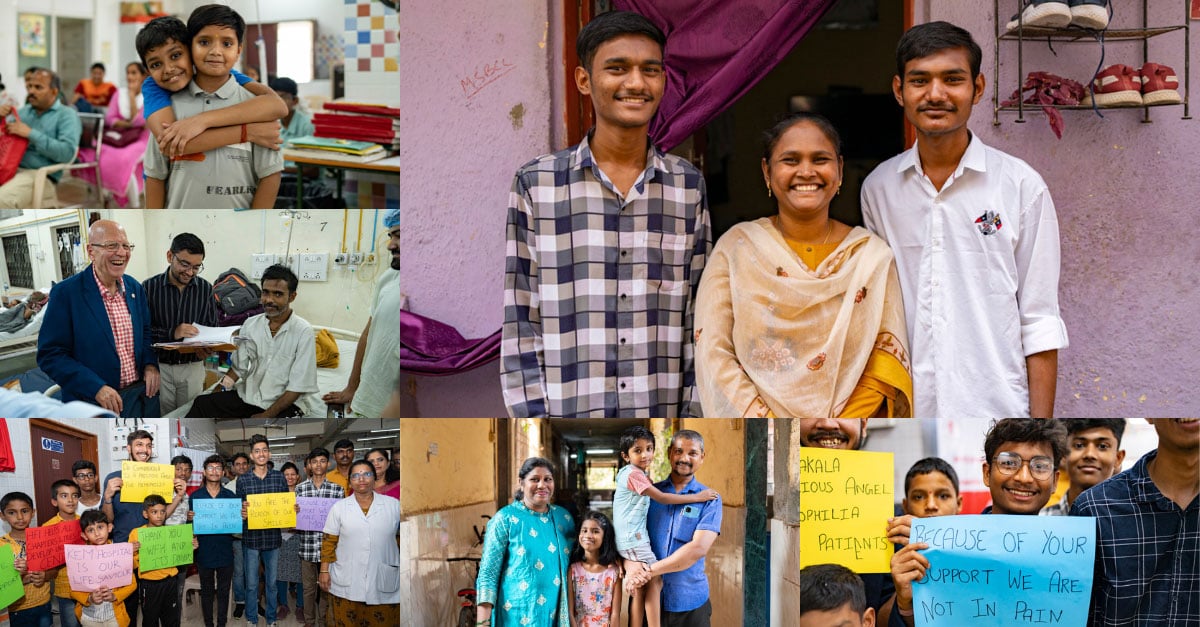
WFH Humanitarian Aid Program donations increased significantly in 2015 with the expansion of the Program, and the difference has had a major impact on people with bleeding disorders (PWBDs) in India—where about 30% of the total WFH Humanitarian Aid Programs donations are delivered. “I have seen lives change because of this program,” explains Harshal Kale, WFH Regional Manager, South Asia & East Asia. “I have seen people getting [medical operations] and going back to their normal lives.”
The WFH has been the backbone [of the Hemophilia Federation of India (HFI)] since our inception in 1983. Our relationship in the medical fraternity has drastically improved with the [increase of treatment] products.
—Prem Roop, President of the Hemophilia Federation of India (HFI)
Shubhranshu S. Mohanty, MD, Professor and Unit Head, Orthopedics at the King Edward Memorial Hospital in Mumbai, says that close collaboration with the WFH has been a key success factor for his hospital. This collaboration includes maximizing the benefits of the different WFH programs in India, including getting the most out of training and product donations. Today, physicians are confident enough to treat many different complications related to bleeding disorders, including synovitis, pseudotumors, fractures, joint replacements—and even a robot-assisted knee replacement surgery. About 150 surgeries are performed every year, and each of these surgeries uses treatment product donated by the WFH Humanitarian Aid Program.
For one family, Program donations have been literally life changing: Rahul is a deaf person with hemophilia. When he was a child, he fell and hurt his knees badly enough that he couldn’t walk. “I used to carry him. I had to climb a bridge with him,” his mother explains. “We used to take him to the school on a wheelchair. And we took him back on a wheelchair.” Then he started receiving donated factor, and his condition improved enough for him to be eligible for surgery. This surgery allowed him to walk again. He’s now able to contribute to chores at home and is no longer a burden to his family.
Thanks to greater collaboration with the WFH, the relationship between the bleeding disorders community, medical specialists and the Hemophilia Federation of India (HFI), has never been stronger. “The WFH has been the backbone [of the Hemophilia Federation of India (HFI)] since our inception in 1983,” says Prem Roop, President of the Hemophilia Federation of India (HFI). “Our relationship in the medical fraternity has drastically improved with the [increase of treatment] products.”
The experiences of all stakeholders in India can be summarized as follows: collaboration, dependable treatment product donations and prophylaxis are the key to improving care for PWBDs in India. In short, this is the impact that the WFH is having in India through the WFH Humanitarian Aid Program and other initiatives.
Almost 42 million IUs of factor were donated to India through the WFH Humanitarian Aid Program in 2023. Since 2015, over 370 million IUs of factor have been donated to India. To find out more about the WFH Humanitarian Program, please click here.
About the WFH Humanitarian Aid Program
The WFH Humanitarian Aid Program improves the lack of access to care and treatment by providing much-needed support for people with inherited bleeding disorders in developing countries. By providing patients with a more predictable and sustainable flow of humanitarian aid donations, the WFH Humanitarian Aid Program makes it possible for patients to receive consistent and reliable access to treatment and care. None of this would be possible without the generous support of Sanofi and Sobi, our Founding Visionary Contributors; Bayer, CSL Behring and Roche, our Visionary Contributors; Grifols, our Leadership Contributor; and Takeda and Japan Blood Products Organization, our Contributors. To learn more about the WFH Humanitarian Aid Program, visit www.treatmentforall.org.