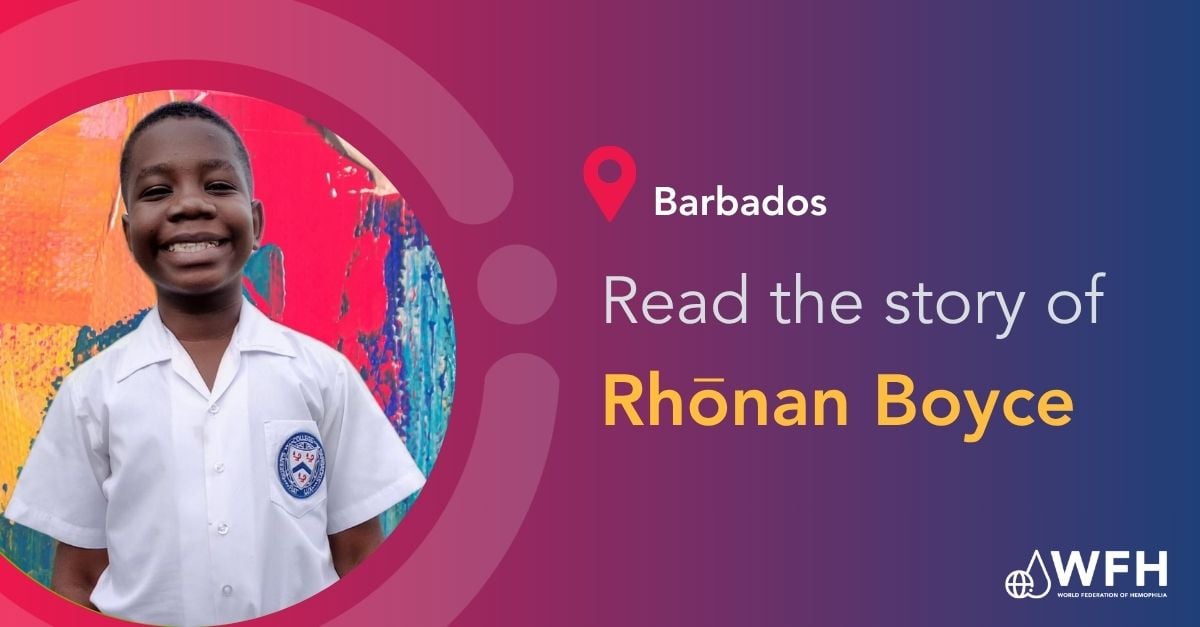
The day Rhōnan Boyce was brought to the hospital to have his bruise treated, he was transferred to the pediatric unit at the Queen Elizabeth Hospital in Bridgetown, Barbados, after emergency physicians suspected a bleeding disorder. The diagnosis of severe hemophilia was a shock to his family. “Rhōnan had hemophilia A. How? How was this possible?” his mother remembers asking, noting that no one else in the family had ever been diagnosed with the condition. Soon after, the family learned that Rhōnan would require clotting factor infusions three times a week.
As traumatic as it was for the family to learn of their son’s condition, they were fortunate to have had the diagnosis at all. In many countries, people with a bleeding disorder spend their entire lives suffering because of their condition—without ever knowing why. In Barbados, care levels are much better, thanks to support provided by the WFH—and particularly, the WFH Humanitarian Aid Program.
As Rhōnan grew older, treatment became increasingly difficult. Regular intravenous infusions were challenging, and he experienced ongoing acute bleeds in his muscles and joints. Social moments could also be painful. “To watch him on the sidelines… to hear him say he wasn’t picked because others did not want to hurt him brought tears to my eyes on more than on occasion,” his mother recalls. “But he has always been resilient.”
The family faced another setback when Rhōnan developed an inhibitor, a complication that makes standard treatments less effective. Concern about his health and future weighed heavily on his parents, especially when bleeding episodes forced him to miss school.
Once he started on non-factor replacement therapy his quality of life changed drastically… He is [now] able to play with his classmates… and he continues to excel in school. In short, he has a normal life.
—Renée Boyce, Rhōnan’s mother
Hope arrived when Rhōnan’s hematology team learned he could receive non-factor replacement therapy provided by the WFH Humanitarian Aid Program. Since starting the treatment, Rhōnan’s life has been transformed. He now receives injections every two weeks instead of intravenous infusions several times a week. Acute bleeds have stopped, and he rarely misses school. Now 13, Rhōnan is thriving. He enjoys playing sports like volleyball and football and has even joined a soccer club—activities that once seemed impossible. In short, he—and his family—can enjoy a normal life.
The WFH Humanitarian Aid Program has donated over 3.7 million IUs of factor and 8,000 mg of non-factor replacement therapy to Barbados since 2015. Over 1 million IUs of factor, and 4,000 mg of non-factor replacement therapy were donated in 2025 alone. To find out more about the WFH Humanitarian Aid Program please click here.
About the WFH Humanitarian Aid Program
The WFH Humanitarian Aid Program improves the lack of access to care and treatment by providing much-needed support for people with inherited bleeding disorders in developing countries. By providing patients with a more predictable and sustainable flow of humanitarian aid donations, the WFH Humanitarian Aid Program makes it possible for patients to receive consistent and reliable access to treatment and care. None of this would be possible without the generous support of Sanofi and Sobi, our Founding Visionary Contributors; Bayer, CSL Behring and Roche, our Visionary Contributors; Grifols, our Leadership Contributor; and Takeda, our Contributor. To learn more about the WFH Humanitarian Aid Program, visit www.treatmentforall.org.