In 2016, Egypt was enrolled in a phase II of the WFH Global Alliance for Progress (GAP) Program to help improve diagnosis and advocacy in the country—ultimately so members of the bleeding disorders community could have more accessible treatment. The WFH worked alongside medical and lay volunteers from the Egyptian Society of Hemophilia (ESH)—including Magda Rakha, MD, President of the ESH; Sonia Adolf, MD; and Isis Soliman, MD—in order to make this important endeavour a success.
The GAP Program has a very personal meaning for many members of the ESH, including Mohammed Abu-Hagar, whose younger brother Mustafa (who had severe hemophilia A) died from an intra-cranial bleed following a car accident. Unfortunately, local doctors at the time were not aware of the complications related to hemophilia, and as a result, Mustafa did not receive the care he needed. Abu-Hagar vowed to work with the ESH as a lay volunteer any way he could so that other children would not suffer the same fate as his brother. His efforts have been successful, and he recently witnessed a case where increased knowledge of bleeding disorders in the medical community helped improve the quality of life of a young man previously unable to walk. “We have come a long way,” said Mohammed, “and all of us at ESH will continue our fight to ensure that every single PWH in Egypt receives prompt care and treatment and lives a pain-free life.”
GAP Program support in Egypt has taken many forms. For example, the WFH was represented at the annual hemophilia highlight session of Egypt’s Society for Pediatric Hematology and Oncology (ESPHO) congress. The WFH also organized several workshops, such as sessions on the effective use of extended half-life (EHL) products; MSK complications, national laboratory diagnosis; psycho-social training for nurses and social workers; and a national youth leadership training. Over the last five years, WFH events have trained and raised the awareness of more than 700 healthcare practitioners (HCPs) and 1,600 lay volunteers.
As a result of WFH GAP Program efforts and the dedication of the ESH, Egypt has made solid progress in decreasing the gap between identified vs expected people with hemophilia (PWH). For example, an additional 777 PWH have been identified between 2015 and 2019—bringing the total identified PWH in Egypt from 5,420 in 2015 to 6,197 in 2019. This represents 60% of Egypt’s expected PWH population as per the Annual Global Survey 2019. There was an 80% increase in government procurement of treatment products over the same period—although levels remain lower than required. “While we have done very well to identify new members of our community,” explains Rakha, “most of our new members have severe and moderate cases. This indicates that we need to work harder to identify the mild cases and to also reach communities in villages and cities far from Cairo.”
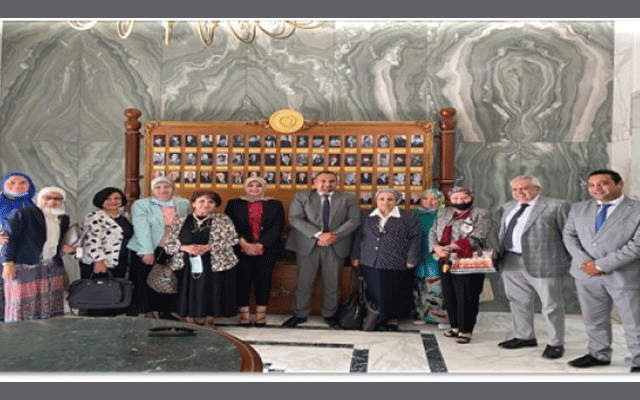
Now in Egypt, hemophilia care is much better coordinated under a national plan based on national treatment guidelines, and government advocacy efforts are having a positive impact on the quality of care in the country. A July 2020 meeting that members of the ESH and leading hematologists had with the Prime Minister’s Medical Committee and Health Adviser has helped bring high-priority needs to the attention of policy makers at the highest levels in Egypt. These efforts will continue through regular meetings to discuss increasing access to replacement and novel therapies. The ESH will be working actively with the government to ensure that the WFH Guidelines for the Management of Hemophilia, 3rd edition are integrated into Egyptian health protocols. With WFH support, Egypt is also leading the way in the Eastern Mediterranean in systemizing and documenting inhibitor management through an immune tolerance induction (ITI) pilot program. The ESH has also advanced musculoskeletal services through individually customized treatment plans using Exercise Pro software. Through advocacy, Egypt has also increased the number of PWH on prophylaxis, and an agreement has been secured from the government to expand prophylaxis coverage for all children under 6 years of age in the government’s health-insurance-run hemophilia treatment centres (HTCs).
Despite the impressive progress in recent years, the vision of Treatment for All in Egypt is far from becoming a reality. El-Ekiaby said, “We have made steady progress in improving access to care and treatment in recent years, but we still have many challenges ahead. Our priority moving forward is to increase the procurement of factor to help us apply universal prophylaxis and home therapy. We also need to improve the management of patients with inhibitors. The collaborative roles of the WFH, the ESH, HCPs and the government are key to address these challenges and improve the quality of life for all members of the bleeding disorders community.”
We offer our thanks and gratitude to the following WFH Board Members, current and former WFH Committee Members, and all other volunteers for their active support to GAP activities in Egypt through visits and knowledge sharing particularly Glenn Pierce, Magdy El-Ekiaby, Dawn Rottellini, Johnny Mahlangu, Pierre Toulon, Sukesh Nair, Frederica Cassis, Adolfo Llinas, Mauricio Silva and Adly Sabbour.
The GAP Program is supported by funding from: Bayer, Biotest, CSL Behring, Pfizer, Sanofi Genzyme, Sobi and Takeda. The WFH would also like to thank the World Health Organization for its support of the Program.