With the volume of donations it facilitates around the world and in the number of individuals and countries it reaches and serves, it is truly unique in its scope. In 2017, the program helped distribute more than 160 million IUs of clotting factor concentrates (CFC) to 60 countries. The donated CFCs reached more than 16,000 patients and were used to treat more than 45,000 bleeding episodes. The donations also helped make 781 major and minor surgeries possible and allowed 1,210 patients to be put on prophylactic treatment.
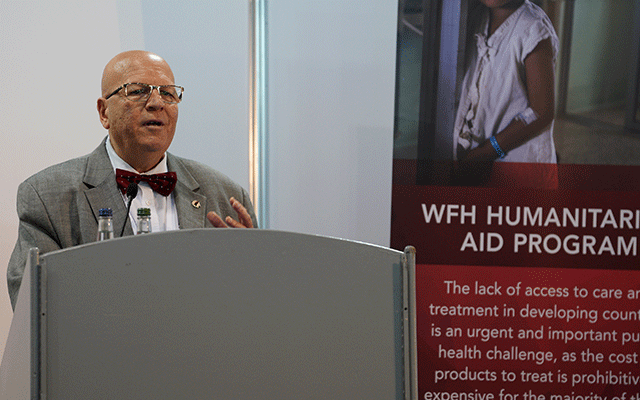
The WFH Humanitarian Aid Program was recently highlighted during the WFH 2018 World Congress which took place in Glasgow, Scotland, this past May. Alain Weill, WFH President, took the opportunity during the session WFH Humanitarian Aid Program: Catalyst towards global change to reiterate his call to action for all manufacturers to contribute to this program. Glenn Pierce, MD, WFH VP Medical, addressed the importance of training to maximize the impact of the program. He also touched upon some of the challenges the WFH faces related to the program. John Cox, CEO of Bioverativ, a Sanofi company, and Guido Oelkers, CEO of Sobi—the two companies that are visionary contributors to the program—spoke during this session about the importance of contributing. They outlined how important it is for their organizations to participate in humanitarian aid efforts and help people with hemophilia in developing countries. They added that companies have a moral responsibility to continue supporting people in need and they encouraged more manufacturers to join together to contribute to this program.
Haemophilia Journal recently published an article that covered achievements of the WFH Humanitarian Aid Program in 2016—a year after the program’s scope was expanded (G. F. Pierce et al, Haemophilia. 2018;24:229-235). Along with contributions by WFH staff and volunteers, Pierce explored the situation in recipient countries before the expansion of this program and highlighted how these countries could now respond to the treatment needs more effectively due to the increased predictability of donations.
In the article, Pierce and the other contributors describe the goals of the program, the country selection criteria, logistics, training and the key performance indicators (KPI) used in the program. In the discussion section, they described the challenges in recipient countries, including the lack of laboratory instrumentation and reagents, the lack of trained health care professionals, the under-diagnosed hemophilia population and the lack of home treatment. The authors concluded that increased confidence in the continuing prospective availability of sufficient CFCs was an incentive to improve care and management, organize active outreach program and diagnose more people with hemophilia. The article went on to show that humanitarian aid has allowed healthcare providers to perform corrective surgeries, put young children on prophylaxis and eradicate inhibitors by immune tolerance induction (ITI).
Contributors
The visionary contribution from Bioverativ, a Sanofi company, and Sobi to the WFH Humanitarian Aid Program translates into 500 million IUs over five years (2015-2020). Bioverativ and Sobi also make ongoing substantial financial contributions to support the logistics of product delivery and training of providers and patients in humanitarian aid countries. Furthermore, the eight-year commitment (2014-2021) from Grifols totaling 200 million IUs, along with a ten-year commitment (2009-2018) from CSL Behring for a total of 22 million IUs, and the three-year agreement (2017-2019) with Green Cross for 6 million IUs, allows for a more predictable and sustainable flow of humanitarian aid donations to the global community.