news-congress2018-ha-june2018

WFH Humanitarian Aid Program: catalyst towards global change

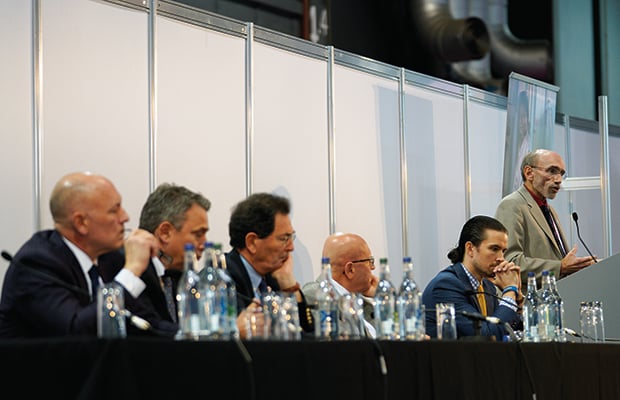
The highly-anticipated and well-attended “WFH Humanitarian Aid Program: Catalyst towards global change” session was one of the most popular sessions of this year’s Congress and delegates left with a broader understanding of the efforts of the World Federation of Hemophilia (WFH) to reach Treatment for All.

The session covered various aspects of the Program, including its overall vision and some insight into the community that the Program is looking to serve. Practical issues were also addressed, including some reflection on the scope of challenges faced when operationalizing a global program. The session comprised five speakers, including WFH President Alain Weill.

Weill highlighted the issue of increasing donations of factor concentrates—a key point of his second Call to Action—as well as the importance of training and the economic benefits the WFH Humanitarian Aid Program will bring countries.

The first presentation was given by Assad Haffar, Director of Humanitarian Aid Program, WFH, who laid out the vision of the Program and talked about some of the patients the Program was helping.

The audience then heard from Glenn Pierce, MD, PhD, who sits on the WFH Board of Directors. Pierce expanded upon the mission of the WFH Humanitarian Aid Program, including defining the scope of the challenges faced, the reality of operationalizing the expanded Program, addressing unmet needs and current training activities.

John Cox, Chief Executive Officer of Bioverativ, a Sanofi company and Guido Oelkers, Chief Executive Officer of Sobi then spoke to how their organizations have come together with the WFH, and other partners, to increase the reach of the Program. Both addressed the value of participating from a moral perspective and spoke powerfully on they felt it was imperative that more companies contribute to the Program.

Contributors

The visionary contribution from Bioverativ, a Sanofi company, and Sobi to the WFH Humanitarian Aid Program translates into 500 million IUs over five years (2015-2020). Bioverativ and Sobi also make ongoing substantial financial contributions to support the logistics of product delivery and training of providers and patients in humanitarian aid countries. Furthermore, the eight-year commitment (2014-2021) from Grifols totaling 200 million IUs, along with a ten-year commitment (2009-2018) from CSL Behring for a total of 22 million IUs, and the three-year agreement (2017-2019) with Green Cross for 6 million IUs, allows for a more predictable and sustainable flow of humanitarian aid donations to the global community.
We’ve accomplished a lot this year, we need your help to continue strong.

Would you like to read more about similar articles?

Disclaimer

The information on the WFH website is provided for general information purposes only. The WFH does not engage in the practice of medicine and under no circumstances recommends particular treatment for specific individuals. For diagnosis or consultation on a specific medical problem, the WFH recommends that you contact your physician or local treatment centre. Before administering any products, the WFH urges patients to check dosages with a physician or hemophilia centre staff, and to consult the pharmaceutical company’s printed instructions.

While every effort has been made to ensure the accuracy of the information on this site, the WFH does not guarantee the information is accurate, and is not responsible in any way whatsoever for damages arising out of the use of this website or any of the information contained herein.

Messages posted to WFH discussion forums, Facebook, Twitter, and other social media platforms do not represent the opinions of the World Federation of Hemophilia, its staff, or Board of Directors. The author of a message is solely responsibility for its content. Information posted on WFH social networks and platforms should never be a substitute for individualized professional medical advice, even when the author has medical qualifications or is considered an authority. Information posted to a discussion group should not be used to diagnose or treat a specific health problem without consulting a qualified healthcare professional. The WFH recommends that you contact your physician or local treatment centre if you have any individual questions or concerns.

References and links to other websites or references to other organizations, products, services, or publications do not constitute endorsement or approval by the WFH. The WFH is not responsible and assumes no liability for the content of any linked websites.

Fraud Alert

Unauthorized solicitations – Warning

The WFH has been made aware of various correspondences—circulated via e-mail and telephone—coming from individuals impersonating WFH staff or falsely stating that they are associated with the WFH. These correspondences, which may seek to obtain money using the name of someone affiliated with the WFH, are fraudulent and come from outside of our organization.

If you receive a suspicious solicitation, exercise extreme caution. In the case of an email, look at the email address to see if it looks suspicious (for example, all WFH emails come from @wfh.org).

We are asking you to remain vigilant, and if you have any doubts about the correspondence, please forward the email to the WFH at [email protected] or call +1 514-875-7944.