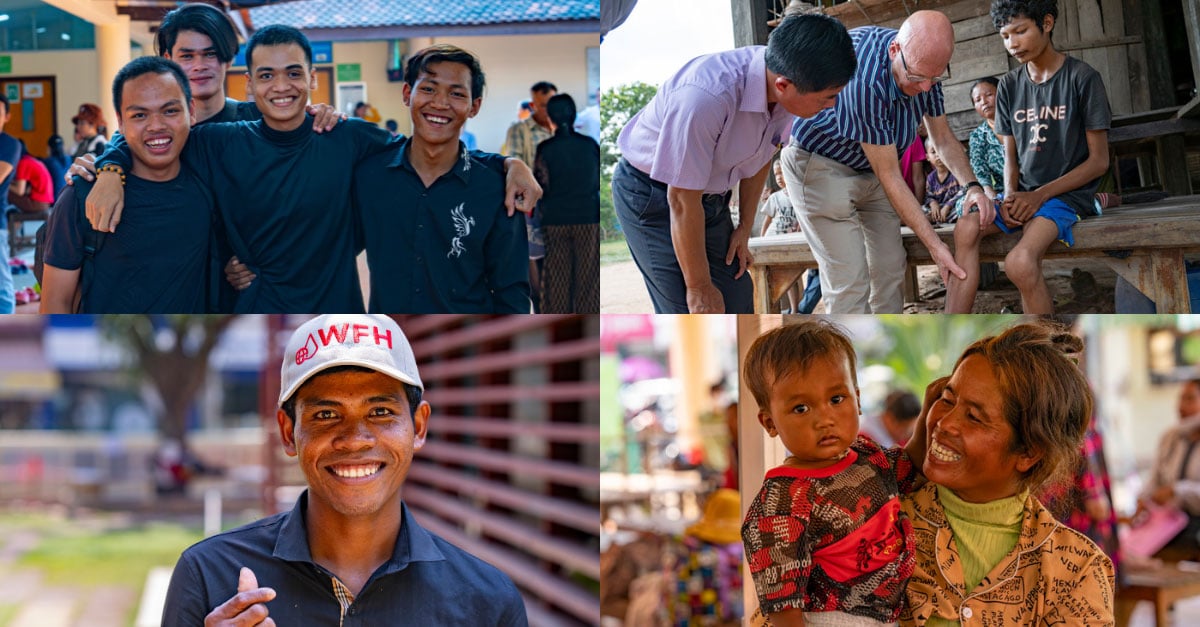
The WFH supports the inherited bleeding disorders community in Cambodia by working with many stakeholders. This includes the national member organization (NMO)—the Cambodia Hemophilia Association—and government representatives. Through efforts such as the WFH Humanitarian Aid Program and the International External Quality Assessment Scheme (IEQAS), care is being improved in the country every day. In the case of the WFH Humanitarian Aid Program, training for specialists and physicians is provided on the efficient use of donated treatment products to maximize utilization.
The following three articles and videos showcase the work being done by the WFH in Cambodia.
WFH leverages collaboration in Cambodia to support community
During a visit in 2024, WFH representatives visited Cambodia to assess progress and refine priorities. They noted significant care improvements over 15 years, including at Angkor Hospital for Children, where prophylactic treatment has transformed lives, allowing children to attend school. Overall, the support of the WFH—through donated treatment products and training, and alongside collaboration with local stakeholders—has greatly improved life outcomes for PWBDs.
To read the article based on this video, click here.
WFH collaboration supports Cambodian bleeding disorders community
Care in Cambodia improved significantly when the Cambodia Hemophilia Association partnered with the WFH to advocate with the government to secure better support. These improvements in treatment have had a real effect on PWBDs in the country. For example, Loeub Poy is a young boy, who, before receiving treatment, couldn’t walk for even for two hours without his knees swelling. Now, thanks to donated treatment products, he can walk normally, play with his peers, and go to school.
To read the article based on this video, click here.
The WFH and our sponsors: making a difference in Cambodia
Thanks to support from sponsors, PWBDs in Cambodia have access to much quantities of treatment products than in the past. This has reduced the instance of acute bleeds and has made access to home-based prophylactic treatment a life-changing reality. WFH Humanitarian Aid Program training has also made it possible for healthcare professionals do provide a better level of care for PWBDs. In the case of pediatric hematologist Sing Heng, MD, training made it possible for him to build a local team to provide comprehensive care at Angkor Children’s Hospital.
To read the article based on this video, click here.
The WFH Humanitarian Aid Program has donated over 19 million IUs of factor and over 470,000 mg of non-factor replacement therapy to Cambodia since 2015. Over 3.7 million IUs of factor, and over 140,000 mg of non-factor replacement therapy were donated in 2024 alone. To find out more about the WFH Humanitarian Aid Program, please click here.
About the WFH Humanitarian Aid Program
The WFH Humanitarian Aid Program improves the lack of access to care and treatment by providing much-needed support for people with inherited bleeding disorders in developing countries. By providing patients with a more predictable and sustainable flow of humanitarian aid donations, the WFH Humanitarian Aid Program makes it possible for patients to receive consistent and reliable access to treatment and care. None of this would be possible without the generous support of Sanofi and Sobi, our Founding Visionary Contributors; Bayer, CSL Behring and Roche, our Visionary Contributors; Grifols, our Leadership Contributor; and Takeda, our Contributor. To learn more about the WFH Humanitarian Aid Program, visit www.treatmentforall.org.