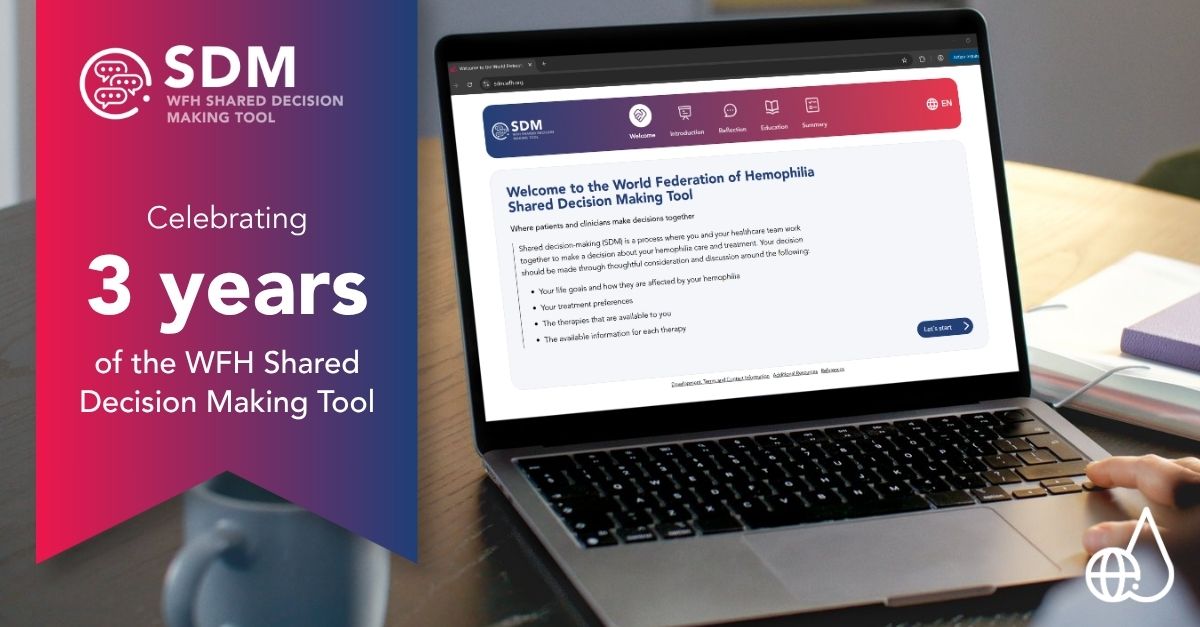
The WFH Shared Decision Making (SDM) Tool is an interactive decision-support system designed to facilitate discussions regarding treatment options between people with hemophilia A or B and/or caregivers and their healthcare team, leading to informed decision-making. A key strength of the tool is that it continues to evolve; it’s regularly updated to reflect emerging evidence, new therapies, and changes in hemophilia care. Over the last three years, the tool has generated a growing body of scientific evidence supporting the development, implementation, and evaluation of shared decision-making in hemophilia care, including four peer-reviewed publications, four scientific abstracts, and one additional evaluation manuscript currently in development. To read the report WFH Shared Decision-Making Tool: Three years of global impact, click here.
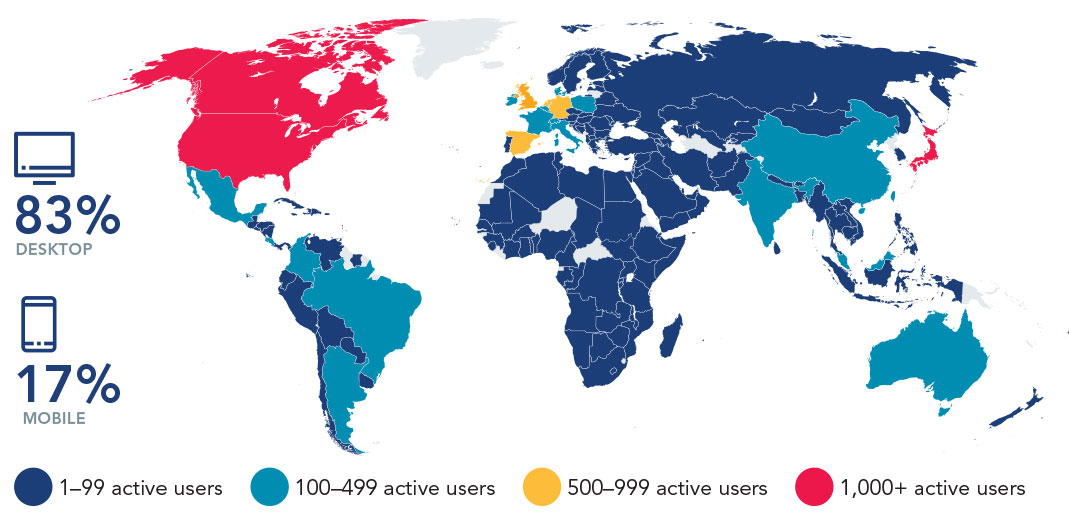
- 34,000+ people reached worldwide
- 16,357 actively engaged users
- 157 countries
- 11 languages available
A major milestone for the tool was the publication of 15 best practice recommendations for implementing SDM in clinical practice. “Implementing Shared Decision-Making in Haemophilia Care: Best Practice Recommendations From a Western European Multi-Stakeholder Delphi Process” was developed through a rigorous, multi-stakeholder eDelphi consensus process and published in Haemophilia, the official journal of the WFH (click here to access that publication). Regional workshops have helped build capacity among people with hemophilia and healthcare professionals, with activities in the Americas and Europe and expansion to the Asia-Pacific region planned for 2026.
The usefulness of the tool has fostered a growing community of dedicated individuals who are moving the initiative beyond awareness and toward practical implementation in clinical care. This growing international network of “SDM champions” is creating the foundation for broader implementation of shared decision-making in clinical practice. Marlène Beijlevelt, a Nurse Practitioner specializing in bleeding disorder care in the Amsterdam University Medical Center, Amsterdam, is one such champion. She incorporates the tool into her daily clinical practice whenever people with bleeding disorders or their families are facing important treatment decisions, particularly during diagnosis, transitions in care, or when considering a new therapy (read her story here).
Looking ahead, the next phase of the WFH Shared Decision Making (SDM) Tool will focus on expanding access, strengthening implementation in clinical practice, and growing a sustainable global network of SDM champions.
To read the report WFH Shared Decision-Making Tool: Three years of global impact, click here. To find out more about the WFH Shared Decision-Making (SDM) Tool, click here.
We like to acknowledge and thank our WFH Corporate Partners, Pfizer, Roche, Sanofi and Sobi for their contributions to the WFH SDM Program.