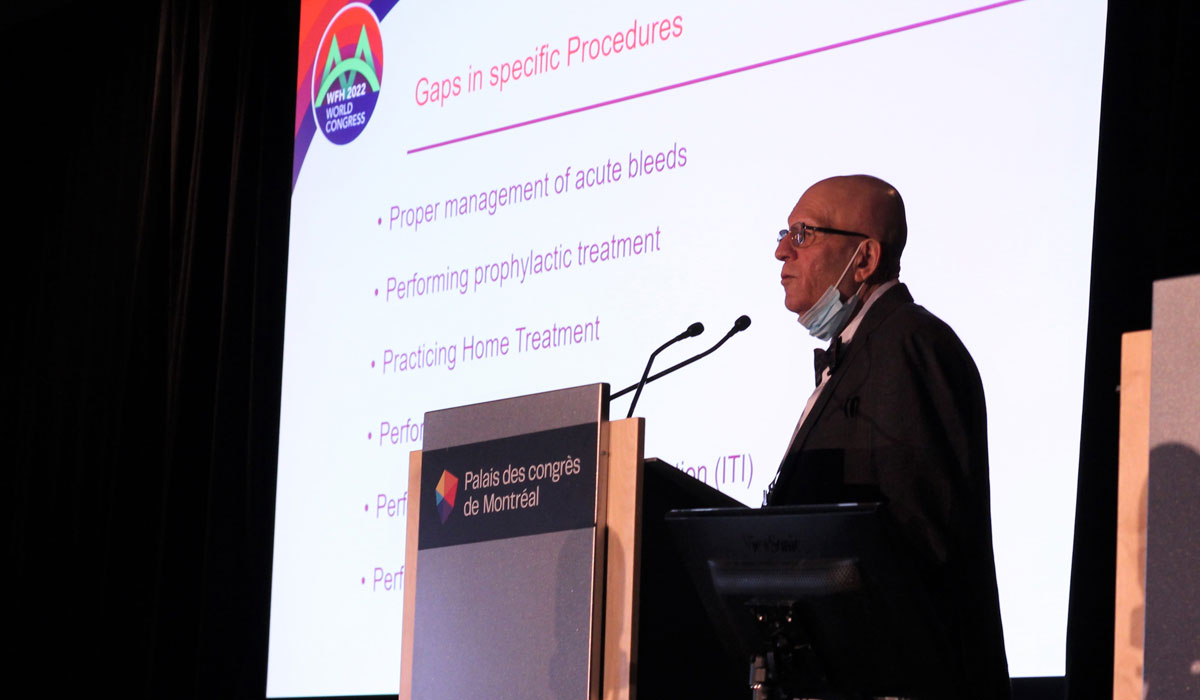
Assad Haffar, MD, WFH Medical & Humanitarian Aid Director, began the session with an overview of what has been accomplished over the last seven years. He noted that the program’s increased (and now more consistent) donations have allowed doctors to fully treat patients according to international standards and the WFH Treatment Guidelines; perform corrective surgeries and other procedures; establish prophylactic treatment programs for children; and demonstrate to health authorities the value of treating with CFCs for future sustainability. Haffar noted that over a billion IUs of treatment product have been donated since the expansion of the program in 2016, and over 22,000 patients have been treated. Also, nearly 3,000 patients have been put on prophylactic treatment. All of this has had a significant impact on people with bleeding disorders (PWBDs) around the world.
In the past we could only do surgeries for life-threatening conditions…. Now [thanks for the WFH Humanitarian Aid Program] we can do corrective surgeries.
- Assad Haffar, MD, WFH Medical & Humanitarian Aid Director
Haffar also covered the training that the Program delivers. This training addresses the use of new products; educates front line doctors; trains second line treaters; educates emergency room doctors; and provides train the trainers (ToT) sessions. The Program has also dramatically improved logistics and compliance by developing new Quality Management System (QMS); developing new Standard Operation Procedures (SOPs); employing new staff including Compliance Managers and Training Managers; developing a Self-Audit Mechanism; ensuring full traceability of products till end user for any possible recall; and establishing an online reporting database and a mobile app.
Shikuku explained that the Program has also helped with advocacy (national and county), has supported parliamentary involvement-petition and funding, and has encouraged the government to budget for factor purchases. All in all, in Kenya today, treaters are not worried anymore about diagnosing patients as free treatment is available; patients and parents have more faith in the Kenyan Hemophilia Association (KHA); and KHA and treaters are able to advocate with hospitals to actively diagnose more patients.
The final presentation of the session was given by Bishesh Sharma Poudyal, MD, Hematologist, Civil Service Hospital of Kathmandu, Nepal. His presentation, “Humanitarian Aid donations helps advocacy efforts for sustainable care”, covered how the Program has helped the Nepalese bleeding disorder community. Specifically, the Program has improved quality of life, access to treatment, the quality of psycho-social relationships, and the development of localized advocacy tools and access to resources. Khakurel talked about how donations have drastically increased since 2015. Where there was once a grim statistic of seven to ten people dying from hemophilia-related complications per year, in 2021, there were zero reported deaths.
Other encouraging results in Nepal: of the patients enrolled in the prophylaxis program, 50% are children below 12 years of age. Even more encouraging is that the government added hemophilia to The Act Relating to Right of Person with Disabilities, and the Nepal Hemophilia Society (NHS) signed Memorandum of Understanding (MoU) with Department of Health Services, Epidemiology and Disease Control Division and NHS which ensured the selection of appropriate provincial hospitals to establish hemophilia care units in all the seven provinces of Nepal.
“Humanitarian Aid donations improve diagnosis” was given by Kibet Shikuku, Lecturer at the University of Nairobi, Kenya. In his presentation, he shared diagnostic experiences in patients with hemophilia and other bleeding disorders and demonstrated the impact of increased factor donations on clinician, patient and parent experiences in Kenya. In his country, the Program helps by supporting the care of routine bleeds, prophylaxis, inhibitor management, and surgeries like safe circumcision. The impact of the WFH Humanitarian Aid Program in Kenya has been great. Now, more doctors are active with the program; there is an increased interest to manage patients-most specialties; an improved confidence-diagnose/initiate care; more research by students and more opportunities for professional growth for scholars; an improved capacity for training staff; and improved data collection and use.
About the WFH Humanitarian Aid Program
The WFH Humanitarian Aid Program improves the lack of access to care and treatment by providing much-needed support for people with inherited bleeding disorders in developing countries. By providing patients with a more predictable and sustainable flow of humanitarian aid donations, the WFH Humanitarian Aid Program makes it possible for patients to receive consistent and reliable access to treatment and care. None of this would be possible without the generous support of Sanofi and Sobi, our Founding Visionary Contributors; Bayer, CSL Behring and Roche, our Visionary Contributors; Grifols, our Leadership Contributor; and Takeda, our Contributor. To learn more about the WFH Humanitarian Aid Program, visit www.treatmentforall.org