Acerca de
Nuestra Labor
Datos y herramientas
Eventos
Noticias
ISTH methodology article

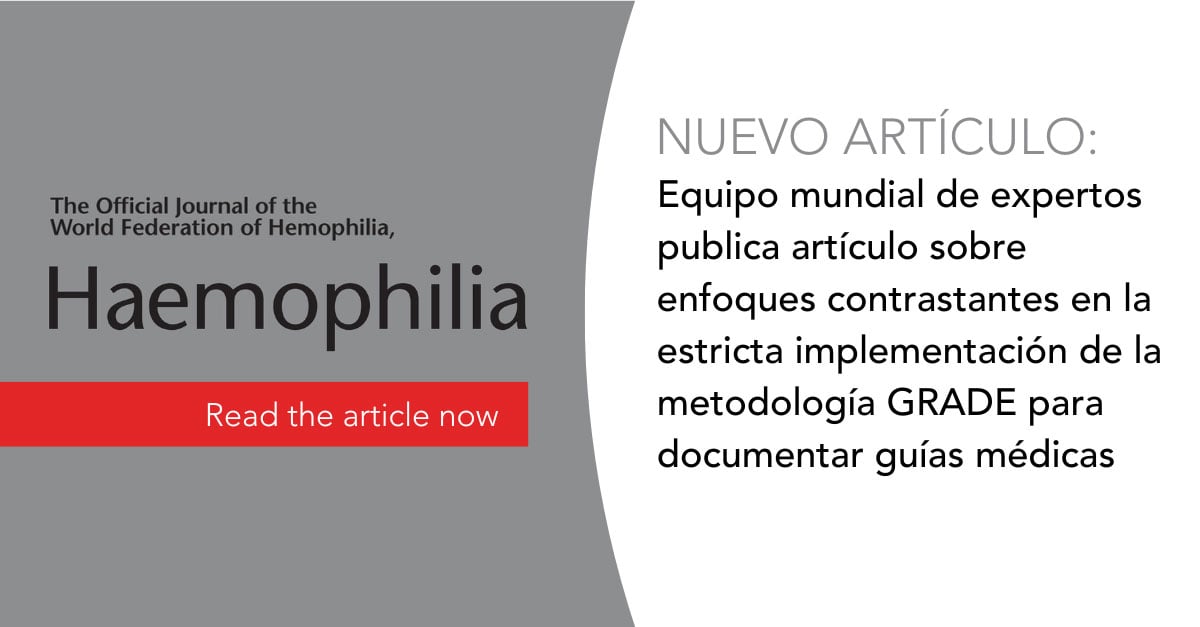
Equipo mundial de expertos publica artículo sobre enfoques contrastantes en la estricta implementación de la metodología GRADE para documentar guías médicas

Acaba de publicarse en el periódico Haemophilia un artículo que describe la manera en la que la implementación de la metodología GRADE (Grading of Recommendations Assessment, Development and Evaluation) puede incidir en la preparación de guías médicas. El artículo analiza y destaca las limitaciones y la oportunidad desperdiciada de las guías de la ISTH para el tratamiento de la hemofilia, específicamente en lo relativo a la estricta implementación de la metodología GRADE en dicho documento.

También disponible en: English Français

GRADE es un método riguroso y bien establecido para evaluar pruebas científicas tomando en cuenta factores tales como diseño del estudio, riesgo de sesgo y sesgo de publicación. Ofrece un proceso transparente para elaborar recomendaciones basadas en pruebas confiables. No obstante, la aplicación de la metodología GRADE a la preparación de guías médicas en el contexto de enfermedades poco comunes es más compleja y podría requerir adaptaciones específicas. El artículo Contrasting Approaches in the Implementation of GRADE Methodology in Guidelines for Haemophilia and von Willebrand Disease (Enfoques contrastantes en la implementación de la metodología GRADE para guías sobre la hemofilia y la enfermedad de Von Willebrand) analiza el uso deficiente del sistema GRADE en la elaboración de las guías de la ISTH para el tratamiento de la hemofilia. El artículo fue publicado por un equipo de 48 partes interesadas en el campo, integrado por expertos en hemofilia, investigadores, médicos, pacientes y defensores de pacientes, quienes representan a varias organizaciones de todo el mundo, entre ellas AICE, AHAD-AP, AHCDC, ATHN, CLAHT, EHC, CRH y MHEMO francesas, HTCCNC, NBDF, PEDNET, UKHCDO y la Federación Mundial de Hemofilia (FMH).

Este es un resumen (en inglés) en lenguaje sencillo del artículo Contrasting Approaches in the Implementation of GRADE Methodology in Guidelines for Haemophilia and von Willebrand Disease. Para leer la versión completa haga clic aquí.

New guidelines for the management of hemophilia have recently been released by the ISTH, generating numerous reactions throughout the global community. These guidelines were developed by strictly applying the most rigorous approach of the methodology approach called GRADE, which only considers the results of so-called randomized clinical trials as valid. These studies compare the effectiveness of several treatments administered to patients, ideally selected randomly. However, such studies are very rare in hemophilia and often difficult to conduct due to the rarity and heterogeneity of the disease.

The strict application of GRADE has led the ISTH to develop guidelines proposing limited, conservative, and unambitious therapeutic principles for hemophilia which fail to consider newer treatment options.

This article highlights the missed opportunities by these ISTH guidelines. It presents a substantial number of arguments showing that adaptation of GRADE methodology could have been possible and valuable in this field. This approach should have included the plethora of scientific data available from registries and real-world studies. It should have also integrated the multiple patients-related outcome data, without overlooking the perspectives of experts familiar with these innovations. Such a scientifically validated use of GRADE, applied to other diseases, could have resulted in guidelines that reflect the true potential of new therapeutic options for hemophilia and, above all, meet the legitimate aspirations of an entire community.

Si desea leer el artículo Contrasting Approaches in the Implementation of GRADE Methodology in Guidelines for Haemophilia and von Willebrand Disease haga clic aquí. Si desea leer las Guías de la FMH para el tratamiento de la hemofilia, 3a edición, haga clic aquí.

We’ve accomplished a lot this year, we need your help to continue strong.

Would you like to read more about similar articles?

Disclaimer

The information on the WFH website is provided for general information purposes only. The WFH does not engage in the practice of medicine and under no circumstances recommends particular treatment for specific individuals. For diagnosis or consultation on a specific medical problem, the WFH recommends that you contact your physician or local treatment centre. Before administering any products, the WFH urges patients to check dosages with a physician or hemophilia centre staff, and to consult the pharmaceutical company’s printed instructions.

While every effort has been made to ensure the accuracy of the information on this site, the WFH does not guarantee the information is accurate, and is not responsible in any way whatsoever for damages arising out of the use of this website or any of the information contained herein.

Messages posted to WFH discussion forums, Facebook, Twitter, and other social media platforms do not represent the opinions of the World Federation of Hemophilia, its staff, or Board of Directors. The author of a message is solely responsibility for its content. Information posted on WFH social networks and platforms should never be a substitute for individualized professional medical advice, even when the author has medical qualifications or is considered an authority. Information posted to a discussion group should not be used to diagnose or treat a specific health problem without consulting a qualified healthcare professional. The WFH recommends that you contact your physician or local treatment centre if you have any individual questions or concerns.

References and links to other websites or references to other organizations, products, services, or publications do not constitute endorsement or approval by the WFH. The WFH is not responsible and assumes no liability for the content of any linked websites.

Fraud Alert

Unauthorized solicitations – Warning

The WFH has been made aware of various correspondences—circulated via e-mail and telephone—coming from individuals impersonating WFH staff or falsely stating that they are associated with the WFH. These correspondences, which may seek to obtain money using the name of someone affiliated with the WFH, are fraudulent and come from outside of our organization.

If you receive a suspicious solicitation, exercise extreme caution. In the case of an email, look at the email address to see if it looks suspicious (for example, all WFH emails come from @wfh.org).

We are asking you to remain vigilant, and if you have any doubts about the correspondence, please forward the email to the WFH at [email protected] or call +1 514-875-7944.