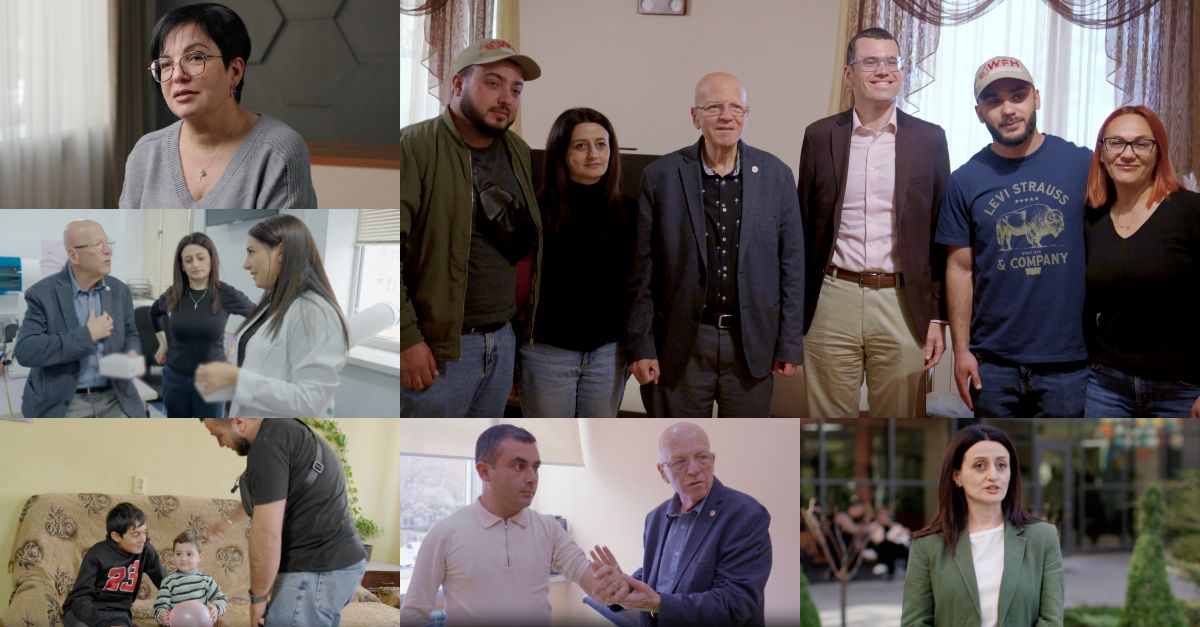
“I am a Vice President of the Armenian Association of Haemophilia and Thrombophilia, and at the same time, I’m a parent of a person suffering from hemophilia,” said Natalya Barinyan, recalling the fear and uncertainty she faced in 1998 when her son was diagnosed. “There were no medicines… They usually [only] used ice and very primitive drugs to treat [him].” The hardships faced by so many at that time were due to many factors. According to Karine Kocharyan, WFH Regional Manager, Europe and Central Asia, Armenia’s inherited Soviet-era healthcare system, compounded by conflict and economic hardship, made access to medical care difficult in general. For people with hemophilia, things were especially difficult. In 1997, when the Armenian Hemophilia Association was founded, here were little more than cryoprecipitate and fresh frozen plasma available in hospitals.
Things improved for the community when, a few years after the Armenian Hemophilia Association became a WFH national member organization (NMO) in 1998, WFH Humanitarian Aid Program donations started arriving.
We see a huge difference between the first time we were here in 2016 and today… We hope that in 2030, hemophilia care will be nation-wide in Armenia.
—Assad H. Haffar, MD, WFH Director of Humanitarian Aid and Medical Training
On a recent visit to the country, corporate representative Scott Williams saw the change in the country firsthand. “Patients have the opportunity today to have access [to care] that was not possible ten years ago… I was so struck by the strength of advocacy.” He praised families that were, “going above and beyond for their children.”
Barinyan explained that the improvement in the level of care since the mid-nineties has been life changing, with the new generation enjoying the kind of support their parents wouldn’t have dreamed of. “Our patients—lucky people—they have access to perfectly trained doctors… there is no comparison,” she says.
Assad H. Haffar, MD, WFH Director of Humanitarian Aid and Medical Training, explained that Armenia has made remarkable progress in hemophilia care, notably in the capital, but that work remains to be done in regional areas. He expressed hope that by 2030 care will be accessible nationwide—a goal he believes is achievable with continued partnership and commitment.
This story is the final part in a three-part series. To read the first article, “Long-term collaboration transforms hemophilia care in Armenia”, please click here. To read the second article, “Improved care brings hope to Armenian families living with hemophilia” please click here.
WFH efforts in Armenia have included multiple initiatives besides the WFH Humanitarian Aid Program, such as the WFH International External Quality Assessment Scheme (IEQAS), which helps hemophilia treatment centres (HTCs) monitor and strengthen laboratory performance; and a Hemophilia Organization Twinning (HOT) partnership that connects developing patient organizations with more established ones to exchange expertise and build capacity.
The WFH Humanitarian Aid Program has donated nearly 19 million IUs of factor and over 310,000 mg of non-factor replacement therapy to Armenia since 2015. Over 3 million IUs of factor, and over 50,000 mg of non-factor replacement therapy were donated in 2025 alone. To find out more about the WFH Humanitarian Aid Program please click here.
About the WFH Humanitarian Aid Program
The WFH Humanitarian Aid Program improves the lack of access to care and treatment by providing much-needed support for people with inherited bleeding disorders in developing countries. By providing patients with a more predictable and sustainable flow of humanitarian aid donations, the WFH Humanitarian Aid Program makes it possible for patients to receive consistent and reliable access to treatment and care. None of this would be possible without the generous support of Sanofi and Sobi, our Founding Visionary Contributors; Bayer, CSL Behring and Roche, our Visionary Contributors; Grifols, our Leadership Contributor; and Takeda, our Contributor. To learn more about the WFH Humanitarian Aid Program, visit www.treatmentforall.org.