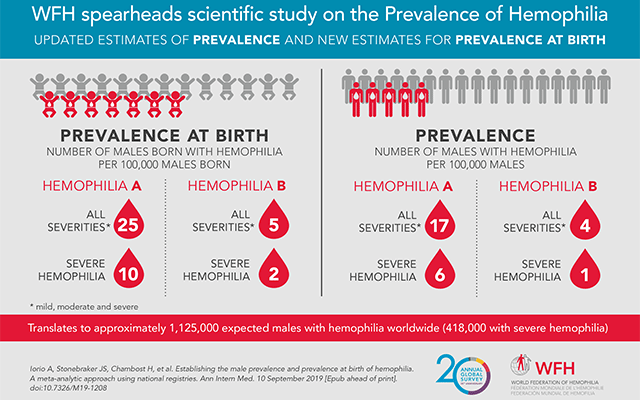
The World Federation of Hemophilia (WFH) has spearheaded a scientific study updating the prevalence of hemophilia to higher numbers than previously estimated and providing, for the first time, estimates of the prevalence of hemophilia at birth (Annals of Internal Medicine, 10 September 2019).
Hemophilia is an inherited bleeding disorder caused by a defect in the F8 or F9 gene, which encodes instructions for making the factor proteins that helps blood clot. Lack of treatment leads to chronic and disabling joint disease. Bleeding into organs and intracranial hemorrhages can lead to disability and death. Treatment aims to prevent or stop debilitating and life-threatening bleeds; however, treatment is expensive and scarce in many countries.
Researchers from McMaster University, North Carolina State University, Aix-Marseille University, and the University of Sheffield joined efforts to respond to a call to action of the World Federation of Hemophilia (WFH) to provide precise estimates of the prevalence and prevalence at birth of hemophilia and the associated life expectancy disadvantage for male patients with hemophilia A or B, which is critical information needed to plan for the improvement of hemophilia care worldwide. The authors conducted a meta-analysis of registry data in countries with comprehensive registries (Australia, Canada, France, Italy, New Zealand, and the United Kingdom) and found that prevalence of hemophilia is higher than previously estimated. The authors report a prevalence, per 100,000 males, of 17 for all severities of hemophilia A, 6 for severe hemophilia A, 4 for all severities of hemophilia B, and 1 for severe hemophilia B. For the first time, the prevalence at birth of hemophilia, defined as the number of people born with hemophilia per 100,000 male births, was estimated. The prevalence at birth per 100,000 males is 25 for all severities of hemophilia A, 10 for severe hemophilia A, 5 for all severities of hemophilia B and 2 for severe hemophilia B. This translates to approximately 1,125,000 males with hemophilia worldwide, of whom about 418,000 have severe hemophilia, the majority of whom are undiagnosed. The life expectancy disadvantage for people with hemophilia living in high-income countries is 30% for hemophilia A, 37% for severe hemophilia A, 24% for hemophilia B, and 27% for severe hemophilia B. The gap in life expectancy for patients with hemophilia is considerably worse in lower-income countries, where lack of treatment has affected the hemophilia population, and resulted in life expectancy disadvantages of approximately 64%, 77%, and 93% for countries with upper-middle, lower-middle, and low incomes, respectively, according to World Bank definitions.
Alfonso Iorio, MD, lead author and past-chair of the Data and Demographics committee of the WFH states: “This paper is a milestone in our journey to providing care to hemophilia patients worldwide. Knowing how many patients are expected in each country given its population is an important measure of the efficiency of the health care system. Knowing how many patients should be there, and how many less are reported to national and international registries is a measure of the work left to be done. Knowing how many patients are out there will enable health care systems to estimate the resources needed to treat the disease, and will enable drug manufacturers to increase the investment in research to match the demand of a patient population three times larger than previously thought. It will also serve to underline the importance of outreach and identification campaigns.”
Glenn Pierce, MD, PhD, Vice President, Medical of the WFH, emphasizes the importance of this work to the WFH: “It shows the power of the high-quality registries produced by the hemophilia community. Having this work published in a high impact general internal medicine journal in the U.S.A. is a testament of the credibility our community has built year after year, and is the best auspice of success for the WFH World Bleeding Disorders Registry.”
To read the press release on the Annals of Internal Medicine website, please click here.
Citation for this scientific publication
Iorio A, Stonebraker JS, Chambost H, et al. Establishing the male prevalence and prevalence at birth of hemophilia. A meta-analytic approach using national registries. Ann Intern Med. 10 September 2019 [Epub ahead of print]. doi:10.7326/M19-1208.