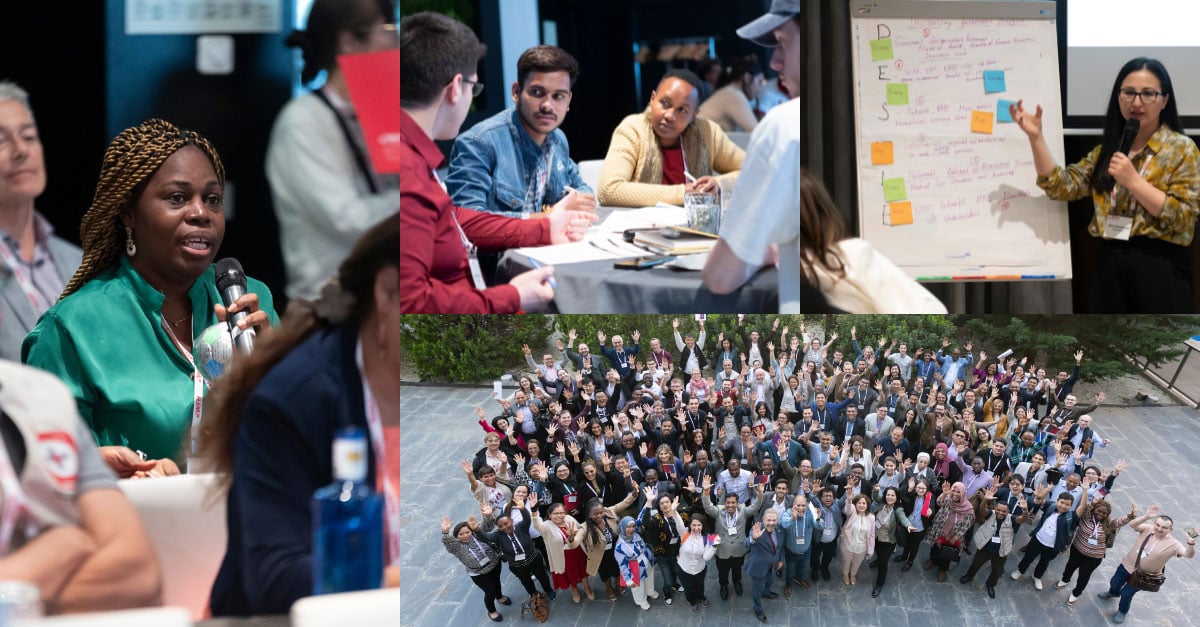
This year’s Global NMO Training (GNMOT) focused on key areas such as stakeholder collaboration, good governance, project proposal development, budgeting and financial reporting, and monitoring and evaluation. The training was attended by 108 participants from 91 countries. Six months after the training, participants were surveyed on how the training impacted their work and the value of the tools that were made available for them. When asked for the impact of the training on their NMO, 61% reported increased advocacy work, 67% reported better project planning, and 55% reported enhanced strategic planning. Overall, the feedback was highly positive, with 95% of participants considering the training content relevant to their work and 79% reporting increased knowledge post-training.
For the first time at a GNMOT, participants had the chance to showcase the work being done by their NMOs through poster presentations. This new initiative encouraged participants to learn how to submit abstracts, present their posters, and share their work with an international audience. The new initiative was a success, with one participant saying, “I loved to see the highlights [from the other NMOs] so I could learn from them. This was a great initiative, and I hope it continues.”
The following quotes show some of the feedback participants from different NMOs had six months after the Global NMO Training (GNMOT).
Lebanon: Association Libanaise de l'Hémophilie
The NMO in Lebanon—the Association Libanaise de l’Hémophilie—reported improved decision-making processes that led to greater trust and collaboration among members. “After participating in the GNMOT, we improved the way we make decisions by clarifying processes and including more members in discussions,” said a representative. “We set up regular meetings to better organize our activities and ensure transparency.”
Argentina: Fundación de la Hemofilia
A youth participant from the Fundación de la Hemofilia, the NMO in Argentina, shared his GNMOT learnings with other NMO volunteers at a virtual training which focused on project management and knowledge transfer. “Together, we carried out practical work focused on project proposal development, which allowed us analyze the work of the NMO and use the tools learnt at GNMOT like the SMART system for setting objectives,” he explained.
Bangladesh: Hemophilia Society of Bangladesh
For the Bangladeshi NMO, the Hemophilia Society of Bangladesh, budgeting and financial reporting practices became more structured and transparent following the training. One NMO member said, “We introduced a detailed budgeting template that categorizes expenses for clearer tracking. Additionally, we now provide yearly financial reports to stakeholders, enhancing accountability and enabling better financial planning for future projects.”
India: Hemophilia Federation India
At the Hemophilia Federation India, the NMO in India, regular evaluation processes were instituted after the training, including participant feedback sessions after events. “Following our national conferences and workshops, we conducted surveys to assess attendee satisfaction and gather suggestions for improvement,” noted a representative. This feedback has been instrumental in refining future events to better meet community needs.
Togo: Association Togolaise des Hémophiles
The networking opportunities that presented themselves at the GNMOT were also invaluable. One representative from the NMO in Togo—Association Togolaise des Hémophiles—was “inspired by experiences of other organizations [learnt at networking] to revitalize activities within youth group and to establish a mothers’ group.” This group recently initiated a project aimed at raising awareness and identifying new patients, demonstrating the direct impact of the training on their community.
The WFH Global NMO Training has had a profound impact on its participants, equipping them with the skills and knowledge to enhance the capabilities of their NMOs and better serve their local inherited bleeding disorders communities. The positive feedback and tangible improvements underscore the critical role of such capacity-building initiatives in achieving comprehensive care for all people with bleeding disorders.
To find out more about training for WFH NMOs, click here.
Special thanks to Hemophilia of Georgia for their support to the Youth Leadership Program and activities during the 2024 Global NMO Training in Madrid, Spain.