The WFH supports the bleeding disorders in Kenya through several programs and other endeavours, the overall objective being to make sustainable care possible in the country. National member organizations (NMOs) are also part of the equation, and are included in many training activities to expand their knowledge base, help them support PWBDs, and leverage advocacy opportunities. Currently, the WFH Path to Access to Care and Treatment (PACT) Program is active in Kenya. Also, a WFH World Bleeding Disorders Registry (WBDR) Research Support Program (RSP) grant has been given to support data-gathering efforts, and two WFH International Hemophilia Training Centre (IHTC) Fellows come from the country. The WFH Humanitarian Aid Program is also very active in Kenya, and it was through this endeavour that the ultrasound training was provided.
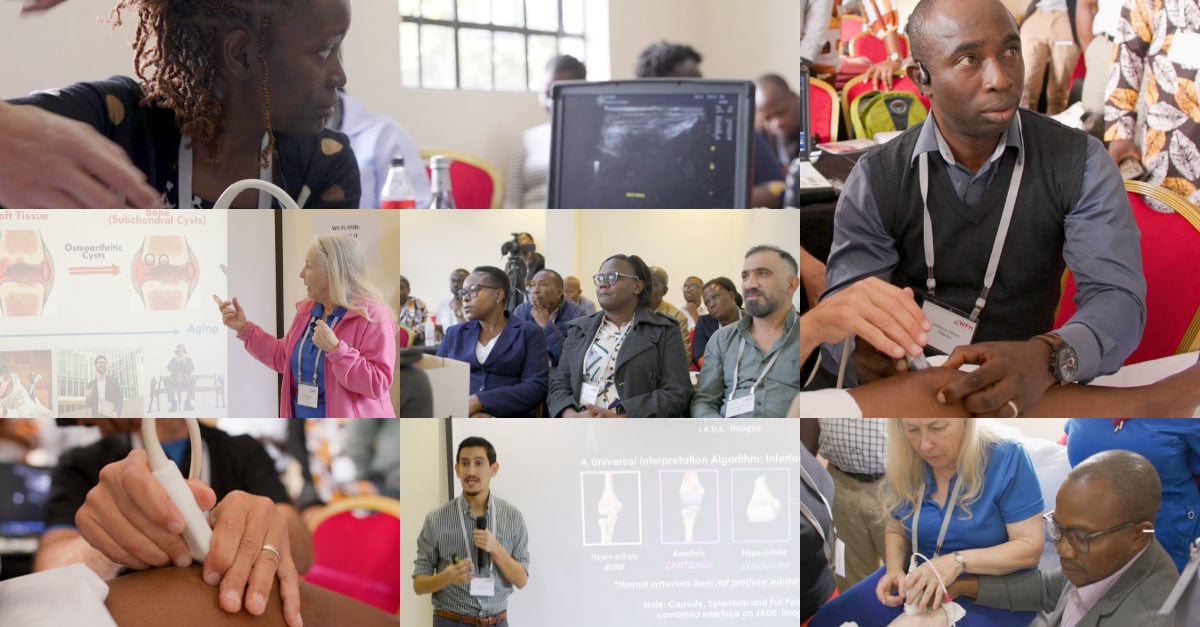
The hands-on ultrasound workshop was provided in Nairobi, Kenya, to improve hemophilia joint care. Organized by the WFH Humanitarian Aid Program, the workshop focused on ultrasound techniques, specifically related to ultrasound-guided joint injections using the Joint Tissue Activity and Damage Exam (JADE) protocol. The training included chemical synovectomy, a treatment for chronic synovitis . Twenty orthopedic surgeons and physiotherapists from six countries took part in the training, including specialists from Zambia, Nigeria, Uganda, Tanzania, Iraq and Kenya.
Thus far in the region, joint procedures such as arthrocentesis or corticosteroid injections have been performed using blind techniques, which means that the procedures are done without any visibility in the joint. This approach poses risks to neurovascular structures. The ultrasound-guided approach reduces complications and improves patient safety and enhance outcomes.
As part of this new approach, the WFH Humanitarian Aid Program will supply handheld ultrasound devices as well as rifampicin, the agent used in chemical synovectomy. These resources will allow HCPs to perform accurate joint assessments and targeted interventions to mitigate pain and improve mobility for people with bleeding disorders.
The workshops followed a “train-the-trainer” model, empowering participants to return to their countries and teach what they had learned to other HCPs. This ripple effect encourages the propagation of skill development across the continent.
Bleeding disorders remains underdiagnosed in Africa, where cultural misconceptions and limited medical awareness hinder effective care. On the continent, the identification rate of people with hemophilia—the number identified over the total number expected—is only 8% [source: WFH Report on the Annual Global Survey 2023]. By providing workshops like these, the WFH Humanitarian Aid Program aims to improve care by providing knowledge, tools—and hope.
The WFH Humanitarian Aid Program has donated over 41 million IUs of factor and nearly 650,000 mg of non-factor replacement therapy to Kenya since 2015. Over 8 million IUs of factor, and nearly 100,000 mg of non-factor replacement therapy were donated in 2024. To find out more about the WFH Humanitarian Aid Program, please click here.
About the WFH Humanitarian Aid Program
The WFH Humanitarian Aid Program improves the lack of access to care and treatment by providing much-needed support for people with inherited bleeding disorders in developing countries. By providing patients with a more predictable and sustainable flow of humanitarian aid donations, the WFH Humanitarian Aid Program makes it possible for patients to receive consistent and reliable access to treatment and care. None of this would be possible without the generous support of Sanofi and Sobi, our Founding Visionary Contributors; Bayer, CSL Behring and Roche, our Visionary Contributors; Grifols, our Leadership Contributor; and Takeda and Japan Blood Products Organization, our Contributors. To learn more about the WFH Humanitarian Aid Program, visit www.treatmentforall.org.