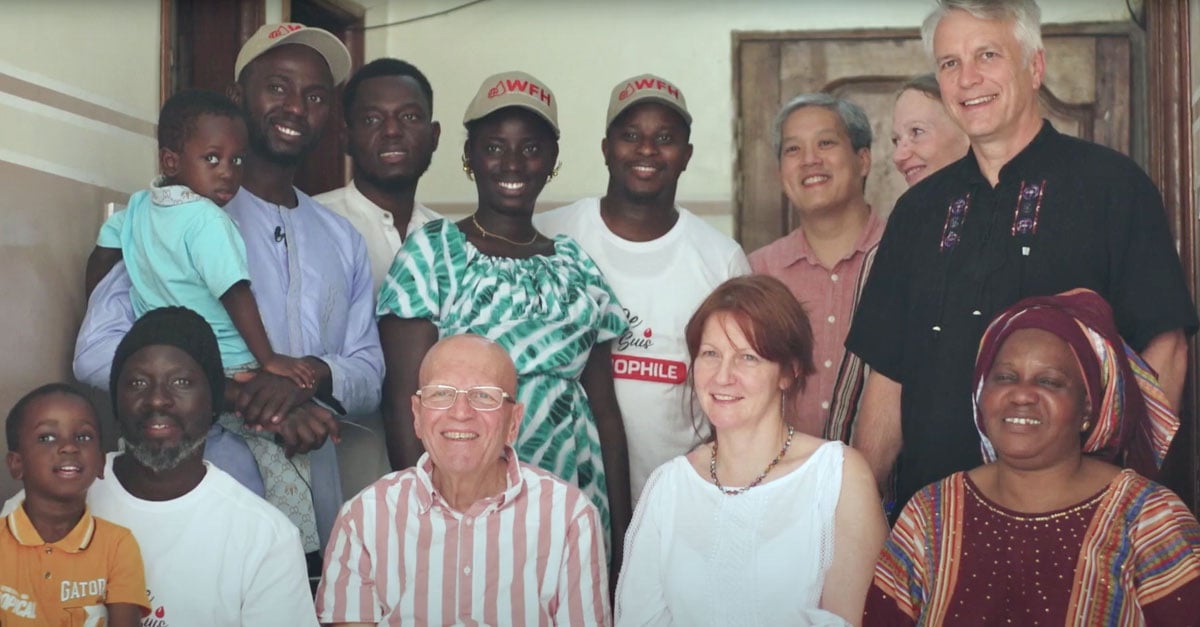
In May, the WFH Humanitarian Aid Program team went to Senegal to visit a hemophilia treatment centre, the ministry of health, a blood bank, and PWBDs who have benefitted from WFH support, to see how care levels are progressing, and to determine how to best optimize support in the future. The visit also included a workshop on the use of donated non-factor replacement therapies, which was attended by 45 hemophilia treaters from 19 countries throughout Africa.
During the home visits, the team heard the stories of the life-changing effect of WFH support. One poignant account came from the parents of a young boy named Ousmane who had been suffering from acute bleeds since birth. His mother recalled instances where he would receive treatment, and then after getting back home, the boy’s bleed would return and they would have to go back to the hospital. This stopped once he started receiving donated treatment product provided by the WFH Humanitarian Aid Program. “We really saw the importance of this treatment and we hope that other children like him will receive this treatment,” his mother says. “Here it is lacking, and we want everyone to be able to benefit from it.”
The team also heard from Galaye Diaw, a man with hemophilia. During this visit, Len Valentino, MD, a WFH volunteer, had the opportunity to chat with Galaye to learn more about his story, and to offer him suggestions on how to best manage the mobility issue he has in his right knee. The patient explained that now that he has access to donated treatment products, he bleeds less. “Apart from my knee, everything is fine,” he said, although Valentino hear a clicking sound when the man moved his leg. After a few exploratory questions, and after palpitating his knee, the physician was able to offer Galaye some practical tips for improving his joint health. “The first thing I would say,” said Valentino, “[is] if you take care of your knee and you keep exercising, you probably don’t ever need to have surgery on your knee. It will probably continue to improve and get better.”
Keeping an open dialogue with stakeholders like the team at the Ministry of Health is a very important part of what we do at the WFH, because the best way to make real change is to work together and collaborate as a team.
—Cesar Garrido, President, WFH
On another day of the visit, Cesar Garrido, President of the WFH, met with the Deputy Minister of Health from the Ministry of Health in Dakar, Senegal. This visit aimed to strengthen collaborations and discuss strategies to enhance the treatment and management of bleeding disorders in the country. During the meeting, key topics were covered, such as improving access to treatment products, implementing comprehensive care programs, and increasing awareness about bleeding disorders. The event was another important step for ensuring that PWBDs in Senegal receive the support and medical attention they need to live more normal lives.
The visit underscored the importance of continuous support and dependable treatment product donations for PWBDs in Senegal. All too often, in emerging economies, access to care can mean the difference between life and death.
Since 2015, over 12.7 million IUs of factor, and over 320,000 mg of non-factor replacement therapy, have been donated to Senegal. Over 1.5 million IUs of factor and 100,000 mg of non-factor replacement therapy were donated in 2023 alone. To find out more about the WFH Humanitarian Program, please click here.
About the WFH Humanitarian Aid Program
The WFH Humanitarian Aid Program improves the lack of access to care and treatment by providing much-needed support for people with inherited bleeding disorders in developing countries. By providing patients with a more predictable and sustainable flow of humanitarian aid donations, the WFH Humanitarian Aid Program makes it possible for patients to receive consistent and reliable access to treatment and care. None of this would be possible without the generous support of Sanofi and Sobi, our Founding Visionary Contributors; Bayer, CSL Behring and Roche, our Visionary Contributors; Grifols, our Leadership Contributor; and Takeda and Japan Blood Products Organization, our Contributors. To learn more about the WFH Humanitarian Aid Program, visit www.treatmentforall.org.