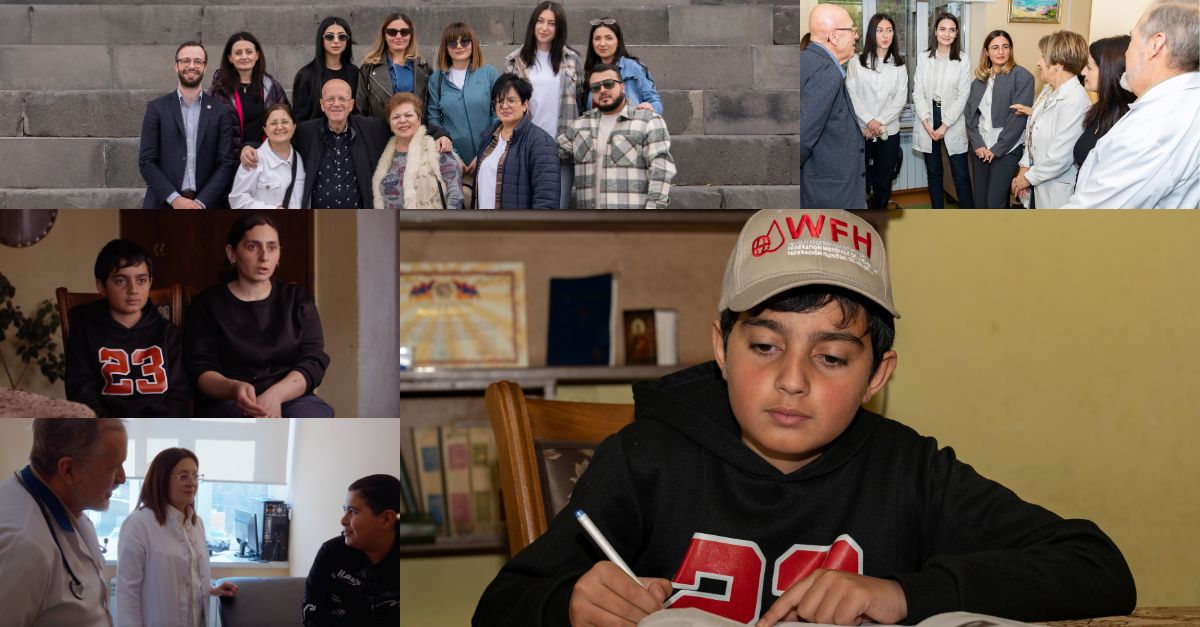
Before the WFH Humanitarian Aid Program began offering training and donated treatment products in Armenia in 2015, the situation was dire. As Heghine Khachatryan, MD, Head of the Hemophilia and Thrombosis Centre, describes the situation bluntly: “Most of the patients were disabled. Eighty percent were disabled, because they didn’t have medication.” Treatment relied heavily on frozen plasma and cryoprecipitate, with hospital stays lasting for weeks or months.
Today, conditions have changed dramatically thanks to training for healthcare professionals and a dependable supply of donated treatment product. “We now have everything we need since the day when WFH Humanitarian Aid Program donations… started being delivered to Armenia,” said Khachatryan. “Patients receive prophylactic therapy, [and] disability has decreased.”
Right now, as a physician, I feel very glad that I have this factor. And those injections that patients need… the young patients that are newly diagnosed, are getting the proper care.
—Clodet Stepanians, MD, Pediatric Hematologist, Hemophilia and Thrombosis Centre, Yerevan
For families like Manvel’s, the difference is life changing. “When his leg or arm… swells, we give him an injection of treatment product, and he is already better the next day,” said his mother Sirakpi. Manvel himself has plans for the future, which is bright and full of hope: “When I finish school, I want to study programming, learn English well, learn a good profession and start working if everything goes well.”
WFH efforts in Armenia include the WFH Humanitarian Aid Program, as well as the WFH International External Quality Assessment Scheme (IEQAS) which monitors and improves laboratory performance in hemophilia treatment centres (HTCs), and a Hemophilia Organization Twinning (HOT), which partners emerging and established hemophilia patient organizations to share knowledge and skills.
This story is the second in a three-part series. To read the first article, “Long-term collaboration transforms hemophilia care in Armenia”, please click here.
The WFH Humanitarian Aid Program has donated nearly 19 million IUs of factor and over 310,000 mg of non-factor replacement therapy to Armenia since 2015. Over 3 million IUs of factor, and over 50,000 mg of non-factor replacement therapy were donated in 2025 alone. To find out more about the WFH Humanitarian Aid Program please click here.
About the WFH Humanitarian Aid Program
The WFH Humanitarian Aid Program improves the lack of access to care and treatment by providing much-needed support for people with inherited bleeding disorders in developing countries. By providing patients with a more predictable and sustainable flow of humanitarian aid donations, the WFH Humanitarian Aid Program makes it possible for patients to receive consistent and reliable access to treatment and care. None of this would be possible without the generous support of Sanofi and Sobi, our Founding Visionary Contributors; Bayer, CSL Behring and Roche, our Visionary Contributors; Grifols, our Leadership Contributor; and Takeda, our Contributor. To learn more about the WFH Humanitarian Aid Program, visit www.treatmentforall.org.