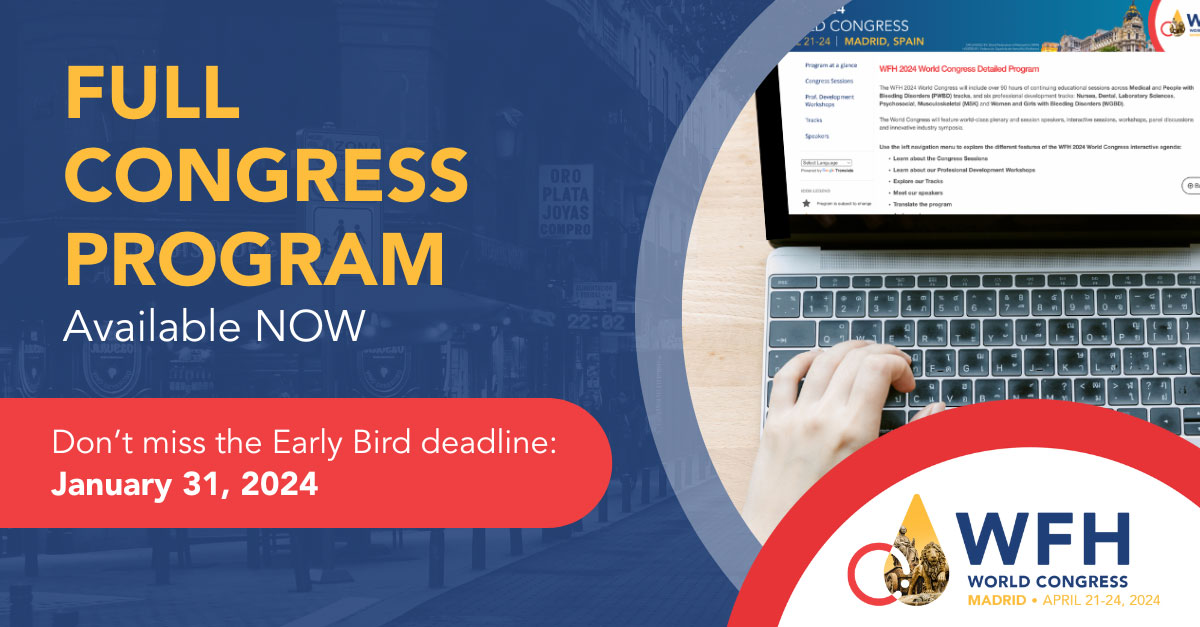
If you want some tips on where to get started, here are eight key sessions you won’t want to miss.
Track: Medical
Speakers: Giancarlo Castaman (Italy), Roseline d’Oiron (France), Samantha Gouw, (Netherlands), and Víctor Jiménez-Yuste (Spain).
In healthcare, a comprehensive approach to patient well-being necessitates a multifaceted methodology. This session will explore joint health assessments set against the new treatment landscape, evaluate the limitations of Quality of Life (QoL) measures, and make recommendations on how they can be improved. We will also explore how to incorporate outcome measures specific to women and girls with bleeding disorders (WGBD). Finally, we will investigate alternatives to traditional metrics such as the annualized bleeding rate (ABR) as a crucial step for refining and expanding our understanding of patient outcomes.
Track: PWBD
Speakers: Donna Coffin (Canada), Minackshi Dhurmoo-Luchmun (Mauritius), Thomas Sannie (France) and Michael Wang (United States).
Shared decision-making (SDM) demands a comprehensive approach that considers varied perspectives. This session will touch on the patient perspective, as well as the perspective of national member organizations (NMOs), who are key players in advocating for different treatment options in their country. We will also explore the psychosocial aspect of how patients can better prepare for and foster discussions with their healthcare team, and in turn, look at what the healthcare team can do to better inform and engage their patients in making treatment decisions. Tools like the WFH Shared Decision-Making Tool were created to facilitate this process and foster collaborative decision-making. By combining these elements, healthcare initiatives can more effectively address all aspects of patient care.
Track: Musculoskeletal
Speakers: Cindy Bailey (United States), Nihal Bakeer, (United States), Antonio Gavrilovski (Macedonia), and Walid Saied (Tunisia).
Join this session to learn more about the use of ultrasound in the early detection and treatment of pediatric synovitis, and discover solutions to key challenges which can present themselves in young patients with pediatric hemophilic synovitis. Explore how minimally invasive orthopedic procedures play a pivotal role in reducing trauma and expediting recovery for young patients. Learn more about the key musculoskeletal challenges experienced by aging PWBDs. This session—spanning early detection to advanced age—shows that only a continuity of care fully considers the needs of all PWBDs.
Track: Women and girls with bleeding disorders (WGBD)
Speakers: Nathan Connell (United States), Kate Khair (United Kingdom) and Sarah O’Brien (United States).
In this session, participants will learn more about addressing the challenges of the different life stages of WGBDs, including gender transitioning. We will explore how dedicated WGBD clinics play a pivotal role in providing tailored medical attention and support to this underserved community. Discover how the integration of coordinated multidisciplinary care further enhances the effectiveness of support for WGBDs of all ages.
Track: Nurses
Speakers: Cathy Harrison (United Kingdom), Marlene Beijlevelt (Netherlands), Sara Garcia-Barcenilla (Spain), and Christine Lynn, (United Kingdom).
Discover how the advent of novel therapies is changing the surgical treatment landscape. Learn more about the use of vonicog alfa in the management of von Willebrand disease (VWD) during surgical procedures. Hear more about surgical experiences involving the extensor hallucis longus (EHL). Explore the role of non-factor replacement therapy in treating PWBDs.
Track: Psychosocial
Speakers: Patricia Cabre (Spain), Silvina Graña (Argentina) and Jane Portnoy (Australia).
The well-being and success of individuals with bleeding disorders (PWBDs) in educational settings depend on several factors. Being able to consistently attend school influences a PWBD’s overall sense of belonging and support within the school community. Learn more about the factors impacting PWBDs in a school setting, including peer relationships and bullying, and how psychosocial interventions can help to improve academic and QoL outcomes. Hear more about different avenues in career planning for PWBDs.
Track: Laboratory
Speakers: Emna Gouider (Tunisia), Pierre Toulon (France) and Augusto Federici (Italy).
A comprehensive understanding of von Willebrand disease (VWD) diagnosis involves exploring an array of available tests and diagnostic strategies, while considering the reality of different economic contexts. Join this session to learn more about the tests currently available to diagnose VWD, and to learn more about the unique challenges facing low-income and high-income countries, and how this impacts the diagnostic strategy of VWD.
Track: Dental
Speakers: Lochana Nanayakkara (United Kingdom), Miryam Parreira (Argentina), Zikra Alkhayal (Saudi Arabia), and Rebecca Schaffer (United States).
Maintaining good oral health is essential for PWBD as it directly contributes to an improved QoL, directly impacting their physical well-being. In this session, we’ll look at the important role played by the multi-disciplinary team in maintaining oral health for PWBD. Next, the session will look at the risks associated with bleeding protocols, including an exploration of their impact on QoL. Participants will also hear patient testimonies related to QoL. The final topic covered will be the pivotal role dental providers play in the management of sleep apnea for PWBD.
To view the complete WFH 2024 World Congress program, please click here. To find out more about Congress, please click here.