The WFH is active in Zambia through several endeavours which aim to cover the widest breath of support possible. The objective: help the country attain sustainable care. To this end, the WFH Humanitarian Aid Program provides training and donated treatment product, while the WFH Path to Access to Care and Treatment (PACT) Program is helping to improve outreach and diagnosis and increase access to sustainable care. The WFH is also giving healthcare professionals at the University Teaching Hospital in Lusaka the opportunity to better manage their data—while contributing to hemophilia research—through a World Bleeding Disorders Registry (WBDR) Research Support Program grant.
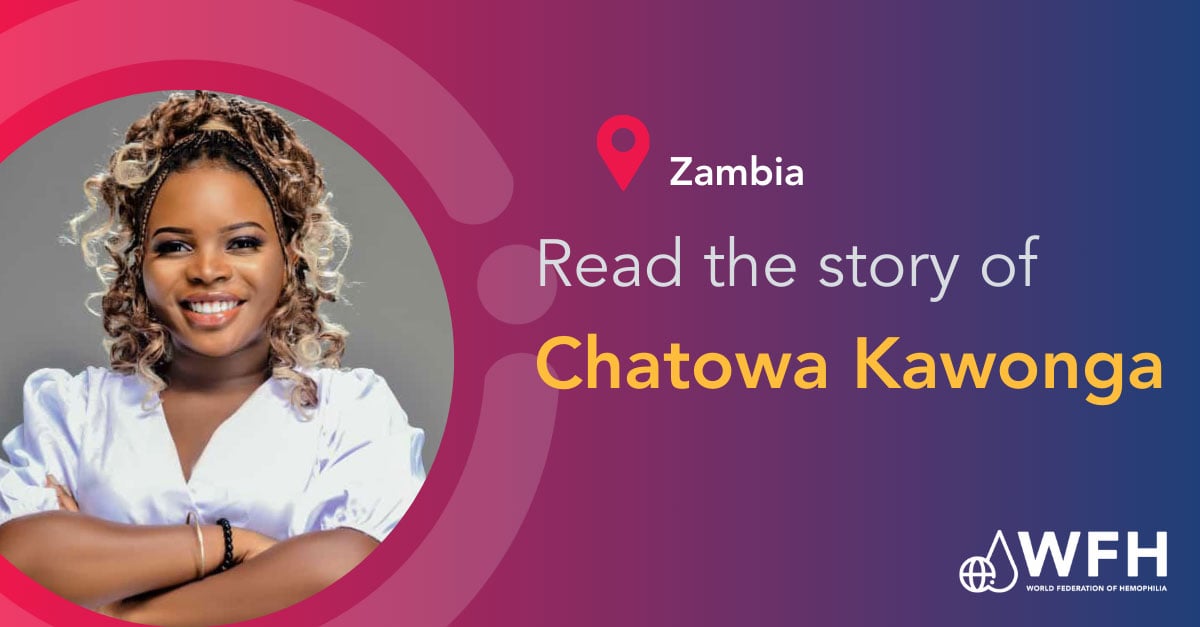
These efforts have helped people with bleeding disorders in the country, including Chatowa Kawonga. Now nineteen years old, it took Kawonga years to be correctly diagnosed. Initially, physicians thought she had endometriosis. It was only recently that she was properly diagnosed with VWD—thanks to training provided to the medical community by the WFH Humanitarian Aid Program. This training has allowed physicians to better recognize the symptoms of a bleeding disorder, and has also allowed them to provide better care to those who have been diagnosed.
Despite the challenges she faced because of her condition, she excelled academically, emerging as the top student at Kabulonga Girls Secondary School. In 2022, she was the only student to score a perfect six points in Zambia’s Grade 12 national exams—a rare achievement.
Her academic journey has now led her to the University of Zambia’s Ridgeway Campus, where she is studying Medicine and Surgery. Her choice of career is no coincidence. “I want to help people who, like me, live with conditions that are misunderstood or neglected,” Kawonga says.
Kawonga has also served as a school prefect, led teams in national science and spelling competitions, and remains the youngest member of the Kabulonga Girls Alumni Association. Through these roles, she has become a role model for resilience, service, and ambition—for women, for people with VWD, and for PWBDs. She is now acting as a patron for a charity gala supporting awareness of blood disorders.
Chatowa Kawonga is using her voice to advocate for better healthcare access and education. In this way she’s helping to support the inherited bleeding disorders community in Zambia, and inspire future generations of PWBDs.
The WFH Humanitarian Aid Program has donated over 16.3 million IUs of factor and over 188,000 mg of non-factor replacement therapy to Zambia since 2015. Nearly 2.5 million IUs of factor, and 22,000 mg of non-factor replacement therapy were donated last year alone. To find out more about the WFH Humanitarian Aid Program please click here.
About the WFH Humanitarian Aid Program
The WFH Humanitarian Aid Program improves the lack of access to care and treatment by providing much-needed support for people with inherited bleeding disorders in developing countries. By providing patients with a more predictable and sustainable flow of humanitarian aid donations, the WFH Humanitarian Aid Program makes it possible for patients to receive consistent and reliable access to treatment and care. None of this would be possible without the generous support of Sanofi and Sobi, our Founding Visionary Contributors; Bayer, CSL Behring and Roche, our Visionary Contributors; Grifols, our Leadership Contributor; and Takeda, our Contributor. To learn more about the WFH Humanitarian Aid Program, visit www.treatmentforall.org.