The renewed agreement includes donated non-factor replacement therapy, which will be used by the WFH Humanitarian Aid Program to continue to treat people with hemophilia A in countries where there is little or no access to treatment. The initial agreement, signed in 2019, was a milestone for the inherited bleeding disorders community, as it marked the first time that patients in developing countries would receive access to non-factor replacement therapy. In the last seven years, donated non-factor replacement therapy provided by Roche has benefited 1,248 people across 38 countries.
“This renewed commitment reflects a shared belief that meaningful progress for people with hemophilia A requires long term solutions,” said Daud Chaudry, Global Head for Hemophilia. “Building on our enduring partnership with the WFH and collaboration within the WFH Humanitarian Aid Program, we aim to support predictable, full dose prophylactic care while helping to strengthen local health systems, enabling countries to build sustainable models of care that support people with hemophilia A throughout their lives.”
Cesar Garrido, WFH President, praised Roche for their continued commitment to the global inherited bleeding disorders community. “The WFH Humanitarian Aid Program has continued to expand access to life-saving treatments for those in greatest need thanks to Roche,” he said. “With their ongoing partnership, we can sustain this critical work—helping people with bleeding disorders live fuller, more stable lives through access to prophylactic care.”
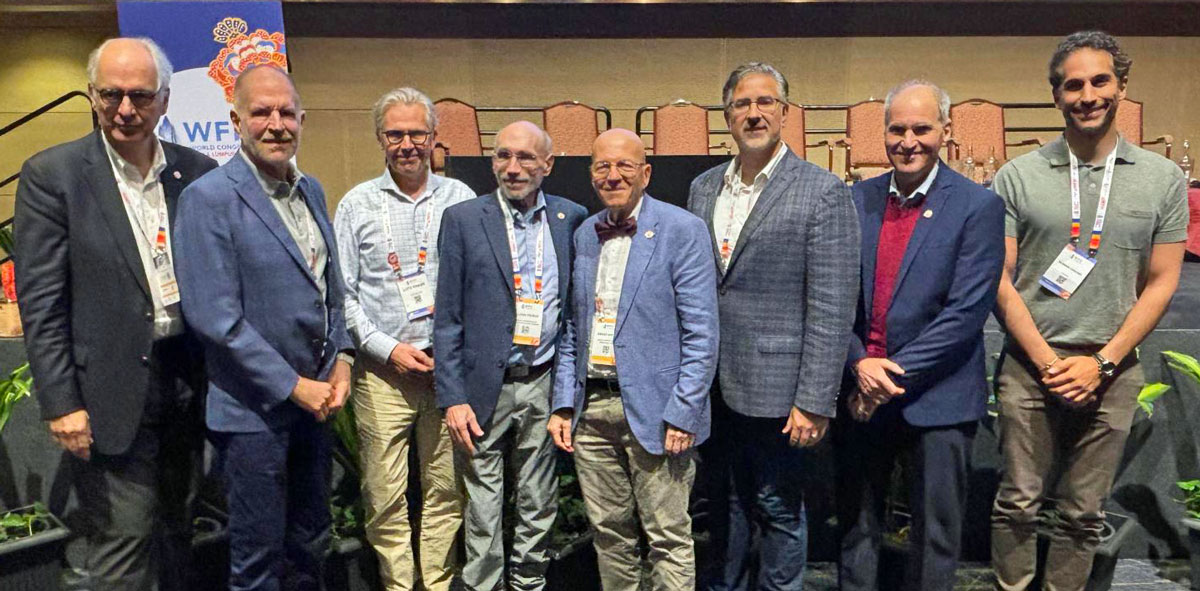
From the WFH, Cesar Garrido, President; Alain Baumann, CEO; Assad E. Haffar, MD, Humanitarian Aid and Medical Training Director; Glenn Pierce, MD, PhD, former Vice President, Medical, WFH; Mark Skinner, Board Member, WFH USA; and Len Valentino, MD, WFH USA President, were present at the WFH 2026 World Congress in Kuala Lumpur, Malaysia.
From the Roche team, Daud Chaudry, Global Head for Hemophilia; Mauricio Bordonaba, Global Commercialization Strategy Lead, Hemophilia; Romain Chafaie, Global Access Lead, Hemophilia; Tuende Czirok, MD, Global Medical Lead, Hemophilia; and Lutz Knabe, Partner of people living with Hemophilia A; were present.
To find out more about the Program, please click here.
About the WFH Humanitarian Aid Program
The WFH Humanitarian Aid Program improves the lack of access to care and treatment by providing much-needed support for people with inherited bleeding disorders in developing countries. By providing patients with a more predictable and sustainable flow of humanitarian aid donations, the WFH Humanitarian Aid Program makes it possible for patients to receive consistent and reliable access to treatment and care. None of this would be possible without the generous support of Sanofi and Sobi, our Founding Visionary Contributors; Bayer, CSL Behring and Roche, our Visionary Contributors; Grifols, our Leadership Contributor; and Takeda, our Contributor. To learn more about the WFH Humanitarian Aid Program, visit www.treatmentforall.org.