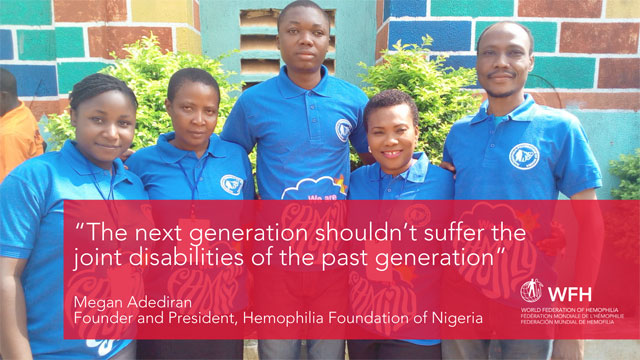
There is no limit to how far someone would go for a loved one, and no end to the impact that dedication can have on an entire community. With patience, persistence, and support from the World Federation of Hemophilia (WFH), the Hemophilia Foundation of Nigeria has been able to drastically improve the lives of people living with a bleeding disorder in the country.
Megan Adediran—Founder and Executive Director of the Hemophilia Foundation of Nigeria—had no idea that her son had hemophilia when he was born. On July 14, 2004, after he had been hospitalized with bleeding for five days following his circumcision, she knew she needed answers.
“I went online and searched hemophilia foundations and found 67 organizations around the world… I went back home and sent my story to all 67. Three days after I got an email from Assad Haffar, MD saying my son’s story had been flying around the world. He asked me to send him my phone number so that he could call me.” Not long after, Adediran received her first WFH Humanitarian Aid donation of treatment. “That was the beginning of my relationship with the WFH,” she explained.
At that time in Nigeria, diagnosis and treatment for people living with bleeding disorders was non-existent. Healthcare professionals were skeptical these disorders could affect the population in Nigeria. “We did not have physiotherapists that knew anything about hemophilia, diagnosis was zero,” said Adediran. “…When I started healthcare providers believed that hemophilia is not a black person’s disease.”
Motivated to enact change in her country, and inspired by the WFH vision of Treatment for All, Megan relaunched the HFN, which had been dormant for nearly 30 years. This was the beginning of a prosperous partnership that would transform the bleeding disorders community in Nigeria.
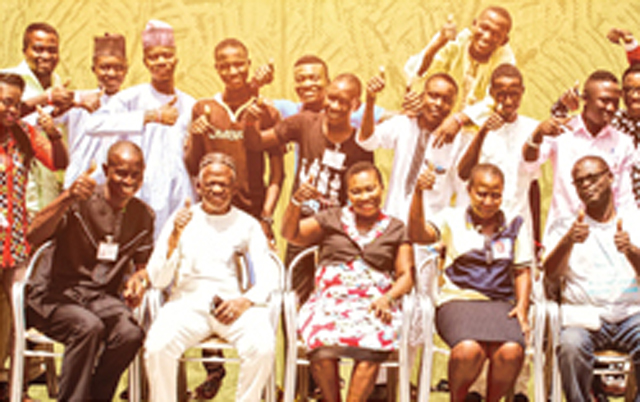
Nigeria was one of the first countries to enroll in the WFH Cornerstone Initiative when the program was launched in 2013. The clear goals and the support provided to meet them led to tangible change. In under three years, over 350 healthcare professionals received training, and the number of people diagnosed with a bleeding disorder grew by 83%. A medical advisory board was also established to strengthen the collaboration between healthcare providers and the patient community—a must for effective advocacy.
With this infrastructure in place, more product donations were making their way to the country through the WFH Humanitarian Aid Program and were being administered by trained healthcare providers. For the first time, people with bleeding disorders in Nigeria were able to count on effective treatment for their condition. Between 2015 and 2019, the WFH Humanitarian Aid program was able to donate more than 22.7 million IUs of treatment product to Nigeria.
“In 2015, only 178 patients were diagnosed. One year later that number increased to 271 patients as word spread that predictable treatment was available. The WFH Humanitarian Aid Program has given hope to families,” said Adediran.
Akintunde Richard, a young man from Abeokuta, was one of the many individuals who were able to benefit from these treatment product donations.
 Before being diagnosed, Akintunde Richard, was experiencing neck stiffness, high blood pressure and intense headaches—which led him to being scheduled for brain surgery before a physician was able to properly diagnose him. “I was able to reach out to Megan Adediran and she and [the doctor] immediately took action to help,” said his grateful mother, Akintunde Collins. “[Soon after], my son was discharged and is now in good health.”
As of 2016, children between the ages of two and ten began receiving consistent prophylaxis and the results are nothing short of miraculous to families in Nigeria. “[We have seen] significant improvement in the joint health of those children that started young compared to the ones that did not have the option [of treatment],” said Adediran.
The Hemophilia Foundation of Nigeria continues to strive to improve the lives of people living with bleeding disorders. In 2020, the organization was enrolled in the WFH Path to Access to Care and Treatment (PACT) Program, a 5-year initiative designed to increase access to sustainable care for people with inherited bleeding disorders through training, education, partnerships, and evidence-based advocacy. “The next generation shouldn’t suffer the joint disabilities and the premature deaths of the past generation,” explained Adediran.
For nearly 60 years, the WFH has been working to create sustainable change for the global bleeding disorders community. You can be part of the legacy we are leaving today for future generations in Nigeria and around the world—a future in which all people with inherited bleeding disorders are diagnosed and have access to care, regardless of their type of disorder, their gender or where they live.
Thank you to everybody who supports the work of the WFH, your generosity often makes the difference between life and death for many around the world. Every dollar you contribute allows us to continue our important work of pursuing Treatment for All.
- Megan Adediran, Founder and Executive Director of the Hemophilia Foundation of Nigeria