PACT-Impact-Report-2023-header

WFH PACT Program 2023 Impact Report now available

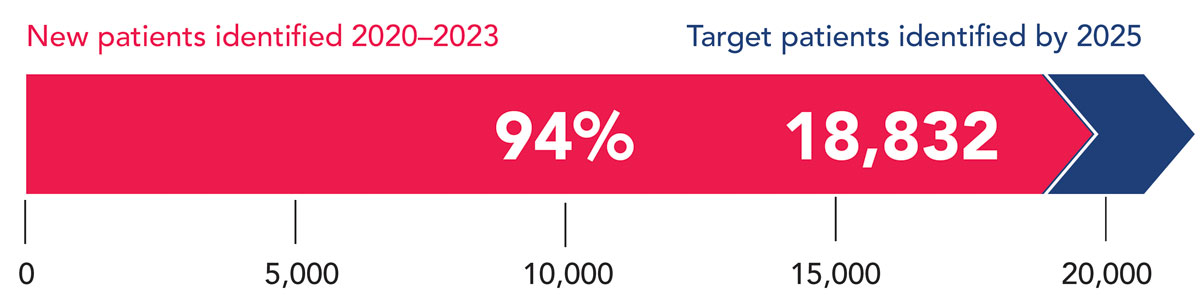
The WFH PACT Program 2023 Impact Report has been published! The WFH Path to Access to Care and Treatment (PACT) Program is a 5-year initiative designed to improve outreach and diagnosis and increase access to sustainable care for people with inherited bleeding disorders. Over a period of five years, the PACT Program aims to identify 20,000 new PWBDs in 20 targeted countries; improve access to care through training and education; and increase government support to establish or expand existing national bleeding disorders programs.

Also available in: Français Español

To date, the WFH PACT Program has contributed to a notable increase in the level of care in the target countries. These successes are highlighted in the WFH PACT Program 2023 Impact Report, which is now available online here. Read on to find out more about the key successes the Program had last year.

OBJECTIVE 1: Identify 20,000 new people with bleeding disorders (PWBDs)

  • Identified 18,832 new people with PWBDs over three years, which is 94% of the set target
OBJECTIVE 2: Improve access to care through training and Education

  • Strengthened the knowledge and skills of healthcare practitioners (HCPs) and national member organization (NMO) members related to developing effective outreach and diagnosis projects
  • Widened the global reach of the WFH PACT Advocacy Academy by offering instruction in French and Spanish in addition to English
  • Received positive feedback from previous PACT Advocacy graduates through a survey conducted on the impact of the course on NMO advocacy work and other programs and initiatives

82% of the respondents stated they implemented their advocacy projects, and 83% reported their NMOs launched new activities and initiatives, among other outcomes.

  • Enhanced the knowledge and skills of HCPs in the clinical management of bleeding disorders, contributing to an increase in level of care offered to PWBDs

OBJECTIVE 3: Increase government support

  • Collaborated with governments by signing Memoranda of Understanding (MoUs), and helping to enact policy changes to improve government support and commitment for increasing equitable access to diagnosis, treatment and care

The level of care in Zambia has increased significantly over the last few years, thanks to the hard work of many committed stakeholders. The signing of this MoU signifies an exciting new chapter in this journey.

—Cesar Garrido, President, WFH

  • Made tangible progress towards having bleeding disorders recognized as a government priority in several PACT countries through the joint efforts of NMOs, HCPs, and the WFH

The Ministry of Health understands the importance of patient associations. This is reflected in the sustained support we receive from the directorate of noncommunicable diseases (NCDs) and the hemophilia treatment centre (HTC) for our important activities. The WFH PACT Program provides us with an opportunity to better collaborate as a partner with the Ministry and increase our visibility and leadership in the country.

—Abdoulaye Loum, President of the Association Sénégalaise des Hémophiles (ASH)

To find out more about the WFH PACT Program’s contribution to improving diagnosis and care for people with bleeding disorders around the world—including some inspirational case studies—please read the report here. To learn more about the WFH Path to Access to Care and Treatment (PACT) Program, please click here.

The PACT Program is supported by funding from Roche and Sanofi, our visionary partners; CSL Behring and Pfizer, our leadership partners; and Bayer, Biotest and Grifols, our collaborating partners.

We’ve accomplished a lot this year, we need your help to continue strong.

Would you like to read more about similar articles?

Disclaimer

The information on the WFH website is provided for general information purposes only. The WFH does not engage in the practice of medicine and under no circumstances recommends particular treatment for specific individuals. For diagnosis or consultation on a specific medical problem, the WFH recommends that you contact your physician or local treatment centre. Before administering any products, the WFH urges patients to check dosages with a physician or hemophilia centre staff, and to consult the pharmaceutical company’s printed instructions.

While every effort has been made to ensure the accuracy of the information on this site, the WFH does not guarantee the information is accurate, and is not responsible in any way whatsoever for damages arising out of the use of this website or any of the information contained herein.

Messages posted to WFH discussion forums, Facebook, Twitter, and other social media platforms do not represent the opinions of the World Federation of Hemophilia, its staff, or Board of Directors. The author of a message is solely responsibility for its content. Information posted on WFH social networks and platforms should never be a substitute for individualized professional medical advice, even when the author has medical qualifications or is considered an authority. Information posted to a discussion group should not be used to diagnose or treat a specific health problem without consulting a qualified healthcare professional. The WFH recommends that you contact your physician or local treatment centre if you have any individual questions or concerns.

References and links to other websites or references to other organizations, products, services, or publications do not constitute endorsement or approval by the WFH. The WFH is not responsible and assumes no liability for the content of any linked websites.

Fraud Alert

Unauthorized solicitations – Warning

The WFH has been made aware of various correspondences—circulated via e-mail and telephone—coming from individuals impersonating WFH staff or falsely stating that they are associated with the WFH. These correspondences, which may seek to obtain money using the name of someone affiliated with the WFH, are fraudulent and come from outside of our organization.

If you receive a suspicious solicitation, exercise extreme caution. In the case of an email, look at the email address to see if it looks suspicious (for example, all WFH emails come from @wfh.org).

We are asking you to remain vigilant, and if you have any doubts about the correspondence, please forward the email to the WFH at [email protected] or call +1 514-875-7944.