
Upcoming Events
Top Stories
Thank you for visiting our Websites and Platforms and reviewing our Privacy Policy, as well as our personal information and privacy practices.
The World Federation of Hemophilia (hereinafter "the WFH" or "WFH") recognizes that privacy is everyone's business and takes the confidentiality and security of your personal information very seriously. For this reason, we have taken steps to ensure that any personal information we collect about you is protected by a range of rigorous procedures and security measures to ensure that your information is kept confidential and used only for the purposes detailed in this Policy, unless otherwise authorized by law.
WFH is committed to protecting the privacy of all individuals about whom it collects personal information. To this end, this policy aims to establish responsible and transparent practices for the management of personal information, and to meet the requirements of the rules established by the Act Respecting the Protection of Personal Information in the Private Sector ("ARPPIPS", CQLR c. P-39.1) as amended by Quebec's Act to modernize legislative provisions as regards the protection of personal information ("Law 25"), and the Personal Information Protection and Electronic Documents Act ("PIPEDA", S.C. 2000, c. 5) (hereinafter the "Acts"). WFH is also subject to the provisions of the European General Data Protection Regulation ("GDPR"). Where applicable, additional rights and obligations may apply under the UK General Data Protection Regulation ("UK GDPR") and other applicable privacy laws.
1. |
PURPOSE |
|---|---|
| 1.1 | This WFH Digital Platforms Privacy Policy (hereinafter "Policy" or "Privacy Policy") explains not only how we collect, use, disclose and store any information related to your personal data when you visit any Website (or "Websites") or mobile applications ("Applications" or "Platforms") operated by WFH, but also how you can access, update or take control of your personal information. |
| 1.2 | This Policy replaces and updates the WFH Website Privacy Policy (IT 003). |
2. |
SCOPE |
|---|---|
| 2.1 | This Policy generally applies to:
|
| 2.2 | External links. This Policy does not apply to links to third-party websites, plug-ins, services, social networks or applications, including those offered via hyperlinks displayed on our Websites and/or Platforms. If you follow a link to a third-party website or use a third-party plug-in, please note that these third parties have their own privacy policies and we do not accept any responsibility or liability for those policies. We do not control these third-party websites and encourage you to read the privacy policy of each site you visit before providing them with any personal information. |
3. |
DEFINITION OF "PERSONAL INFORMATION" |
|---|---|
| 3.1 | When used in this Privacy Policy, “personal information” means any information about an individual that can be used to identify an individual, including, but not limited to, your name, address, email address, telephone number, gender, banking details, employment, health or other information. |
4. |
RESPONSIBILITIES OF WFH |
|---|---|
| 4.1 | The WFH will fulfill all requirements to protect, collect, use, disclose and retain personal information under the Acts and all other applicable laws and regulations. We attach great importance to the proper management of your data and take full responsibility for it. |
| 4.2 | The WFH will also ensure that it has reasonable security measures in place to protect and respect the confidentiality of any personal information in its custody and control. |
5. |
HOW DO WE COLLECT YOUR CONSENT? |
|---|---|
| 5.1 | The WFH considers you to have validly consented to the collection, use or disclosure of your personal information if (i) you give your express written or oral consent; (ii) you voluntarily provide personal information for an obvious purpose; or (iii) if you do not object to the collection, use or disclosure of personal information by the WFH within a reasonable time after the WFH has given you clear notice, including through this Policy, of its intention to do so and the intended purposes. Consent may be withdrawn at any time as set out in Section 18 of this Policy. |
| 5.2 | In some cases, the WFH may collect personal information about an individual without their consent in accordance with the Acts or any other law or regulation that permits doing so. |
6. |
WHY WE COLLECT PERSONAL INFORMATION |
|---|---|
| 6.1 | We strongly believe in both minimizing the information we collect and limiting its use and purpose. WFH uses your personal information only for the purposes and for the duration required for which it was collected, or for any use that may be required or permitted by legal compliance, government request, court order or other lawful purpose. |
| 6.2 | We collect personal information for a variety of reasons. In general, WFH collects only the personal information necessary to fulfill its mission. We may also collect information for administrative purposes — to better understand the visitors who come to our websites and/or Platforms and the content of our websites and/or Platforms that is of interest to them. The purposes for which we collect personal information include, but are not limited to:
|
| 6.3 | Wherever possible, rather than using personal information, we will anonymize and/or aggregate personal information so that it no longer identifies an individual and use it for the purposes stated above or for any purpose permitted by law. |
| 6.4 | If we ever wish to use or disclose your personal information for purposes other than those specifically described in this Policy, we will obtain your consent. |
7. |
WHAT PERSONAL INFORMATION DO WE COLLECT? |
|---|---|
| 7.1 | WFH only collects personal information that is directly related to one of our programs or activities. We take steps to ensure that the personal information we collect about you is adequate, relevant, not excessive and used for limited purposes. We collect only the information we need. |
| 7.2 | The WFH collects information on its Websites and/or Platforms in two ways: |
| 7.2.1 | Information you provide directly to us: In many cases, we collect personal information directly from you when you provide your information by subscribing to our Newsletter, when you fill out other forms on our Websites and/or Platforms, when you make an inquiry or when you contact us in person or through the WFH Websites and/or Platforms. The provision of this information is strictly voluntary. We strongly encourage you not to provide any information beyond what is necessary. |
| 7.2.2 | Information collected automatically: You should be aware that when you access or browse our Websites and/or Platforms, an exchange of information, subject to your prior consent, takes place automatically between your device and WFH's hosting environment. This exchange is required only because of the technological demands inherent in Internet browsing and is used for statistical purposes to improve your experience — the information exchanged does not identify you personally. The information exchanged is as follow:
|
| 7.3 | By using the WFH Websites and/or Platforms, you agree to the terms and conditions set forth in this Privacy Policy. |
8. |
USE OF COOKIES |
|---|---|
| 8.1 | The main types of data collected on WFH Websites and/or Platforms are cookies and personalization settings. Cookies are small text files that are downloaded when you visit certain pages of a site and stored in the memory of the device you are using. Cookies are completely harmless and cannot contain any viruses. They enable certain information (browser type, language, country, identifier, etc.) to be recorded and retrieved by the server on subsequent visits. Under no circumstances do cookies allow visitors to be identified. The data remains completely anonymous and is used only to facilitate browsing and improve the WFH’s Websites and/or Platforms based on the needs of its visitors. |
| 8.2 | Cookie consent mechanism. When you first visit our Websites and/or Platforms, a cookie banner allows you to accept, refuse or customize your cookie preferences by category: (i) strictly necessary cookies (always active, required for the site to function); (ii) functional cookies (preferences, language); (iii) analytics cookies (anonymized statistics); and (iv) marketing cookies (advertising and retargeting). Only strictly necessary cookies are placed before your consent. You may modify your choices at any time via the "Cookie preferences" link in the footer of the Websites and/or Platforms. |
| 8.3 | If you do not wish cookies to be used, your browser options can be configured to refuse and/or delete cookies. Please note that disabling or deleting cookies may deprive you of certain functions offered on our Websites and/or Platforms. In addition, this procedure must be repeated for each browser and computer used. |
| 8.4 | Google Analytics 4 (GA4). We use Google Analytics 4 (GA4), which replaced Universal Analytics on July 1, 2023, to gather information automatically about visits to our Websites and/or Platforms and to help us maintain and improve their design and content. GA4 is configured with IP anonymization, deactivation of data sharing with Google for advertising purposes, and a maximum data retention period of 14 months. GA4 collects information about the date and time when our Websites and/or Platforms were accessed and may track a user's movement within the site, but does not collect personal information that directly identifies the visitor. You can install the Google Analytics Opt-out Browser Add-on to prevent information about your visits to our Websites and/or Platforms from being sent to Google. |
| 8.5 | Meta Pixel. WFH also uses web beacons (“Pixels”) to analyze visitor activity to our Websites and/or Platforms. We use Meta Pixel to collect information about your interactions with our Websites and/or Platforms, such as pages visited, actions taken, buttons clicked and any pages visited as a result of the button clicks. Web beacons do not contain any personal information but may contain a unique identifier necessary for retargeting and targeted advertising. Meta Pixel allows us to measure the effectiveness of our advertising by understanding the actions you take on our Websites and/or Platforms. We use this data solely for analytical purposes to improve our services and deliver more relevant content. Meta Pixel is only loaded after you have given prior consent through our cookie banner (see Section 8.2). Transfers of personal information to Meta (United States) are governed by the EU-US Data Privacy Framework or Standard Contractual Clauses, as applicable (see Section 12 and Appendix A). |
9. |
PRIVACY BY DEFAULT |
|---|---|
| 9.1 | In accordance with Quebec Law 25 and the principle of privacy by design, WFH ensures that the default privacy settings of any technological product or service offered to the public guarantee the highest level of confidentiality, without any intervention required from the individual. This obligation does not apply to cookie settings, which are governed by Section 8 of this Policy. |
| 9.2 | Privacy considerations are integrated from the design stage of any new project, service or platform involving personal information, in accordance with the privacy by design principle. |
10. |
RESPONSES TO JOB OFFERS |
|---|---|
| 10.1 | If you have applied for a job with WFH, we will use your personal information for recruitment and other human resources purposes. We keep the documents sent (CV, cover letter, etc.) by the candidates for a maximum of three (3) years. Documents are then securely destroyed. |
11. |
PROTECTION OF THE PRIVACY OF MINORS |
|---|---|
| 11.1 | WFH does not knowingly collect personal information from children under the age of 14 without the consent of the child's parent or legal guardian. If we learn that we have collected or received personal information from a child for whom parental confirmation was required, we will delete that information. If you believe that we may have received information from or about a child for whom we should have obtained parental consent, please contact us. |
12. |
DO WE DISCLOSE YOUR PERSONAL INFORMATION TO THIRD PARTIES? |
|---|---|
| 12.1 | Rest assured that WFH does not sell or rent your personal information to third parties for commercial purposes. We may share your personal information only in the limited cases described below (Sections 12.2 and 12.3), and only in accordance with the Acts. |
| 12.2 | As part of the services offered by our external suppliers. WFH may transfer personal information that we collect or that you provide as described in this Policy to service providers and other third parties we use to support our organization. Such third parties are contractually obligated to keep personal information confidential, use it only for the purposes for which we disclose it and process personal information in accordance with the standards set out in this Policy and in compliance with the Acts. |
| 12.3 | In the context of a legal obligation. WFH may disclose your personal information to comply with any court order, law or legal process, including to respond to any government or regulatory request, in accordance with applicable law, to combat fraud or harms to WFH or our members, or if we believe that disclosure is necessary or appropriate to protect the rights, property or safety of WFH or others. |
13. |
SHARING PERSONAL INFORMATION OUTSIDE QUÉBEC |
|---|---|
| 13.1 | Your personal information is processed and stored in Québec. In order to carry out our mission, we may in some cases store, process and transfer your information around the world, including outside Québec or to jurisdictions outside your country of residence — if you are located in the Economic European Area or Switzerland, please review Appendix A "Additional terms" which apply to you in addition to the main terms of this Policy. Data may also be stored locally on the devices you use to access WFH Websites and/or Platforms. |
| 13.2 | In such cases, the transfer will only take place if we find that the information would be adequately protected, in particular considering the sensitivity of the information, the purpose for which it is used, the protection the information would be afforded, and the legal framework applicable in the state or province where the information would be transferred. Any transfer will also be subject to appropriate contractual agreements to ensure adequate protection. |
14. |
HOW DO WE PROTECT YOUR PERSONAL INFORMATION? |
|---|---|
| 14.1 | The security of your personal information is very important to us. The personal information we collect is stored in a secure environment using industry-recognized technologies. We will protect personal information against loss or theft, unauthorized access, use or disclosure, copying, modification or destruction. |
| 14.2 | When you visit our Websites and/or Platforms and are asked for personal information, this information is used exclusively by WFH. In order to protect your personal information, we have implemented customary security measures that are appropriate to the sensitivity of the information collected, including the following physical, organizational, contractual and technological measures:
|
| 14.3 | Individuals working for WFH or acting on our behalf must make reasonable efforts to minimize the risk of unintentional disclosure of personal information. In addition, our policies, procedures and codes of conduct are clearly communicated to our employees, contractors, volunteers, consultants and subcontractors and WFH will ensure that they are adhered to and respected. All individuals who fail to comply with the principles and procedures of this Policy will be subject to corrective measures, including termination of their employment relationship, tenure or contract. |
| 14.4 | Despite these precautions, no method of transmission or storage is 100% secure or error-free. As a result, we cannot guarantee absolute security. If you have reason to believe that your interaction with us is no longer secure, please contact us immediately. |
| 14.5 | If we become aware of a security breach involving your personal information, we will take reasonable measures to mitigate the risk of harm and prevent similar incidents, as well as notify you and the appropriate authorities as soon as possible, in accordance with the Acts. |
15. |
RETENTION AND DESTRUCTION OF PERSONAL INFORMATION |
|---|---|
| 15.1 | Except as permitted or required by the Acts or any applicable law or regulation, WFH will retain your personal information only for as long as necessary to fulfill the purposes for which we collected it, including for the purposes of satisfying legal, accounting or reporting requirements to the appropriate government and regulatory bodies. |
| 15.2 | Personal information that is no longer required for the purposes for which it was collected will be destroyed, erased or made anonymous in accordance with applicable laws. |
| 15.3 | Under some circumstances, we may anonymize your personal information so that it can no longer be associated with you. We reserve the right to use de-identified and anonymized data for any legitimate purpose without further notice to you or your consent. |
| 15.4 | If the WFH uses personal information to make a decision that directly affects an individual, we will retain that information for as long as necessary to fulfill the purposes for which the information was collected. Once the information has been used, individuals may access their personal information as set out in the Acts. |
| 15.5 | Indicative retention periods. The following table summarizes the indicative retention periods applied by WFH:
Category of personal information
Indicative retention period
Category
Retention period
Newsletter subscribers
Until un-subscription + 12 months
Donor information (with tax receipts)
7 years (tax compliance)
Job applications (CV, cover letter)
3 years, then secure destruction
Contact form / general inquiries
24 months after last contact
Website analytics (GA4)
14 months maximum
Cookies (non-essential)
13 months maximum
Confidentiality incident register
Minimum 5 years
|
16. |
ACCESSING, CORRECTING, DE-INDEXING AND PORTABILITY OF YOUR PERSONAL INFORMATION |
|---|---|
| 16.1 | It is important that the personal information we hold about you is accurate and current. Please keep us informed if your personal information changes. You can contact us via the WFH Online Contact Form or email us at [email protected]. |
| 16.2 | Upon request, an individual is entitled to be informed of the existence, use and disclosure of their personal information and to obtain access to that information, or to obtain a copy of their personal information in electronic or non-electronic format subject to appropriate notice. An individual has the right to challenge the accuracy and completeness of their personal information, have it amended, or withdraw consent to the use of their information. In addition, WFH complies with all laws regarding access to and correction of your personal information. |
| 16.3 | An individual has also the right to receive computerized personal information collected from them in a structured, machine-readable, and commonly used format. In certain circumstances, the individual may also ask WFH to transfer their computerized personal information directly to third parties. An individual has the right to request that the dissemination of their personal information cease, or to request that any hyperlinks associated with their name and that provide access to personal information be de-indexed or re-indexed. |
| 16.4 | No request for access, rectification, de-indexation or data portability may be considered unless it is made in writing and addressed to the WFH Privacy Officer. You must provide enough detail to enable the WFH to process the request. The Privacy Officer will respond within 30 days of the receipt of a request, unless it extends the time as authorized under the Acts. |
17. |
DECISIONS BASED EXCLUSIVELY ON AUTOMATED PROCESSING |
|---|---|
| 17.1 | In accordance with Section 12.1 of Quebec Law 25 and Article 22 of the GDPR, where WFH uses personal information to render a decision based exclusively on an automated processing of such information, WFH will, at the time of or before the decision, inform the person concerned of:
|
| 17.2 | As of the date of this Policy, WFH does not use systems that render decisions based exclusively on automated processing concerning individuals. This Section will be updated if such systems are introduced. |
18. |
WITHDRAWING YOUR CONSENT |
|---|---|
| 18.1 | If you have given your consent to the collection, use and transfer of your personal information, you may have the legal right to withdraw your consent under certain circumstances. To withdraw your consent, if applicable, contact us at [email protected]. |
| 18.2 | Please note that if you withdraw your consent, we may not be able to provide you with certain services. We will explain the impact of withdrawing your consent to help you make a decision. |
19. |
CHANGES TO OUR PRIVACY POLICY |
|---|---|
| 19.1 | WFH will review and update its policies and procedures as required to keep current with rules and regulations, new technologies and standards. Our Privacy Policy may therefore change from time to time. We will post any Policy changes on our Websites and Platforms and, if the changes are significant, we will provide a more prominent notice. You are responsible for periodically visiting our Websites and/or Platforms and this Policy to check for any changes. |
| 19.2 | Please note that both the English and French versions of our Privacy Policy have equal legal value. |
20. |
CONTACT DETAILS FOR THE PRIVACY OFFICER |
|---|---|
| If you have any comments, questions or requests regarding this Policy or our privacy practices, or to report any abuse by third parties, please do not hesitate to contact Antonio José Almeida, WFH Senior Director, Operations and Privacy Officer by e-mail at [email protected] or at the following postal address: | |
| c/o Privacy Officer, World Federation of Hemophilia 1184 rue Sainte-Catherine Ouest Suite 500 Montreal, Québec H3B 1K1 Canada |
|
| We have procedures in place to receive and respond to complaints or inquiries about our handling of personal information, our compliance with this Policy and applicable privacy laws. If you are not satisfied with WFH's handling of your personal information, you may file a complaint with WFH. The complaint will be investigated by the WFH Privacy Officer, who will determine whether the handling of the information complies with WFH policies and practices and any other applicable laws. The Privacy Officer will make every reasonable effort to resolve complaints. The person filing the complaint will be informed of any progress or outcome of the investigation within a maximum of 30 working days of receipt of the request and/or any additional time required to complete the investigation. |
|
APPENDIX A |
|
|---|---|
| ADDITIONAL TERMS FOR USERS LOCATED IN THE ECONOMIC EUROPEAN AREA (EEA), SWITZERLAND AND THE UNITED KINGDOM | |
| If you are located in the European Economic Area (EEA), Switzerland, or the United Kingdom (hereinafter the “UK”), these additional terms apply to you in addition to the main terms of WFH Privacy Policy. In case of a contradiction between the Privacy Policy and these additional terms, the latter will prevail. | |
| 1 | LEGAL BASIS FOR PROCESSING PERSONAL INFORMATION UNDER THE GENERAL DATA PROTECTION REGULATION (GDPR) / UK GDPR |
| 1.1 | If you are from the European Economic Area (EEA), Switzerland, or the United Kingdom, WFH’s legal basis for collecting and using the personal information described in this Privacy Policy depends on the personal information we collect and the specific context in which we collect it. We only process your Personal information if we have a legal basis to do so, which includes:
|
|
If you have any questions about the lawful bases upon which we collect and use your personal data, please contact: Antonio José Almeida,WFH Senior Director, Operations and Privacy Officer by e-mail at [email protected] or at the following postal address: c/o Privacy Officer, World Federation of Hemophilia, 1184 rue Sainte-Catherine Ouest, Bureau 500 Montréal, Québec H3B 1K1, Canada |
|
| 2 | TRANSFER OF YOUR PERSONAL INFORMATION OUTSIDE OF THE EEA, SWITZERLAND OR THE UK |
| 2.1 | We may process information outside of the EEA, Switzerland, or the UK, including Canada and the USA. |
| 2.2 | Transfer mechanisms: (i) Transfers to Canada are covered by the European Commission's adequacy decision for Canada (commercial sector), reaffirmed in January 2024, and by the corresponding UK adequacy regulations. (ii) Transfers to the United States are based on the EU-US Data Privacy Framework (adopted on July 10, 2023) when the recipient is DPF-certified, or on the European Commission's 2021 Standard Contractual Clauses (SCCs), supplemented by appropriate technical and organizational measures, including for transfers under the UK GDPR (via the UK International Data Transfer Addendum). |
| 3 | ADDITIONAL RIGHTS REGARDING YOUR PERSONAL INFORMATION UNDER THE GENERAL DATA PROTECTION REGULATION (GDPR) / UK GDPR |
| 3.1 | If you are a resident of the European Economic Area (EEA), Switzerland, or the UK, you have certain data protection rights. WFH aims to take reasonable steps to allow you to correct, amend, delete or limit the use of your personal information. |
| 3.2 | If you wish to be informed about what personal information we hold about you and if you want it to be removed from our systems, please contact us. |
| 3.3 | In addition to the rights mentioned in the section 16 ("Accessing, correcting, de-indexing and portability of your personal information") and in section 18 ("Withdrawing your consent"), in certain circumstances, you also have the following data protection right:
|
| 1.1 | This WFH Digital Platforms Privacy Policy (hereinafter "Policy" or "Privacy Policy") explains not only how we collect, use, disclose and store any information related to your personal data when you visit any Website (or "Websites") or mobile applications ("Applications" or "Platforms") operated by WFH, but also how you can access, update or take control of your personal information. |
| 1.2 | This Policy replaces and updates the WFH Website Privacy Policy (IT 003). |
| 2.1 | This Policy generally applies to:
|
| 2.2 | External links. This Policy does not apply to links to third-party websites, plug-ins, services, social networks or applications, including those offered via hyperlinks displayed on our Websites and/or Platforms. If you follow a link to a third-party website or use a third-party plug-in, please note that these third parties have their own privacy policies and we do not accept any responsibility or liability for those policies. We do not control these third-party websites and encourage you to read the privacy policy of each site you visit before providing them with any personal information. |
| 3.1 | When used in this Privacy Policy, “personal information” means any information about an individual that can be used to identify an individual, including, but not limited to, your name, address, email address, telephone number, gender, banking details, employment, health or other information. |
| 4.1 | The WFH will fulfill all requirements to protect, collect, use, disclose and retain personal information under the Acts and all other applicable laws and regulations. We attach great importance to the proper management of your data and take full responsibility for it. |
| 4.2 | The WFH will also ensure that it has reasonable security measures in place to protect and respect the confidentiality of any personal information in its custody and control. |
| 5.1 | The WFH considers you to have validly consented to the collection, use or disclosure of your personal information if (i) you give your express written or oral consent; (ii) you voluntarily provide personal information for an obvious purpose; or (iii) if you do not object to the collection, use or disclosure of personal information by the WFH within a reasonable time after the WFH has given you clear notice, including through this Policy, of its intention to do so and the intended purposes. Consent may be withdrawn at any time as set out in Section 18 of this Policy. |
| 5.2 | In some cases, the WFH may collect personal information about an individual without their consent in accordance with the Acts or any other law or regulation that permits doing so. |
| 6.1 | We strongly believe in both minimizing the information we collect and limiting its use and purpose. WFH uses your personal information only for the purposes and for the duration required for which it was collected, or for any use that may be required or permitted by legal compliance, government request, court order or other lawful purpose. |
| 6.2 | We collect personal information for a variety of reasons. In general, WFH collects only the personal information necessary to fulfill its mission. We may also collect information for administrative purposes — to better understand the visitors who come to our websites and/or Platforms and the content of our websites and/or Platforms that is of interest to them. The purposes for which we collect personal information include, but are not limited to:
|
| 6.3 | Wherever possible, rather than using personal information, we will anonymize and/or aggregate personal information so that it no longer identifies an individual and use it for the purposes stated above or for any purpose permitted by law. |
| 6.4 | If we ever wish to use or disclose your personal information for purposes other than those specifically described in this Policy, we will obtain your consent. |
| 7.1 | WFH only collects personal information that is directly related to one of our programs or activities. We take steps to ensure that the personal information we collect about you is adequate, relevant, not excessive and used for limited purposes. We collect only the information we need. |
| 7.2 | The WFH collects information on its Websites and/or Platforms in two ways: |
| 7.2.1 | Information you provide directly to us: In many cases, we collect personal information directly from you when you provide your information by subscribing to our Newsletter, when you fill out other forms on our Websites and/or Platforms, when you make an inquiry or when you contact us in person or through the WFH Websites and/or Platforms. The provision of this information is strictly voluntary. We strongly encourage you not to provide any information beyond what is necessary. |
| 7.2.2 | Information collected automatically: You should be aware that when you access or browse our Websites and/or Platforms, an exchange of information, subject to your prior consent, takes place automatically between your device and WFH's hosting environment. This exchange is required only because of the technological demands inherent in Internet browsing and is used for statistical purposes to improve your experience — the information exchanged does not identify you personally. The information exchanged is as follow:
|
| 7.3 | By using the WFH Websites and/or Platforms, you agree to the terms and conditions set forth in this Privacy Policy. |
| 8.1 | The main types of data collected on WFH Websites and/or Platforms are cookies and personalization settings. Cookies are small text files that are downloaded when you visit certain pages of a site and stored in the memory of the device you are using. Cookies are completely harmless and cannot contain any viruses. They enable certain information (browser type, language, country, identifier, etc.) to be recorded and retrieved by the server on subsequent visits. Under no circumstances do cookies allow visitors to be identified. The data remains completely anonymous and is used only to facilitate browsing and improve the WFH’s Websites and/or Platforms based on the needs of its visitors. |
| 8.2 | Cookie consent mechanism. When you first visit our Websites and/or Platforms, a cookie banner allows you to accept, refuse or customize your cookie preferences by category: (i) strictly necessary cookies (always active, required for the site to function); (ii) functional cookies (preferences, language); (iii) analytics cookies (anonymized statistics); and (iv) marketing cookies (advertising and retargeting). Only strictly necessary cookies are placed before your consent. You may modify your choices at any time via the "Cookie preferences" link in the footer of the Websites and/or Platforms. |
| 8.3 | If you do not wish cookies to be used, your browser options can be configured to refuse and/or delete cookies. Please note that disabling or deleting cookies may deprive you of certain functions offered on our Websites and/or Platforms. In addition, this procedure must be repeated for each browser and computer used. |
| 8.4 | Google Analytics 4 (GA4). We use Google Analytics 4 (GA4), which replaced Universal Analytics on July 1, 2023, to gather information automatically about visits to our Websites and/or Platforms and to help us maintain and improve their design and content. GA4 is configured with IP anonymization, deactivation of data sharing with Google for advertising purposes, and a maximum data retention period of 14 months. GA4 collects information about the date and time when our Websites and/or Platforms were accessed and may track a user's movement within the site, but does not collect personal information that directly identifies the visitor. You can install the Google Analytics Opt-out Browser Add-on to prevent information about your visits to our Websites and/or Platforms from being sent to Google. |
| 8.5 | Meta Pixel. WFH also uses web beacons (“Pixels”) to analyze visitor activity to our Websites and/or Platforms. We use Meta Pixel to collect information about your interactions with our Websites and/or Platforms, such as pages visited, actions taken, buttons clicked and any pages visited as a result of the button clicks. Web beacons do not contain any personal information but may contain a unique identifier necessary for retargeting and targeted advertising. Meta Pixel allows us to measure the effectiveness of our advertising by understanding the actions you take on our Websites and/or Platforms. We use this data solely for analytical purposes to improve our services and deliver more relevant content. Meta Pixel is only loaded after you have given prior consent through our cookie banner (see Section 8.2). Transfers of personal information to Meta (United States) are governed by the EU-US Data Privacy Framework or Standard Contractual Clauses, as applicable (see Section 12 and Appendix A). |
| 9.1 | In accordance with Quebec Law 25 and the principle of privacy by design, WFH ensures that the default privacy settings of any technological product or service offered to the public guarantee the highest level of confidentiality, without any intervention required from the individual. This obligation does not apply to cookie settings, which are governed by Section 8 of this Policy. |
| 9.2 | Privacy considerations are integrated from the design stage of any new project, service or platform involving personal information, in accordance with the privacy by design principle. |
| 10.1 | If you have applied for a job with WFH, we will use your personal information for recruitment and other human resources purposes. We keep the documents sent (CV, cover letter, etc.) by the candidates for a maximum of three (3) years. Documents are then securely destroyed. |
| 11.1 | WFH does not knowingly collect personal information from children under the age of 14 without the consent of the child's parent or legal guardian. If we learn that we have collected or received personal information from a child for whom parental confirmation was required, we will delete that information. If you believe that we may have received information from or about a child for whom we should have obtained parental consent, please contact us. |
| 12.1 | Rest assured that WFH does not sell or rent your personal information to third parties for commercial purposes. We may share your personal information only in the limited cases described below (Sections 12.2 and 12.3), and only in accordance with the Acts. |
| 12.2 | As part of the services offered by our external suppliers. WFH may transfer personal information that we collect or that you provide as described in this Policy to service providers and other third parties we use to support our organization. Such third parties are contractually obligated to keep personal information confidential, use it only for the purposes for which we disclose it and process personal information in accordance with the standards set out in this Policy and in compliance with the Acts. |
| 12.3 | In the context of a legal obligation. WFH may disclose your personal information to comply with any court order, law or legal process, including to respond to any government or regulatory request, in accordance with applicable law, to combat fraud or harms to WFH or our members, or if we believe that disclosure is necessary or appropriate to protect the rights, property or safety of WFH or others. |
| 13.1 | Your personal information is processed and stored in Québec. In order to carry out our mission, we may in some cases store, process and transfer your information around the world, including outside Québec or to jurisdictions outside your country of residence — if you are located in the Economic European Area or Switzerland, please review Appendix A "Additional terms" which apply to you in addition to the main terms of this Policy. Data may also be stored locally on the devices you use to access WFH Websites and/or Platforms. |
| 13.2 | In such cases, the transfer will only take place if we find that the information would be adequately protected, in particular considering the sensitivity of the information, the purpose for which it is used, the protection the information would be afforded, and the legal framework applicable in the state or province where the information would be transferred. Any transfer will also be subject to appropriate contractual agreements to ensure adequate protection. |
| 14.1 | The security of your personal information is very important to us. The personal information we collect is stored in a secure environment using industry-recognized technologies. We will protect personal information against loss or theft, unauthorized access, use or disclosure, copying, modification or destruction. |
| 14.2 | When you visit our Websites and/or Platforms and are asked for personal information, this information is used exclusively by WFH. In order to protect your personal information, we have implemented customary security measures that are appropriate to the sensitivity of the information collected, including the following physical, organizational, contractual and technological measures:
|
| 14.3 | Individuals working for WFH or acting on our behalf must make reasonable efforts to minimize the risk of unintentional disclosure of personal information. In addition, our policies, procedures and codes of conduct are clearly communicated to our employees, contractors, volunteers, consultants and subcontractors and WFH will ensure that they are adhered to and respected. All individuals who fail to comply with the principles and procedures of this Policy will be subject to corrective measures, including termination of their employment relationship, tenure or contract. |
| 14.4 | Despite these precautions, no method of transmission or storage is 100% secure or error-free. As a result, we cannot guarantee absolute security. If you have reason to believe that your interaction with us is no longer secure, please contact us immediately. |
| 14.5 | If we become aware of a security breach involving your personal information, we will take reasonable measures to mitigate the risk of harm and prevent similar incidents, as well as notify you and the appropriate authorities as soon as possible, in accordance with the Acts. |
| 15.1 | Except as permitted or required by the Acts or any applicable law or regulation, WFH will retain your personal information only for as long as necessary to fulfill the purposes for which we collected it, including for the purposes of satisfying legal, accounting or reporting requirements to the appropriate government and regulatory bodies. |
| 15.2 | Personal information that is no longer required for the purposes for which it was collected will be destroyed, erased or made anonymous in accordance with applicable laws. |
| 15.3 | Under some circumstances, we may anonymize your personal information so that it can no longer be associated with you. We reserve the right to use de-identified and anonymized data for any legitimate purpose without further notice to you or your consent. |
| 15.4 | If the WFH uses personal information to make a decision that directly affects an individual, we will retain that information for as long as necessary to fulfill the purposes for which the information was collected. Once the information has been used, individuals may access their personal information as set out in the Acts. |
| 15.5 | Indicative retention periods. The following table summarizes the indicative retention periods applied by WFH:
Category of personal information
Indicative retention period
Category
Retention period
Newsletter subscribers
Until un-subscription + 12 months
Donor information (with tax receipts)
7 years (tax compliance)
Job applications (CV, cover letter)
3 years, then secure destruction
Contact form / general inquiries
24 months after last contact
Website analytics (GA4)
14 months maximum
Cookies (non-essential)
13 months maximum
Confidentiality incident register
Minimum 5 years
|
| 16.1 | It is important that the personal information we hold about you is accurate and current. Please keep us informed if your personal information changes. You can contact us via the WFH Online Contact Form or email us at [email protected]. |
| 16.2 | Upon request, an individual is entitled to be informed of the existence, use and disclosure of their personal information and to obtain access to that information, or to obtain a copy of their personal information in electronic or non-electronic format subject to appropriate notice. An individual has the right to challenge the accuracy and completeness of their personal information, have it amended, or withdraw consent to the use of their information. In addition, WFH complies with all laws regarding access to and correction of your personal information. |
| 16.3 | An individual has also the right to receive computerized personal information collected from them in a structured, machine-readable, and commonly used format. In certain circumstances, the individual may also ask WFH to transfer their computerized personal information directly to third parties. An individual has the right to request that the dissemination of their personal information cease, or to request that any hyperlinks associated with their name and that provide access to personal information be de-indexed or re-indexed. |
| 16.4 | No request for access, rectification, de-indexation or data portability may be considered unless it is made in writing and addressed to the WFH Privacy Officer. You must provide enough detail to enable the WFH to process the request. The Privacy Officer will respond within 30 days of the receipt of a request, unless it extends the time as authorized under the Acts. |
| 17.1 | In accordance with Section 12.1 of Quebec Law 25 and Article 22 of the GDPR, where WFH uses personal information to render a decision based exclusively on an automated processing of such information, WFH will, at the time of or before the decision, inform the person concerned of:
|
| 17.2 | As of the date of this Policy, WFH does not use systems that render decisions based exclusively on automated processing concerning individuals. This Section will be updated if such systems are introduced. |
| 18.1 | If you have given your consent to the collection, use and transfer of your personal information, you may have the legal right to withdraw your consent under certain circumstances. To withdraw your consent, if applicable, contact us at [email protected]. |
| 18.2 | Please note that if you withdraw your consent, we may not be able to provide you with certain services. We will explain the impact of withdrawing your consent to help you make a decision. |
| 19.1 | WFH will review and update its policies and procedures as required to keep current with rules and regulations, new technologies and standards. Our Privacy Policy may therefore change from time to time. We will post any Policy changes on our Websites and Platforms and, if the changes are significant, we will provide a more prominent notice. You are responsible for periodically visiting our Websites and/or Platforms and this Policy to check for any changes. |
| 19.2 | Please note that both the English and French versions of our Privacy Policy have equal legal value. |
| If you have any comments, questions or requests regarding this Policy or our privacy practices, or to report any abuse by third parties, please do not hesitate to contact Antonio José Almeida, WFH Senior Director, Operations and Privacy Officer by e-mail at [email protected] or at the following postal address: | |
| c/o Privacy Officer, World Federation of Hemophilia 1184 rue Sainte-Catherine Ouest Suite 500 Montreal, Québec H3B 1K1 Canada |
|
| We have procedures in place to receive and respond to complaints or inquiries about our handling of personal information, our compliance with this Policy and applicable privacy laws. If you are not satisfied with WFH's handling of your personal information, you may file a complaint with WFH. The complaint will be investigated by the WFH Privacy Officer, who will determine whether the handling of the information complies with WFH policies and practices and any other applicable laws. The Privacy Officer will make every reasonable effort to resolve complaints. The person filing the complaint will be informed of any progress or outcome of the investigation within a maximum of 30 working days of receipt of the request and/or any additional time required to complete the investigation. |
APPENDIX A |
|
|---|---|
| ADDITIONAL TERMS FOR USERS LOCATED IN THE ECONOMIC EUROPEAN AREA (EEA), SWITZERLAND AND THE UNITED KINGDOM | |
| If you are located in the European Economic Area (EEA), Switzerland, or the United Kingdom (hereinafter the “UK”), these additional terms apply to you in addition to the main terms of WFH Privacy Policy. In case of a contradiction between the Privacy Policy and these additional terms, the latter will prevail. | |
| 1 | LEGAL BASIS FOR PROCESSING PERSONAL INFORMATION UNDER THE GENERAL DATA PROTECTION REGULATION (GDPR) / UK GDPR |
| 1.1 | If you are from the European Economic Area (EEA), Switzerland, or the United Kingdom, WFH’s legal basis for collecting and using the personal information described in this Privacy Policy depends on the personal information we collect and the specific context in which we collect it. We only process your Personal information if we have a legal basis to do so, which includes:
|
|
If you have any questions about the lawful bases upon which we collect and use your personal data, please contact: Antonio José Almeida,WFH Senior Director, Operations and Privacy Officer by e-mail at [email protected] or at the following postal address: c/o Privacy Officer, World Federation of Hemophilia, 1184 rue Sainte-Catherine Ouest, Bureau 500 Montréal, Québec H3B 1K1, Canada |
|
| 2 | TRANSFER OF YOUR PERSONAL INFORMATION OUTSIDE OF THE EEA, SWITZERLAND OR THE UK |
| 2.1 | We may process information outside of the EEA, Switzerland, or the UK, including Canada and the USA. |
| 2.2 | Transfer mechanisms: (i) Transfers to Canada are covered by the European Commission's adequacy decision for Canada (commercial sector), reaffirmed in January 2024, and by the corresponding UK adequacy regulations. (ii) Transfers to the United States are based on the EU-US Data Privacy Framework (adopted on July 10, 2023) when the recipient is DPF-certified, or on the European Commission's 2021 Standard Contractual Clauses (SCCs), supplemented by appropriate technical and organizational measures, including for transfers under the UK GDPR (via the UK International Data Transfer Addendum). |
| 3 | ADDITIONAL RIGHTS REGARDING YOUR PERSONAL INFORMATION UNDER THE GENERAL DATA PROTECTION REGULATION (GDPR) / UK GDPR |
| 3.1 | If you are a resident of the European Economic Area (EEA), Switzerland, or the UK, you have certain data protection rights. WFH aims to take reasonable steps to allow you to correct, amend, delete or limit the use of your personal information. |
| 3.2 | If you wish to be informed about what personal information we hold about you and if you want it to be removed from our systems, please contact us. |
| 3.3 | In addition to the rights mentioned in the section 16 ("Accessing, correcting, de-indexing and portability of your personal information") and in section 18 ("Withdrawing your consent"), in certain circumstances, you also have the following data protection right:
|
Click here to download the WFH Digital Platforms Privacy Policy (PDF).
Revision date: July 2, 2026
November 27, 2023
The use of all websites and Platforms belonging to the World Federation of Hemophilia (WFH) is subject to the following terms and conditions:
The World Federation of Hemophilia is not responsible for the content of external websites to which its site may link. Throughout our websites and/or Platforms, we provide links to other servers which may contain information of interest to our readers. We assume no responsibility for, and exercise no control over, the organizations, views or accuracy of information contained on other servers. When linking to the WFH, we request that you ensure that there are no associated connections for commercial purposes. If you have a link you’d like us to consider adding to our website, please send an email to [email protected] with the subject “Link request”.
Any communication or material that is publicly transmitted or posted on these other servers, including any data, questions, suggestions, comments or other information, will be treated as non-confidential and non-proprietary information.
Click here to download the Terms and Conditions of use of WFH Digital Platforms (PDF).
Revision date: September 15, 2023
Visit the WFH News page to find out more about the events and developments that are making a difference today.

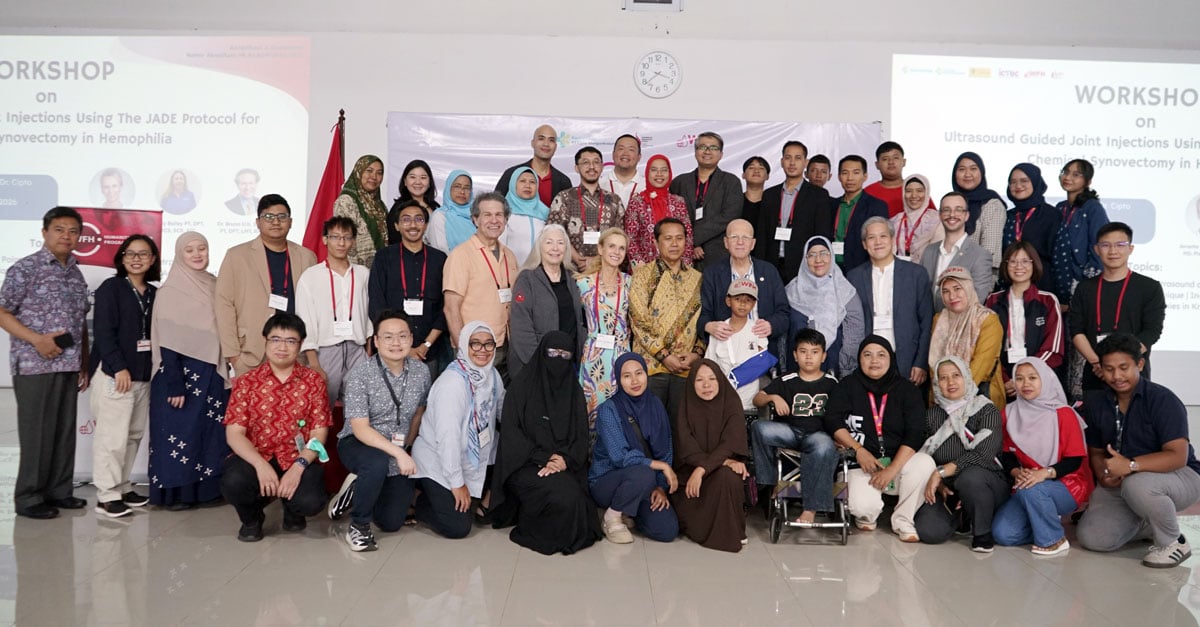
The training included experts from around the globe, all coming together to share their knowledge. There were two major objectives for the training: learning how to use a hand-held ultrasound device to detect early signs of a bleed in a joint, and learning how to inject a chemical synovectomy agent into a joint. Fourteen healthcare professionals took part, from the National Pediatric Hospital, Phnom Penh, Cambodia; Rumah Sakit Nasional Dr. Cipto Mangunkusumo, Indonesia, Jakarta; Hasan Sadikin Central General Hospital, Bandung, Indonesia; Yangon Children’s Hospital, Naypyidaw, Myanmar; University of Santo Tomas Hospital, Manila, Philippines; Mindanao Hemophilia Center, Davao, Philippines; Southern Philippines Medical Center, Davao, Philippines; and Hanoi Medical University Hospital, Hanoi, Vietnam.
One of the experts was Cindy Bailey, Director of Physical and Occupational Therapy, L.A. Orthopaedic Hospital PT, Los Angeles, U.S.A. Bailey emphasized how in addition to the workshop’s main objectives, the training had the added benefit of standardizing approaches to care. “The other reason we do this is to familiarize the physicians, the nurses, and the physical therapist with a specific system: image interpretation. We know exactly what we were looking for, and we can speak of that image together even if we are across the world.”
— Annette von Drygalski, MD, Professor of Clinical Medicine, and Director of the Hemophilia and Thrombosis Treatment Center, University of California, San Diego, U.S.A.
Participants travelled from across the region to go to the workshop and improve their skills. Jan-Tyrone Cabrera, MD, Assistant Professor, University of Santo Tomas, Manila, Philippines, said, “I think this [training] will be very beneficial for me… to be able to properly and systematically assess these joints, and also have a proper aid management for the different stages of hemophilic arthropathy.”
Pham Thu Hang, MD, Rheumatology Consultant, Hanoi University Hospital, Hanoi, Vietnam, described her motivation for attending: “I’m so glad to be here today because I want to improve my practice skills for my hospital for the care of hemophilia patients,” she said.
Annette von Drygalski, MD, Professor of Clinical Medicine, and Director of the Hemophilia and Thrombosis Treatment Center, University of California, San Diego, U.S.A., who was there to train participants, underscored the impact of new handheld ultrasound technology in ultrasound techniques. “This [new technology] will change our practice in that there will be no more blind injections of medications,” she explained, adding that participants are eager to take new techniques back to their home countries. The workshop highlighted the commitment of the WFH to building sustainable clinical capacity and improving outcomes for people with hemophilia worldwide.
We’ve accomplished a lot this year, we need your help to continue strong.
Would you like to read more about similar articles?
The information on the WFH website is provided for general information purposes only. The WFH does not engage in the practice of medicine and under no circumstances recommends particular treatment for specific individuals. For diagnosis or consultation on a specific medical problem, the WFH recommends that you contact your physician or local treatment centre. Before administering any products, the WFH urges patients to check dosages with a physician or hemophilia centre staff, and to consult the pharmaceutical company’s printed instructions.
While every effort has been made to ensure the accuracy of the information on this site, the WFH does not guarantee the information is accurate, and is not responsible in any way whatsoever for damages arising out of the use of this website or any of the information contained herein.
Messages posted to WFH discussion forums, Facebook, Twitter, and other social media platforms do not represent the opinions of the World Federation of Hemophilia, its staff, or Board of Directors. The author of a message is solely responsibility for its content. Information posted on WFH social networks and platforms should never be a substitute for individualized professional medical advice, even when the author has medical qualifications or is considered an authority. Information posted to a discussion group should not be used to diagnose or treat a specific health problem without consulting a qualified healthcare professional. The WFH recommends that you contact your physician or local treatment centre if you have any individual questions or concerns.
References and links to other websites or references to other organizations, products, services, or publications do not constitute endorsement or approval by the WFH. The WFH is not responsible and assumes no liability for the content of any linked websites.
The WFH has been made aware of various correspondences—circulated via e-mail and telephone—coming from individuals impersonating WFH staff or falsely stating that they are associated with the WFH. These correspondences, which may seek to obtain money using the name of someone affiliated with the WFH, are fraudulent and come from outside of our organization.
If you receive a suspicious solicitation, exercise extreme caution. In the case of an email, look at the email address to see if it looks suspicious (for example, all WFH emails come from @wfh.org).
We are asking you to remain vigilant, and if you have any doubts about the correspondence, please forward the email to the WFH at [email protected] or call +1 514-875-7944.