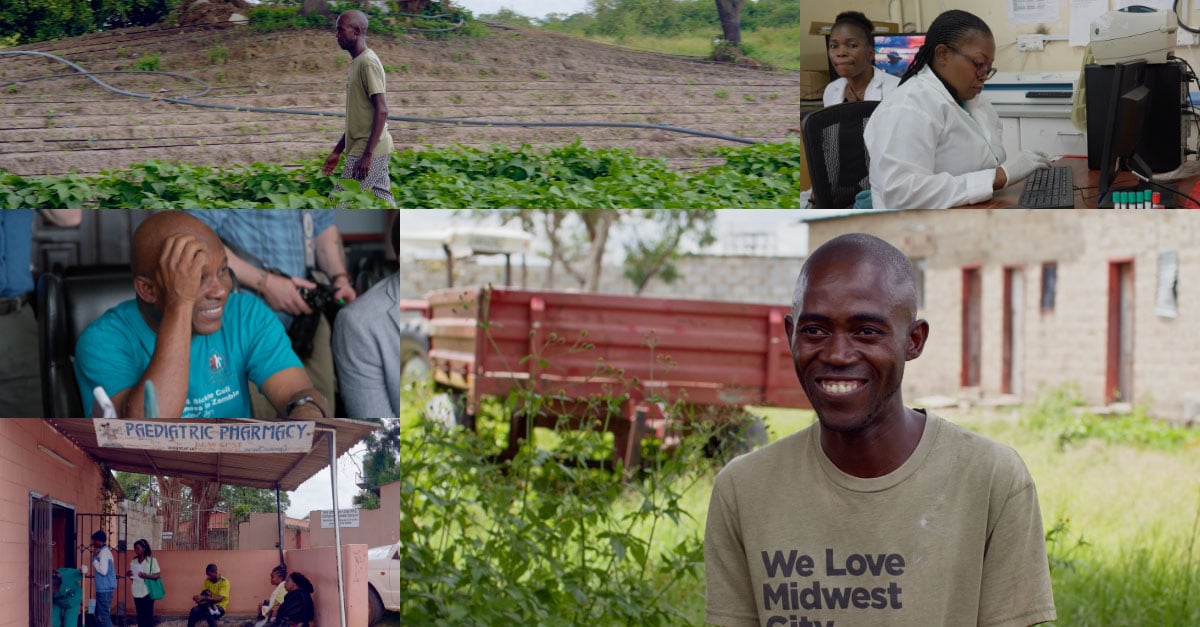
The World Federation of Hemophilia (WFH) supports Martin Mutandwa and the other members of the Zambian inherited bleeding disorders community through a range of efforts. This includes the WFH Humanitarian Aid Program, which provides training and donated treatment products, the WFH Path to Access to Care and Treatment (PACT) Program, which helps improve outreach and diagnosis and increase access to sustainable care, and a World Bleeding Disorders Registry (WBDR) Research Support Program grant, which is helping the medical community better manage bleeding disorder-related data.
Mutandwa’s story reflects a larger transformation within Zambia’s inherited bleeding disorders community. The Haemophilia Foundation of Zambia (HFZ), once struggling to gain recognition, has seen significant growth and impact. Maurice Muchinda, a founding member, recalls how the foundation began with just ten patients and faced difficulty securing government support, as national health priorities focused on malaria, TB, and HIV. The small patient base made it hard to advocate for resources and recognition.
Everything began to shift in 2014. Charity Pikiti, the current chairperson of the foundation, remembers a pivotal moment when Assad E. Haffar, MD, WFH Medical, Humanitarian Aid & Medical Training Director, challenged her to find more patients, promising support if she did. That promise was soon fulfilled, and life-saving factor and non-factor replacement therapy donations provided by the WFH Humanitarian Aid Program helped the foundation gain credibility and confidence. With improved treatment availability and increased awareness, the members of the HFZ now advocate with confidence, knowing the widespread impact of their work.
The support from the WFH Humanitarian Aid Program is something that has kept us going and [brought us to the point] where we are as an association in Zambia.
—Charity Pikiti, Chairperson, Haemophilia Foundation of Zambia (HFZ)
The transformation in the Zambian inherited bleeding disorders community over the last several years has been profound. “We saw the light at the end of the tunnel,” Muchinda says, reflecting on the grown of his foundation—both in terms of member size and in terms of impact—since it became a WFH national member organization (NMO).
For Mutandwa, every morning starts with a visit to his garden, a routine that once seemed impossible. For him, having access to non-factor replacement therapy has not only helped improve his physical condition—it has also helped improve his outlook and his confidence. These feelings echo the spirit of a community that has finally found its footing through the support of the WFH.
The WFH Humanitarian Aid Program has donated over 16.3 million IUs of factor and over 188,000 mg of non-factor replacement therapy to Zambia since 2015. Nearly 2.5 million IUs of factor, and 22,000 mg of non-factor replacement therapy were donated last year alone. To find out more about the WFH Humanitarian Aid Program please click here.
About the WFH Humanitarian Aid Program
The WFH Humanitarian Aid Program improves the lack of access to care and treatment by providing much-needed support for people with inherited bleeding disorders in developing countries. By providing patients with a more predictable and sustainable flow of humanitarian aid donations, the WFH Humanitarian Aid Program makes it possible for patients to receive consistent and reliable access to treatment and care. None of this would be possible without the generous support of Sanofi and Sobi, our Founding Visionary Contributors; Bayer, CSL Behring and Roche, our Visionary Contributors; Grifols, our Leadership Contributor; and Takeda, our Contributor. To learn more about the WFH Humanitarian Aid Program, visit www.treatmentforall.org.