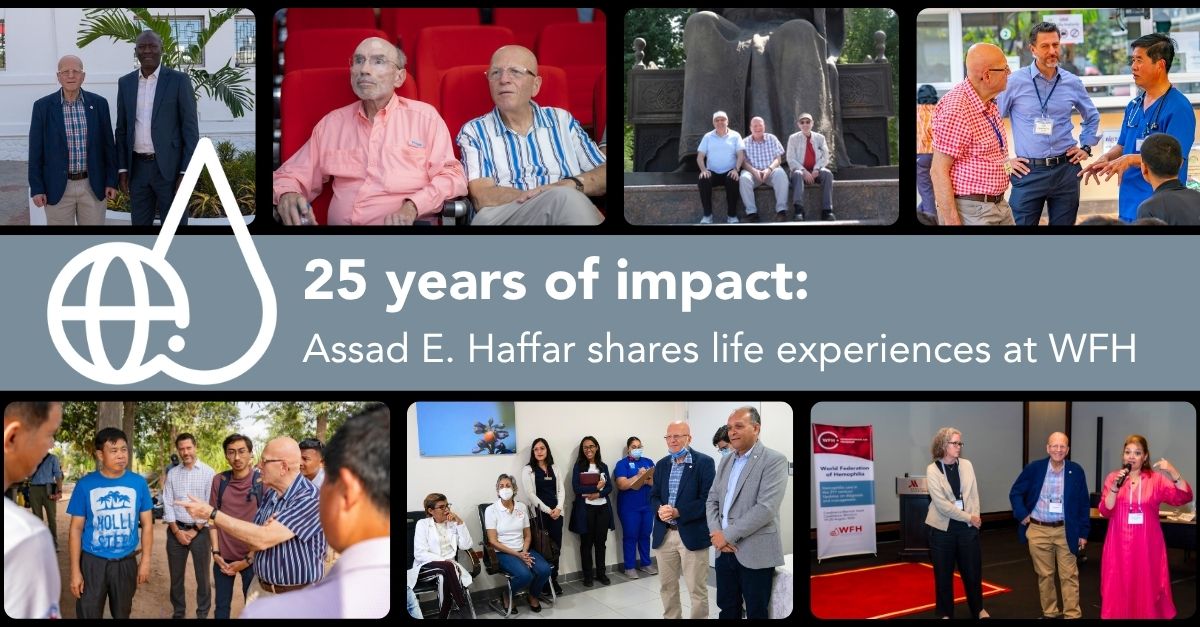
What first drew you to working with the WFH, and what has kept you engaged since you joined the organization?
I became an occupational health physician because I was inspired by Bernardino Ramazzini, a Renaissance physician who believed medicine should serve those most in need—not just the wealthy. That belief shaped my early career. I think of Bernardino Ramazzini when I think of hemophilia: it’s a disease which in our world predominantly affects vulnerable populations in resource-challenged countries. It’s a rare condition that is expensive to treat, and that many health systems neglect. That’s what drew me to the WFH: the chance to help build sustainable care for an overlooked group.
What keeps me committed is the real, measurable impact of what I’m doing. I’ve seen countries create national care programs, people with bleeding disorders (PWBDs) gain access to treatment, and systems evolve to meet the needs of their bleeding disorders community. Being part of a movement that transforms lives continues to inspire me every day.
How has the treatment and management of inherited bleeding disorders evolved since you started in the field?
When I joined WFH in 2000, many countries still distrusted factor concentrates due to the contaminated blood scandals of the 1980s. PWBDs often preferred cryoprecipitate, fearing further infections.
Over time, we helped rebuild trust and establish treatment protocols. Since then, hemophilia care has progressed rapidly. Extended half-life products now reduce injection frequency, making prophylaxis more accessible and effective.
Non-replacement therapies like bispecific antibodies and rebalancing agents have also expanded treatment options, especially for people with inhibitors. And after decades of anticipation, gene therapy is finally becoming a reality.
Today, prophylaxis has become the standard of care in many countries. The treatments are safer, more effective, and more tailored to individual needs. We’ve moved from crisis management to proactive, lifelong care. Many people say that today is the “golden age” of hemophilia treatment. It’s a remarkable evolution I’ve been proud to witness and support.
Can you share a particularly impactful success story from your experience working with the WFH?
I can share two stories that had an impact on me—one from the country level, one at the individual level.
At the country level, I can share the story of the evolution of inherited bleeding disorders care in Jordan. The hemophilia society in that country became a WFH national member organization (NMO) in 2002. We worked with them and the Ministry of Health to form a national committee. Today, Jordan has multiple clinics, reliable diagnostics, and strong access to treatment. It’s a true story of going to almost no care, to comprehensive care. In many ways Jordan is an excellent example for other NMOs.
At the individual level I can share the story of Megan Adediran from Nigeria. In 2004 she contacted me. Her two sons had hemophilia, and she was struggling to find care. We supported Megan through the WFH Humanitarian Aid Program and encouraged her to use her natural leadership abilities to help improve care levels in Nigeria. She did just that and founded the Haemophilia Foundation of Nigeria (HFN), now the country’s WFH NMO. She is still to this day the Executive Director of the HFN. Over the years she has helped established 13 treatment centres and increased diagnosis rates eightfold in Nigeria. She has also served as a Lay Member on the WFH Board of Directors. In the same way that Jordan is an example for other countries, Megan is an example to other people who want to help our community.
Both stories show how individual passion and structured support can drive change. These are the kinds of partnerships that bring the mission of the WFH to life.
How do you balance the business side of the WFH with its vision of Treatment for All?
When I joined the WFH, there was some hesitation at the organization about working with industry—particularly the pharmaceutical companies. The source of this feeling was partly mistrust related to the tainted blood scandals of the 1980s. But I believed these companies—who develop the medicines PWBDs depend on—needed to be part of the solution.
We aligned our mission with industry support, building transparent, meaningful partnerships. We invited corporate partners to witness the real impact of their donations, which deepened their engagement. This helped them see their role not just as suppliers, but as partners in care.
At the same time, we maintained neutrality, ensuring the WFH stays credible and independent. Treating all partners equally is essential.
Thanks to this balanced approach, corporate support now helps fund the WFH Humanitarian Aid Program, as well as other educational endeavours at the WFH. It also helps with capacity-building in underserved regions. In the end, it’s about collaboration and putting PWBDs first.
We’ve shown that working with industry doesn’t dilute our mission. In fact, it strengthens our ability to deliver on it.
What skills or qualities do you think are most important for someone working in this industry?
The most important quality for someone working in this industry is a sense of purpose. This isn’t just a job—it’s a humanitarian mission. People who thrive at WFH are genuinely motivated to improve lives.
Cultural sensitivity is also essential. The WFH operates globally, and understanding diverse histories, values, and traditions helps build meaningful partnerships.
Flexibility is also key. Conditions vary and plans often shift. You need to be adaptable and solution-oriented.
Strong communication and diplomacy skills are also vital. Whether dealing with doctors, PWBDs, ministries, or donors, your ability to connect and collaborate matters.
Finally, curiosity helps. Learning about geography, politics, and history allows you to navigate complex environments with respect and insight.
This work is about more than one’s technical skills—it’s about empathy, resilience, and a deep respect for the communities we serve.
What career advice would you give to someone who wants to work for the WFH?
The WFH offers real opportunities for growth. When I joined, I started as a Program Officer. Over time, I progressed through five roles, eventually becoming the Humanitarian Aid and Medical Training Director.
If you approach the work with heart and initiative, you can advance both professionally and personally in this organization. The WFH supports learning—colleagues have earned graduate degrees while on staff. One person even completed a master’s in public health while working full-time.
Most importantly, I would advise anyone who wants to work for the WFH to take heart in—and be motivated by—the fact that their work directly impacts lives. If you’re driven by purpose and willing to keep learning, the WFH is a place where you can grow your skills, deepen your knowledge, and contribute to something truly meaningful.
Assad E. Haffar, MD, is the Humanitarian Aid and Medical Training Director at the WFH. The WFH Humanitarian Aid Program improves the lack of access to care and treatment by providing much-needed support to national member organizations (NMOs), hemophilia treatment centres (HTCs), and healthcare professionals (HCPs) in emerging countries. To find out more about the Program, please click here.