Women-and-girls-header-WGBDs

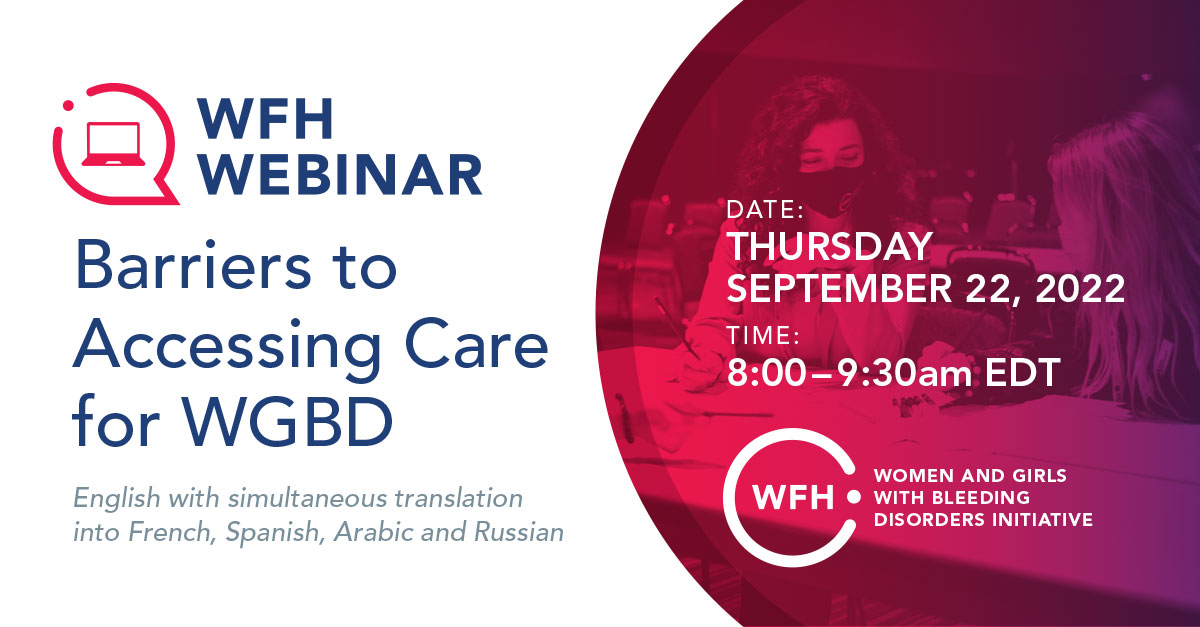
WFH Webinar: Barriers to Accessing Care for WGBD

It’s an unfortunate reality that women and girls with bleeding disorders (WGBD) face greater challenges in accessing timely diagnosis and adequate treatment compared to men in many parts of the world. This is due to different factors, including the persisting assumption that only men can have hemophilia. Initiatives led by the World Federation of Hemophilia (WFH) and other organizations around the world are being implemented to help change this perception, so that WGBD can receive lasting and sustainable care.

Also available in: Français Español

On Thursday, September 22, 2022, from 8 a.m. to 9:30 a.m. ET, the WFH will host “Barriers to Accessing Care for Women and Girls with Bleeding Disorders”, a webinar that will cover the challenges women and girls with bleeding disorders (WGBD) are facing and will explore different solution avenues. This event will provide an opportunity for participants to learn and exchange ideas on a range of topics, including the following:

WGBD with moderate and severe hemophilia, von Willebrand disease (VWD), and other rare bleeding disorders (RBD) experience a significant delay—16 years, on average—in diagnosis compared to men.

Women and girls with hemophilia A are five times more at risk of post-surgical bleeding and three times more at risk of postpartum bleeding than non-affected women.

Data will not only help address research questions around clinical management of WGBD, but they can also help emphasize the scope of issues and inform advocacy initiatives and policy decisions to improve access to care.

Women and girls are expected to make up approximately 30% of people diagnosed with hemophilia, yet the reported figure was only 4.5% in the latest WFH Annual Global Survey (2020).

A panel with healthcare professionals of different specialities will highlight the importance of the comprehensive care approach in the delivery of care for WGBDs. Speakers will include Dawn Rotellini (U.S.A), WFH Board Member and chair of the WFH WGBD Committee; Roshni Kulkarni, MD (U.S.A), WFH WGBD Committee member; Michelle Lavin, MD (Ireland), chair of the VWD & RBD Committee; gynecologist-obstetrician Elizabeth Pumpure, MD (Latvia), and nurse Anne-Louise Cruickshank (South Africa), among others. Live interpretation will be offered in French, Spanish, Russian and Arabic.

To find out more, and to register, click here.

This event is made possible through the generous support of Hemophilia of Georgia (HoG) and the National Hemophilia Foundation (NHF).
We’ve accomplished a lot this year, we need your help to continue strong.

Would you like to read more about similar articles?

Disclaimer

The information on the WFH website is provided for general information purposes only. The WFH does not engage in the practice of medicine and under no circumstances recommends particular treatment for specific individuals. For diagnosis or consultation on a specific medical problem, the WFH recommends that you contact your physician or local treatment centre. Before administering any products, the WFH urges patients to check dosages with a physician or hemophilia centre staff, and to consult the pharmaceutical company’s printed instructions.

While every effort has been made to ensure the accuracy of the information on this site, the WFH does not guarantee the information is accurate, and is not responsible in any way whatsoever for damages arising out of the use of this website or any of the information contained herein.

Messages posted to WFH discussion forums, Facebook, Twitter, and other social media platforms do not represent the opinions of the World Federation of Hemophilia, its staff, or Board of Directors. The author of a message is solely responsibility for its content. Information posted on WFH social networks and platforms should never be a substitute for individualized professional medical advice, even when the author has medical qualifications or is considered an authority. Information posted to a discussion group should not be used to diagnose or treat a specific health problem without consulting a qualified healthcare professional. The WFH recommends that you contact your physician or local treatment centre if you have any individual questions or concerns.

References and links to other websites or references to other organizations, products, services, or publications do not constitute endorsement or approval by the WFH. The WFH is not responsible and assumes no liability for the content of any linked websites.

Fraud Alert

Unauthorized solicitations – Warning

The WFH has been made aware of various correspondences—circulated via e-mail and telephone—coming from individuals impersonating WFH staff or falsely stating that they are associated with the WFH. These correspondences, which may seek to obtain money using the name of someone affiliated with the WFH, are fraudulent and come from outside of our organization.

If you receive a suspicious solicitation, exercise extreme caution. In the case of an email, look at the email address to see if it looks suspicious (for example, all WFH emails come from @wfh.org).

We are asking you to remain vigilant, and if you have any doubts about the correspondence, please forward the email to the WFH at [email protected] or call +1 514-875-7944.